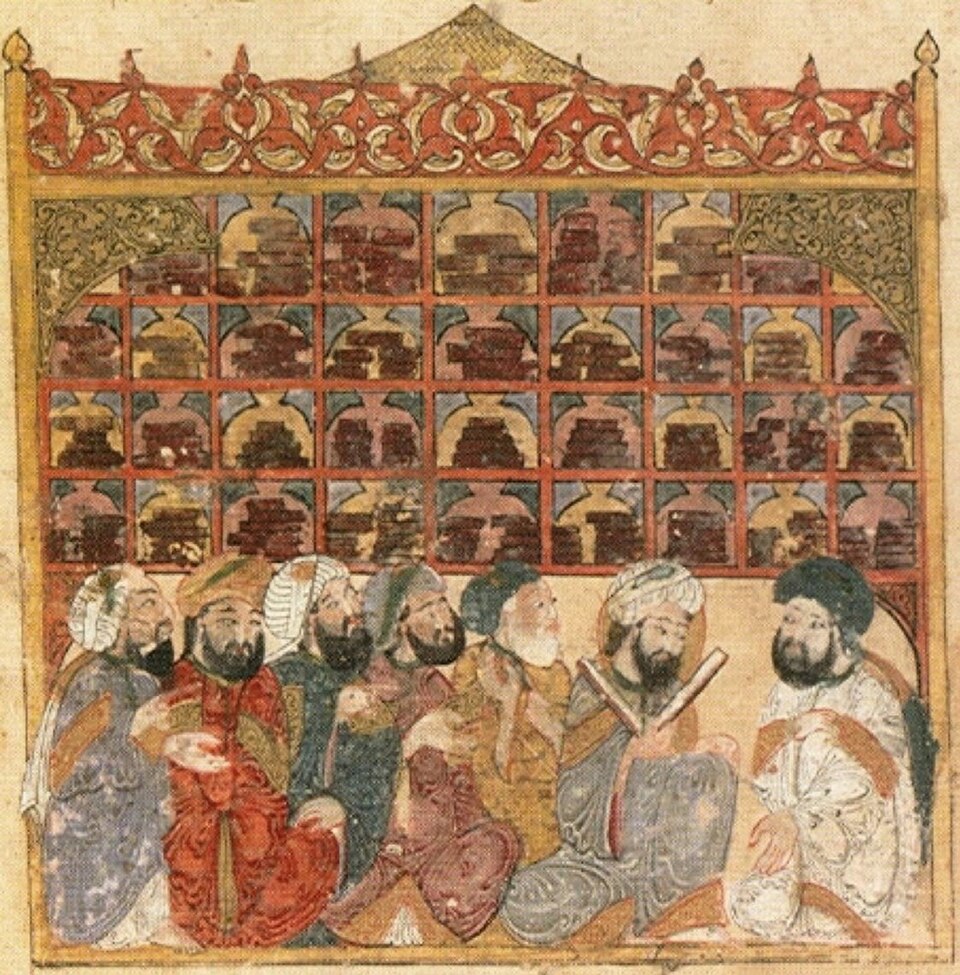
The profession that carries meaning between languages — from the Septuagint and Jerome's Vulgate to Toledo, Nuremberg's booths and the machine-translation age.
Also called: Literary translator · Localization specialist · Sworn translator
Translator: The profession that carries meaning between languages — from the Septuagint and Jerome's Vulgate to Toledo, Nuremberg's booths and the machine-translation age.
"Translation" comes from the Latin translatio, "a carrying across" — and people have been paid to carry meaning across languages for as long as writing exists. The oldest surviving bilingual dictionaries are Sumerian–Eblaite word lists on clay tablets from Ebla, in modern Syria, around 2300 BCE, and Old Kingdom Egyptian princes at Elephantine already bore the official title "overseer of interpreters." Wherever empires, faiths and trade routes crossed a language line, someone stood in the gap.
The modern trade is quieter but structurally the same: read a text in one language, write it again in another so well that nothing important is lost and nothing false is added. Most translators today work freelance, into their native language only, from one or two source languages mastered over years. A degree helps and is common, but the real gates are elsewhere — agency test translations, certification exams with pass rates below 20 percent, and sworn-translator lists controlled by courts and ministries.
This page follows the profession from the Septuagint's seventy-two legendary scholars and Jerome's Vulgate through Baghdad's House of Wisdom, Toledo, Luther's eleven-week New Testament and the two irreconcilable versions of the Treaty of Waitangi, to the Georgetown–IBM experiment of 1954 and the neural machine translation that now drafts most of the world's commercial words. It also gives the honest answer to the question every young linguist asks: how much of this job survives the machine.
Inside the profession
Translation is the professional transfer of meaning between languages — not word substitution, but decisions about register, law, culture and risk made under a deadline the reader will never see.
Equivalence is a negotiation
From the Septuagint and Jerome's Vulgate through Toledo's translation movements to Nuremberg's interpreters and today's localization pipelines, translators have always chosen what to preserve: sense, tone, legal effect, humor or sacred cadence. A contract clause, a drug label and a novel pun demand different fidelities. The craft includes research, terminology management and knowing when to query the author or client rather than guess. Machine output can propose a draft; it cannot accept liability for a mistranslated dosage, indictment or asylum interview. Responsibility attaches to the human who signs the delivery.
Domains create different professions
Literary translators fight for voice and publishability; legal and patent translators fight for precision and consistency; medical and technical translators fight for safety-critical clarity; audiovisual translators fight timing and reading speed; conference interpreters work in real time with no backspace. Specialization is not snobbery — it is risk management. A brilliant literary ear does not qualify someone to localize a medical device IFU. Clients who treat 'bilingual' as a credential create the error patterns professional associations spend decades trying to prevent.
Tools changed the desk, not the liability
Translation memories, termbases, QA checkers and neural MT raised throughput and consistency for repetitive content. They also introduced error classes — fluent nonsense, hallucinated numbers, quietly dropped negations — that look polished. Professional workflow now often means post-editing under scopes that must define quality, not merely 'make it sound native.' Rate pressure from MT has reshaped freelancing. Translators who cannot explain when MT is appropriate lose commercial ground; translators who never revise MT inherit invisible risk.
Ethics sit inside every brief
Translators encounter confidential filings, political speech, marketing claims and trauma narratives. Confidentiality, impartiality in interpreting and refusal of work that requires deceptive localization are professional duties, not optional virtues. Community interpreting in hospitals and courts can decide whether a person understands consent. The public mythology is bilingual fluency; the working reality is continuous research, version control and the humility to flag an ambiguity instead of inventing certainty for a client who wants the file closed today.
How the work branches
Five common shapes of the same title — specialty, setting or career path.
Publishing and cultural institutions
Literary translator
Recreates literary voice under editorial constraint, often with fragile pay and long rights chains.
Law firms, LSPs and IP boutiques
Legal / patent translator
Preserves operative legal meaning across jurisdictions with strict terminology control.
Life sciences and engineering content
Medical / technical translator
Localizes safety-critical instructions, trials and manuals where a wrong unit is a hazard.
Film, games and streaming
Audiovisual translator / localizer
Fits meaning into subtitles, dubbing scripts or UI strings under character and timing limits.
Institutions, courts and healthcare
Conference or community interpreter
Renders speech in real time with ethical duties of accuracy, impartiality and confidentiality.
How it reads by country
Same craft, different gatekeeping, status and daily texture — rewritten for readers in each language.
United States — court interpreting and LSP industry
US translators and interpreters work across a large language-service industry, federal and state court certification regimes and a vast localization market for software and media. Title protection is uneven by state and modality, which keeps credential signaling important.
South Korea — graduate institutes and corporate localization
Korea's competitive translation and interpretation graduate programs feed conference booths, public institutions and export-industry localization. Status attaches strongly to booth interpreting; written freelancers face intense rate pressure from MT-assisted workflows.
Japan — patent density and careful register
Japanese translation demand is heavy in patents, technical manufacturing and entertainment localization. Register sensitivity and client review cultures are strict; game and anime localization have become globally visible specialisms.
Germany — sworn translators and EU multilingualism
Germany maintains formal pathways for sworn/authorized translators used in official procedures, alongside a deep technical-translation market. EU institutional multilingualism and engineering exports sustain specialized careers.
United Kingdom — publishing hub and public-service interpreting
The UK combines a major literary translation and publishing scene with contested funding for public-service interpreting. Freelancers navigate agency intermediaries, ITI/CIOL professional structures and post-Brexit language-service shifts.
Singapore — multilingual state and regional hub work
Singapore's official multilingualism and role as a regional HQ create steady demand for translation and interpreting across government, finance and ASEAN-facing content. Quality expectations are high in a compact, competitive vendor market.
From the archive
Commons CC/PD images self-hosted for this profession.
Why attitude matters here
Bilingual skill can produce a fluent page; whether that page preserves legal effect, medical safety and the author's actual meaning — or merely sounds good — depends on attitudes no automated QA score fully measures.
The reader cannot see the source beside the delivery
End users of translated instructions, contracts or news rarely compare source and target line by line. A translator who smooths away an ambiguity, invents a missing figure or 'improves' a marketing claim creates a reality the client and the public will act on as if it were original. Competence without fidelity is therefore uniquely dangerous: the error arrives wearing native-sounding clothes.
Deadlines and MT pressure reward invisible shortcuts
Post-editing scopes and overnight deliveries make it profitable to trust a fluent neural draft that dropped a negation or hallucinated a dosage form. Whether a translator still checks numbers, names and critical instructions under that pressure — or ships on the basis of readability — is an attitude test repeated daily. The profession's failures are often quiet until a recall, a mistrial risk or a patient complaint appears.
Clients confuse fluency with qualification
Buyers frequently hire the cheapest bilingual speaker and ask professionals to clean the damage later. Translators inside that market face a choice: educate the client and risk losing the job, or accept impossible rates that force skim work. Attitude toward refusing under-scoped, under-paid safety-critical jobs is part of protecting the people who will read the text, not only protecting one's calendar.
Stances that hold up under pressure
Five concrete postures the work rewards, not slogans.
Queries an ambiguity instead of inventing certainty
Flags unclear source passages to the client with options and consequences, rather than silently choosing the reading that makes the target prettier, the delivery faster or the project manager less likely to send another revision round.
Checks every number, negation and proper name twice
Treats figures, dosages, dates, party names, citations and legal operative terms as high-risk tokens that fluency alone cannot validate, especially in MTPE workflows where fluent nonsense is the characteristic failure mode.
Refuses safety-critical work outside domain competence
Declines medical, legal or engineering texts when terminology knowledge, reference resources and revision time are insufficient, instead of gambling on general bilingualism because the agency needs a warm body on the job tonight.
Keeps TM and confidentiality walls intact
Does not paste confidential source text into public consumer AI tools, maintains client segregation in translation memories, and treats leaked terminology databases as a professional failure rather than a convenient productivity hack.
Preserves inconvenient meaning the client wishes softened
Resists requests to delete warnings, soften sworn testimony, erase criticism or rewrite a review into praise when the brief was translation, not copywriting, and documents the request when pressure continues.
Moments that reveal it
Situations that separate résumé language from how someone actually practices.
An MT draft is due in two hours and reads smoothly, but a critical 'not' in a contraindication sentence has vanished in the target.
Does the translator catch and restore it through systematic checking of negations and numbers, or skim for style because the deadline and the rate assume near-final MT quality and the project manager is already chasing the next handoff?
A client asks to remove a regulatory warning from the localized brochure because it 'sounds scary in our market.'
Does the translator refuse, explain the liability clearly and document the request in writing, or comply because the agency relationship depends on being flexible and another vendor will delete the warning anyway?
A literary publisher wants a culturally adapted joke that erases a minority character's specific insult in the source.
Does the translator negotiate an annotated or functionally equivalent solution that preserves the social meaning, or accept the erasure to keep the contract, the series relationship and the next title assignment?
A hospital interpreting assignment involves a procedure the interpreter does not understand, and no specialist is available.
Does the interpreter disclose the limit, slow the interaction and seek clarification or replacement, or push through to avoid looking unprofessional in front of clinical staff who equate hesitation with incompetence?
Where "calling" turns harmful
"Love of languages" as cover for pennies-per-word exploitation
The industry recruits on vocation — bridging cultures, serving literature, helping patients be heard — then uses calling talk to normalize below-living rates, unpaid samples, endless free tests and rush jobs. Passion rhetoric implies that complaining about MTPE rates means a translator is unfit for the craft, subsidizing clients who could pay professional rates.
The profile
Resists AI28
Pay35
Barrier to entry35
Autonomy82
Demand45
Impact55
How exposed is it to AI?
High
Most of the profession's traditional task — producing a competent first draft of routine text — is already automated, and post-editing machine output is now a standardized service with its own ISO norm. What resists is task-shaped, not title-shaped: legally sworn translation, high-stakes medical and legal content, literary and marketing voice, and low-resource languages the models handle poorly. The realistic future is a smaller profession concentrated at the accountable, creative top of the market.
No law requires one in most countries, and skilled self-taught translators exist in every language pair. In practice, though, a bachelor's degree plus a translation master's is the standard route into agency and institutional work, and legally valid translations for courts or immigration require passing a state exam or certification — ATA in the US, NAATI in Australia, sworn-translator appointment in Spain or Germany.
What is the difference between a translator and an interpreter?
A translator works with written text and has time to research, revise and polish; an interpreter renders speech live, with seconds to decide. They are separate professions with separate training — a translator's core skill is writing, an interpreter's is real-time processing under pressure. Many language professionals do some of both early on, then specialize as the demands diverge.
How much do translators earn?
The US median for interpreters and translators was about $57,000 in 2023, according to the Bureau of Labor Statistics. Staff translators at international organisations in Geneva or Brussels earn substantially more, while typical freelance incomes in India or Brazil are a fraction of European rates. Specialization matters most: patent, legal and financial translators consistently out-earn generalists in every market.
Will AI replace translators?
It has already taken the bulk end of the market: machine translation drafts most routine commercial text, and humans increasingly post-edit rather than translate from scratch. What remains firmly human is work where voice, liability or stakes matter — literature, sworn legal documents, medical content, brand copy. The honest picture is a shrinking middle and a premium top, not a vanished profession.
How many languages does a translator need?
Two, known deeply, beat five known shallowly. Professional translators work into their strongest language — almost always their native one — from one or two source languages they can read at near-native depth, including slang, register and cultural reference. Adding a third source language can widen the client pool, but agencies and institutions consistently pay for depth in a pair, not breadth.
What is a sworn or certified translation?
A translation that carries legal force because an authorized translator has stamped and signed it. Systems vary by country: Spain appoints traductores jurados through a foreign-ministry exam, Germany swears translators before regional courts, Australia requires NAATI certification for migration documents, and the US typically accepts a translator's signed certification, often backed by ATA credentials. Without the stamp, the document is just text.
Can you translate into a language that is not your native one?
The profession's rule — the mother-tongue principle, followed by the UN and most international bodies — says no: translators work into their language of strongest command, because reading a source language well is common, while writing publishable prose in it is rare. Exceptions exist in rare language pairs where native-target translators simply do not exist, and quality suffers accordingly.
How long does it take to become a translator?
Roughly five to seven years from leaving school: a bachelor's degree, often a one- or two-year translation master's, then a year or two of test translations, small commissions and portfolio-building before the work pays a living. The deeper investment is the decade or more of language learning that usually starts in childhood — the degree formalizes a skill, it cannot create one.
Embed this ranking
Paste this code into your blog or site — the ranking stays up to date.