🌐Origins & Evolution

Translator · The profession that carries meaning between languages — from the Septuagint and Jerome's Vulgate to Toledo, Nuremberg's booths and the machine-translation age.

Translation is one of the oldest literate professions, and for most of its history one of the most consequential: empires negotiated, religions spread and sciences migrated exactly as fast as translators could carry them. The Greek medicine Europe rediscovered in the twelfth century had survived in Arabic because ninth-century Baghdad paid its translators like princes; the Reformation ran on vernacular Bibles; the modern state still cannot sign a treaty without the trade.

What changed across four thousand years was not the task — saying the same thing again in different words — but what got translated, who was allowed to do it, and what it cost to get it wrong. A mistranslated treaty clause is still being litigated in New Zealand's courts today; a mistranslated Bible verse could get a sixteenth-century translator burned.

Where it began

c. 2300 BCEMesopotamia & Egypt

The palace archive of Ebla, in modern Syria, preserved the oldest known bilingual dictionaries: clay tablets listing Sumerian words beside their Eblaite equivalents, compiled around 2300 BCE for scribes who had to work in both. Egypt professionalized the spoken side at the same time — the Old Kingdom princes of Elephantine, on the Nubian frontier, carried the hereditary title "overseer of interpreters," and the caravan leader Harkhuf's tomb inscriptions show how much a career could be built on speaking the languages across the border.

Timeline

c. 2300 BCEEbla's bilingual word lists

Scribes at Ebla compile Sumerian–Eblaite lexical lists on clay — the oldest surviving bilingual dictionaries, made for working translators rather than scholars. Similar lists spread across Mesopotamia, where administration routinely ran in more than one language.

c. 250 BCEThe Septuagint in Alexandria

Jewish scholars in Ptolemaic Alexandria begin translating the Hebrew Bible into Greek. The Letter of Aristeas later wraps the project in legend — seventy-two translators, six from each tribe, working at Ptolemy II's request — giving the version its name, "the Seventy," and giving translation its first founding myth.

382–405 CEJerome translates the Vulgate

Commissioned by Pope Damasus I in 382 to sort out Latin scripture, Jerome learns Hebrew from Jewish scholars and translates the Old Testament from the original rather than from the Greek Septuagint — a controversial call he defended for decades. His Latin Bible became the Western standard for over a thousand years, and he became the patron saint of translators.

c. 850Hunayn ibn Ishaq in Baghdad

At the height of the Abbasid translation movement, the Nestorian Christian physician Hunayn ibn Ishaq renders roughly a hundred works of Galen into Syriac and Arabic, collating multiple Greek manuscripts before translating — textual criticism centuries ahead of its name. Later biographers claimed the caliph paid for translations with their weight in gold.

c. 1140–1187Gerard of Cremona at Toledo

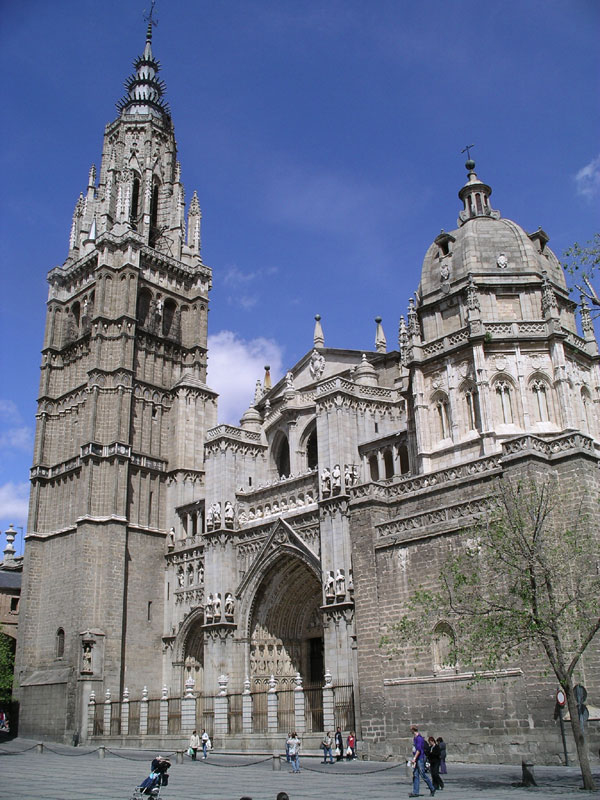
An Italian scholar travels to newly reconquered Toledo looking for Ptolemy's Almagest, unavailable in Latin, and stays for life. Working with local Arabic speakers, Gerard translates more than seventy works of astronomy, medicine and mathematics from Arabic into Latin, making Toledo the channel through which Greek and Arabic science re-entered Europe.

1522Luther's eleven-week New Testament

Hiding in the Wartburg castle under an assumed name, Martin Luther translates the entire New Testament from Greek into German in about eleven weeks. The "September Testament" sells out instantly, and Luther's plain, spoken German — he insisted on listening to "the mother in the house, the children in the street, the common man in the market" — helps standardize the modern German language.

1840The Treaty of Waitangi's two versions

Missionary Henry Williams and his son Edward translate Britain's treaty with the Māori chiefs into Māori overnight, on 4–5 February. Their rendering of "sovereignty" as "kāwanatanga" (governorship), while guaranteeing chiefs "tino rangatiratanga" (full chieftainship), left the two texts promising different things — a translation gap New Zealand's courts and the Waitangi Tribunal are still working through today.

1945–46Nuremberg invents the simultaneous booth

The Nuremberg trials, run in English, French, Russian and German at once, adopt simultaneous interpretation through IBM's headset system under interpreter Léon Dostert — the first large-scale use anywhere. The trials made the four-language courtroom possible and founded the modern conference-interpreting profession, the translator's spoken-word sibling.

1954The Georgetown–IBM experiment

On 7 January 1954 in New York, an IBM 701 translates more than sixty Russian sentences into English using a 250-word vocabulary and six grammar rules. Researchers predict machine translation will be solved within three to five years; the 1966 ALPAC report, finding little progress, cuts US funding for a generation instead.

2016Neural machine translation goes mainstream

Google switches Translate to a neural system in November 2016, cutting errors sharply overnight for major language pairs; the Cologne startup DeepL follows in 2017. Within a few years, machine output becomes the raw material of much commercial translation, and "post-editing" enters the profession's standard vocabulary and price lists.
The eras

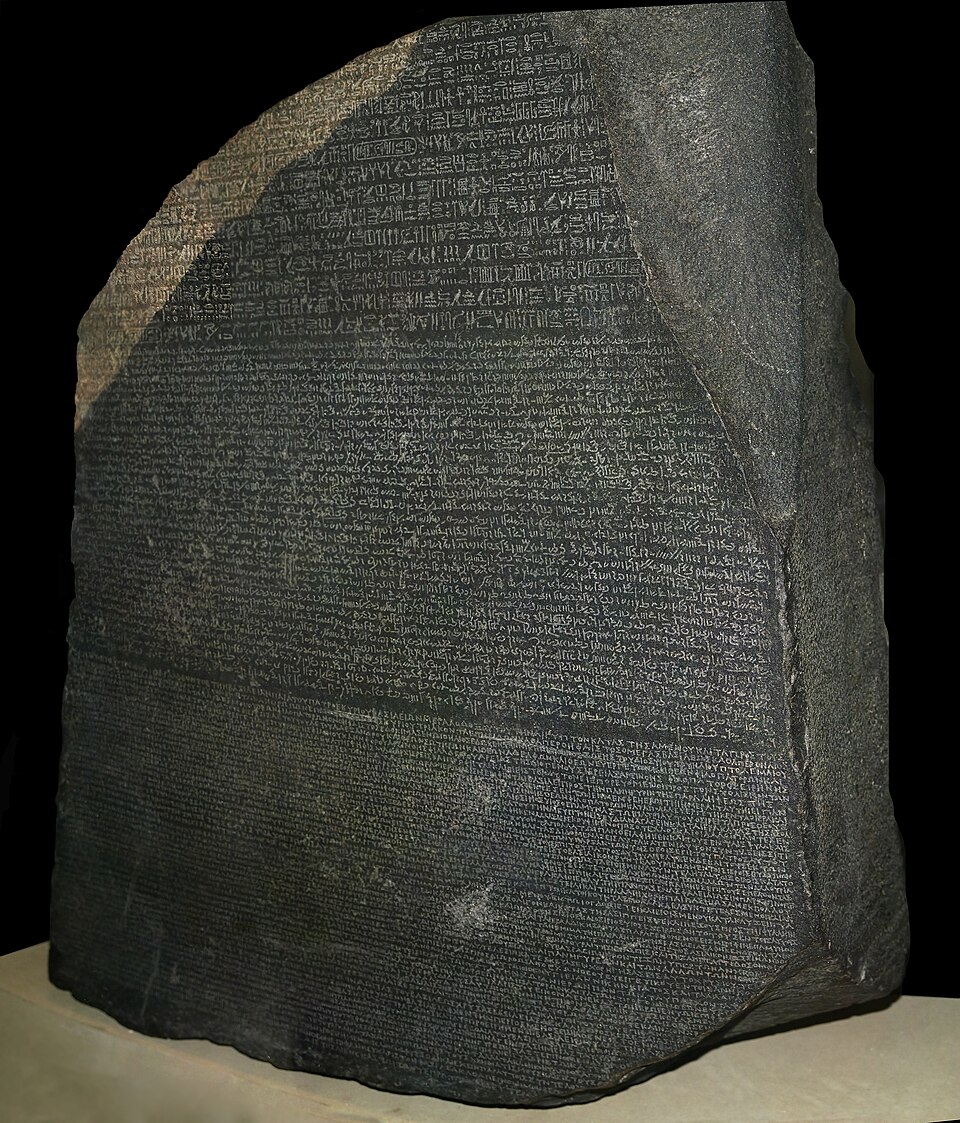
The Rosetta Stone, inscribed with the same decree in hieroglyphic, Demotic and Greek.
Hans Hillewaert · CC BY-SA 4.0 · Wikimedia Commons
c. 2300 BCE – 400 CE

Scribes, dragomans and scripture

The first translators were scribes and frontier officials: Ebla's lexicographers, Egypt's "overseers of interpreters," the bilingual administrators every ancient empire needed. Translation of scripture raised the stakes — the Septuagint gave Greek-speaking Jews their Bible and gave the trade its founding legend of seventy-two scholars, while the trilingual Rosetta Stone of 196 BCE, carved so one decree could be read by three audiences, later became the very symbol of carrying meaning between writing systems.

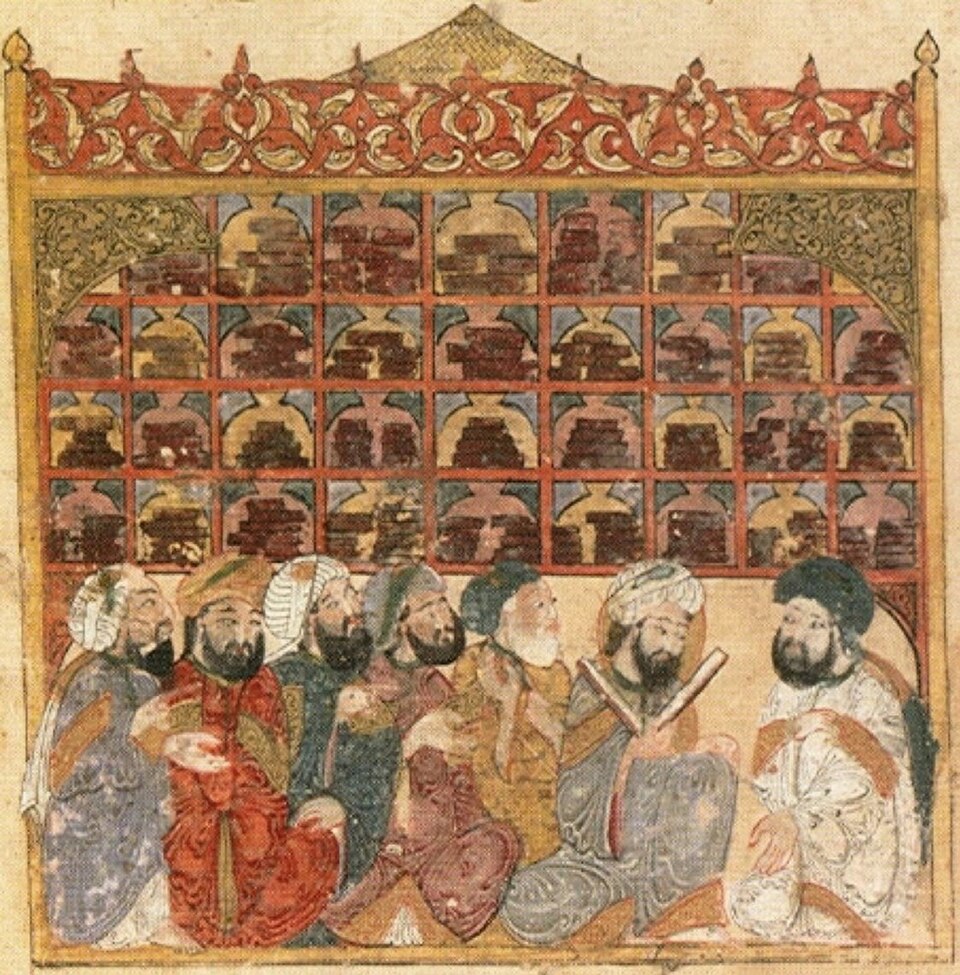
A medieval illustration of scholars at work in an Abbasid library.
Zereshk · Public domain · Wikimedia Commons
400 – 1200

Faith carried between tongues

For eight centuries the biggest translation projects on earth were religious. Jerome's Vulgate fixed Latin scripture; in Chang'an from 401, the Kuchean monk Kumārajīva ran a state-sponsored bureau said to employ hundreds, producing Chinese versions of the Lotus and Diamond sutras still recited today; and Abbasid Baghdad's House of Wisdom paid handsomely to move Greek medicine, mathematics and philosophy into Arabic — the channel through which much of it survived at all.

A depiction of translators at work in medieval Toledo.
Unknown author · CC BY-SA 3.0 · Wikimedia Commons
1100 – 1600

Toledo, print and the vernacular Bible

Toledo's translators turned Arabic learning into Latin and fed Europe's universities; Gerard of Cremona alone accounted for over seventy scientific works. Printing then made translation dangerous as well as influential: vernacular Bibles broke the Latin monopoly on scripture, Luther's German shaped a language, William Tyndale's English New Testament was smuggled in cloth bales and cost him his life in 1536, and the humanist printer Étienne Dolet was burned in Paris in 1546 over three words added to a Plato translation.

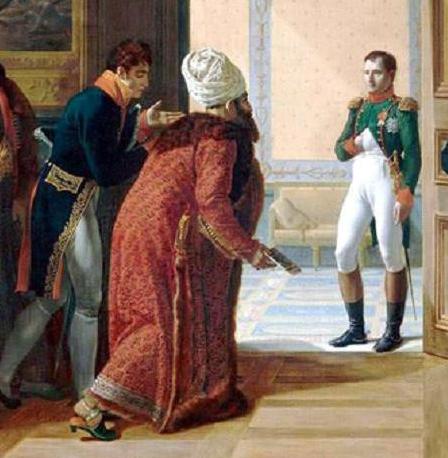
A dragoman, an official interpreter of the Ottoman Empire, in ceremonial dress.
Francois Mulard, 1810 · Public domain · Wikimedia Commons
1600 – 1945

Empires, dragomans and world literature

Early modern diplomacy ran on professional linguists: the Ottoman Empire's dragomans — from 1661 often drawn from Phanariot Greek dynasties — negotiated treaties and rose to govern provinces, while Tokugawa Japan filtered all Western contact through hereditary Dutch interpreters at Nagasaki. Meanwhile translation built "world literature": by the nineteenth century, translators — frequently anonymous, frequently women — were carrying Russian, French and German novels across Europe faster than ever, usually without their names on the title page.

A computer interface translating text between languages.
Quest Visual, Inc. ZTebaykina at en.wikipedia · CC BY-SA 3.0 · Wikimedia Commons
1945 – present

Professional bodies and the machine

The post-war order institutionalized the trade: the UN and the EU built the world's largest translation services, the International Federation of Translators formed in Paris in 1953, and UNESCO's 1976 Nairobi Recommendation urged states to treat translators as authors. Then the tools arrived — translation-memory software from companies like Stuttgart's Trados (founded 1984), statistical and neural machine translation after 2016 — turning much of the job into editing machine drafts and splitting the market between bulk and premium work.

What this job replaced

Neighbouring trades that no longer exist — absorbed, automated or regulated away.

Dragoman of the Sublime Porte

c. 1454–1923

The Ottoman Empire outsourced its diplomacy with Europe to a corps of official interpreter-diplomats, the dragomans. From 1661 the post of Grand Dragoman — first held by Panagiotis Nikousios and then by Alexander Mavrocordatos — became the near-monopoly of Phanariot Greek families, who parlayed language skill into real power, negotiating treaties and eventually ruling Ottoman provinces. The role died with the empire itself and the rise of foreign ministries staffed by trained diplomats who spoke their own languages.

Oranda-tsūji (Nagasaki's Dutch interpreters)

c. 1641–1859

When Tokugawa Japan closed itself to the West, every word exchanged with Europe passed through a hereditary guild of Japanese interpreters of Dutch at Nagasaki — by the eighteenth century a bureaucracy of well over a hundred posts passed from father to son. They doubled as Japan's only channel for Western science, translating medical and technical books in the movement known as rangaku. The opening of Japan and the switch to English in the 1850s erased the trade within a generation.

Latin secretary

c. 1500–1700s

Early modern European states corresponded in Latin, and courts kept a salaried scholar to draft and translate it. England's Council of State appointed the poet John Milton as Secretary for Foreign Tongues in 1649; he composed the republic's Latin correspondence, with Andrew Marvell later assisting, until the Restoration. As French and then national vernaculars displaced Latin in diplomacy over the eighteenth century, the office quietly ceased to exist across Europe.

Trades that vanished →

The pattern across four millennia is that translation booms whenever a civilization decides it is missing something another one has — Greek medicine in Baghdad, Arabic science in Toledo, Western technology in Meiji Japan, everything everywhere on today's internet. The translators themselves are remembered only when the stakes were visible: a Bible, a treaty, a trial.

The machine age has not broken that pattern; it has industrialized it. More words are translated per day now than in any previous century of human history — most of them by software, with the human profession concentrating exactly where it always lived: on the words where getting it wrong costs something.

Keep exploring

More in Education & Humanities