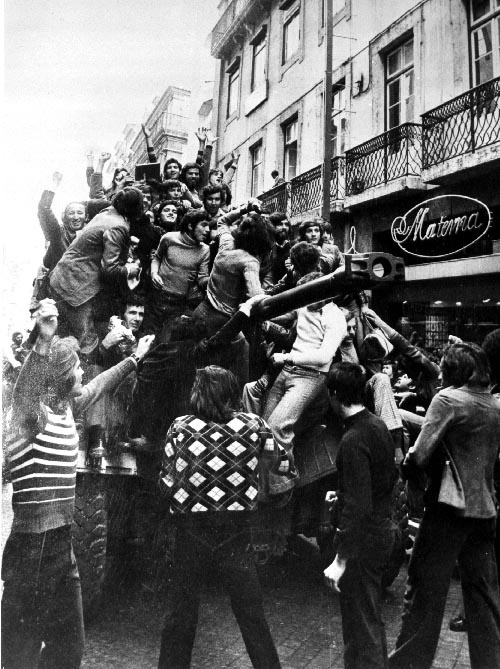
In the early hours of 25 April 1974 the Portuguese Armed Forces Movement (MFA) overthrew Marcelo Caetano's Estado Novo, the dictatorship Salazar had built. A banned song, "Grandola, Vila Morena," played on the radio as a signal. Troops secured Lisbon with almost no fighting. Crowds put red carnations in rifle barrels -- the image that named the revolution.
Four people died when regime police fired on a crowd. Caetano surrendered at the Carmo barracks to General Spinola. The colonial wars in Angola, Mozambique and Guinea-Bissau -- the officers' wound -- ended in a rush of independences (1974-75) and in chaotic, sometimes violent decolonisations, especially Angola.
Intensity in this atlas is near the floor: a coup that refused a bloodbath at home. Political impact was real: democracy in Portugal, an end to Europe's last large colonial war, and a PREC (ongoing revolutionary process) that frightened NATO allies until the 1976 constitution. English memory is a pretty flower and a Eurovision-adjacent folk song. This page keeps the wars in Africa in the paragraph. It is not a how-to.
Day25 Apr 1974
MovementMFA (Armed Forces Movement)
Signal songGrandola, Vila Morena
RegimeEstado Novo / Caetano
Colonial warsEnded in independence 1974-75
Deaths on the day4 (regime fire)
Profile
Scale
16
Intensity
12
Duration
15
Tech shift
10
Political impact
58
Cultural memory
48
Pin a cost beat to a legacy beat
On this topic, pick one published cost band and one legacy lesson already on the page. Educational pairing — not a nation league.
Documented ranges and memory notes only. No ranking of countries, peoples, or armed forces as teams. Not operational advice.
Cost beat already published
Legacy beat already published
Cost or lesson
Theme reading only. Not a nation league.
Deep introduction
A radio song, a flower, and three African wars
25 April was gentle in Lisbon because it was exhausted in Guinea, Angola and Mozambique -- a soldiers' coup against a war the dictatorship would not end.
Why the captains
A decade of African wars, a closed political system, and junior officers who could not see a military victory produced the MFA. Spinola's book Portugal and the Future (1974) cracked public speech.
This is a political-military cause, not a tactic list.
The day
Otelo Saraiva de Carvalho's operations plan moved units into Lisbon. The Carmo surrender was televised. Carnations were a civilian improvisation on a nearly bloodless seizure.
Four dead from PIDE/DGS fire remain the day's ledger -- low is not none.
PREC and decolonisation
1974-76 saw nationalisations, land occupations, and a near-miss of civil conflict. Angola's independence became a Cold War war. Retornados flooded Portugal.
NATO watched a member state's revolution with alarm; the 1976 constitution settled a democracy.
Memory of a gentle coup
25 April is a Portuguese civic holiday. English travel writing keeps the flowers and drops the African dead of the prior decade. This atlas will not.
Memory of a gentle coup stays dated: 1974-04-25 (Carmo surrender) in Lisbon and Portuguese armed forces; aftershocks in Angola, Mozambique, Guinea-Bissau. Salgueiro Maia (Captain on the ground) is a named witness -- The televised young officer of Carmo -- a popular face of the captains. Cost band: four dead from residual regime fire; a famously low-blood seizure that ended a dictatorship and a colonial war. Encyclopedia, not a method.
The low-intensity opposite of Chile 1973 -- and a pairing for Korea 1979 about what officers do to a state.
See also
Chile 1973 coupThe previous year's opposite: a coup that built a dictatorship, not ended one.
12 December 1979 coupAnother 1970s captains-and-generals story with a darker Korean outcome -- compare, do not copy.
Soviet 1991 coup attemptA later junta that failed; 1974's MFA succeeded and then argued with itself.
Vietnam WarPortugal's African wars were a different decolonisation fight in the same era of late empires.
Key terms
MFA
Armed Forces Movement -- the captains' organisation.
Estado Novo
The Salazar/Caetano dictatorship (1933-1974).
Grandola
The signal song on the radio.
PREC
Ongoing revolutionary process, 1974-76.
Retornados
Settlers who returned from Africa after independence.
25 de Abril
The Portuguese civic name.
War made the coup
Guinea-Bissau, Angola, Mozambique -- without those fronts the MFA is unintelligible.
Decolonisation's violence is part of 25 April's ledger, even when Lisbon was gentle.
A flower is not a full history
Carnations were real and later a brand. Four dead in Lisbon and many dead in Africa both belong.
Tourism should not write the textbook.
Democracy after argument
1976, not 25 April morning, is when a constitution locked a European democracy. The year in between was noisy.
Keep Democracy after argument pinned to 1974-05+ (Spinola vs MFA left): The junta argues. Carnation Revolution remains a 25 April 1974 (coup day; PREC to 1976 constitution) file in Lisbon and Portuguese armed forces; aftershocks in Angola, Mozambique, Guinea-Bissau, not a playbook.
16scaleEditorial 0-100 browsing score
12intensityEditorial 0-100 browsing score
15durationEditorial 0-100 browsing score
10techShiftEditorial 0-100 browsing score
Carnation Revolution: concrete atlas depth on Tool-Lifes.
Frequently asked questions
Are the scores a ranking of nations or armies?
No. Scores are browsing aids inside an era-bounded atlas — not live league tables of countries.
How many died on the day?
Four people, killed by regime police fire. The colonial wars before and the Angolan war after have much larger ledgers.
Why did officers move?
They could not win or end the African wars inside the Estado Novo's politics. The MFA was a captains' revolt against a war and a closed regime.
Who led it?
The MFA was collective; Otelo planned operations; Spinola received the surrender and briefly headed the junta -- then fell out with the leftward process.
What happened to the colonies?
Guinea-Bissau, Mozambique and Angola became independent in 1974-75. Angola collapsed into a long internationalised war. Hundreds of thousands of retornados came to Portugal.
Was it a left-wing coup?
It opened a left-revolutionary period (PREC) and then a pluralist constitution. Reducing 25 April to one ideology misses the captains' war-weariness.
Why "carnation"?
Civilians placed flowers in rifle barrels. The image stuck. It is not a full account of the decade.
Is this a how-to?
No. It is a historical file about a past overthrow of a dictatorship.