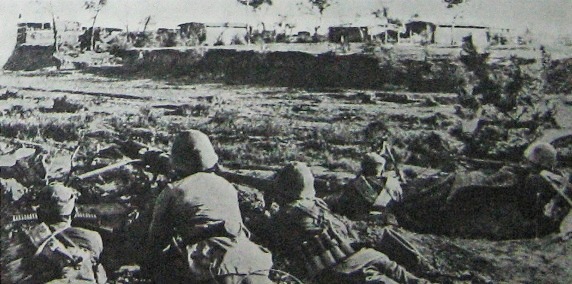
The Chinese Civil War, in its conventional dating, runs from the 1927 Shanghai massacre and the collapse of the First United Front to the Communist victory of 1949 -- interrupted, but not erased, by the war against Japan (1937-45). Chiang Kai-shek's Nationalist government (KMT) and Mao Zedong's Chinese Communist Party fought for the same country with different social programmes and foreign backers.
After Japan's surrender, US-mediated talks failed. The 1946-49 phase was decided in Manchuria and on the mainland railways: Liaoshen, Huaihai and Pingjin (1948-49) wrecked KMT field armies. Mao proclaimed the People's Republic on 1 October 1949; Chiang's Republic of China withdrew to Taiwan.
Deaths across the civil-war years are a wide scholarly band, often about 6-10 million when combat, massacre and associated famine are bundled -- figures overlap the Japanese war and later campaigns. The unfinished legal war across the Strait still structures East Asian security, including the Korean War's Chinese intervention in 1950.
Main span1927-1937 and 1945-1949
Japan intervalUnited front 1937-45
PRC founding1 Oct 1949
ROC to Taiwan1949
Deaths (band)about 6-10 million, wide range
Korea linkPRC intervention 1950
Profile
Scale
72
Intensity
76
Duration
65
Tech shift
40
Political impact
88
Cultural memory
52
Pin a cost beat to a legacy beat
On this topic, pick one published cost band and one legacy lesson already on the page. Educational pairing — not a nation league.
Documented ranges and memory notes only. No ranking of countries, peoples, or armed forces as teams. Not operational advice.
Cost beat already published
Legacy beat already published
Cost or lesson
Theme reading only. Not a nation league.
Deep introduction
Two parties, one China, an interrupted war
The civil war was a social revolution and a conventional war, paused by Japan and finished in 1949 with two Chinese states still claiming one sovereignty.
From united front to massacre
Sun Yat-sen's KMT had accepted Soviet aid and a CCP alliance. After the Northern Expedition, Chiang turned on the Communists in Shanghai in April 1927. Rural soviets, the Jiangxi period, and the Long March (1934-35) kept a CCP remnant alive in Yan'an.
The war against Japan forced a Second United Front that neither side trusted.
Yan'an and Chongqing
While Chiang's government retreated to Chongqing, the CCP expanded in north China behind Japanese lines. US observers (the Dixie Mission) saw a disciplined guerrilla party; US aid still flowed mainly to the KMT.
Corruption, inflation and conscription abuse hollowed Nationalist legitimacy even before 1946's open war.
1946-49 conventional finish
Marshall's mission failed. Soviet withdrawal from Manchuria left a scramble for Japanese weapons. Lin Biao's northeast campaigns and the 1948-49 three great campaigns ended KMT resistance on the mainland.
Crossing the Yangtze in April 1949 opened Nanjing and Shanghai. The PRC was proclaimed before the last southern cities fell.
Taiwan and the long after
The ROC on Taiwan, US naval intervention in 1950 (after the Korean War began), and decades of martial law created a second Chinese modern story. The PRC's later Taiwan policy and the US Taiwan Relations Act (1979) are the diplomatic afterlife.
This page is the civil war, not a live invasion scenario.
1949 recast Korea, the Cold War in Asia, and the later industry of both Chinese states.
See also
Korean WarThe PVA that entered Korea in 1950 was the PLA of the civil-war victory -- a direct sequel.
World War IIThe Japanese war (1937-45) paused and reshaped the civil war; Chongqing and Yan'an were Allied China.
Vietnam WarA later Asian revolutionary war that Beijing also influenced -- comparison, not identity.
Soviet 1991 coup attemptThe other great communist-state crisis in this atlas; 1949 was a founding, 1991 a collapse -- paired as bookends of a century.
Key terms
Northern Expedition
1926-28 KMT-CCP campaign against warlords; ended in the 1927 split.
Long March
1934-35 CCP retreat from Jiangxi to Yan'an -- later a founding myth.
United Front
Two periods of KMT-CCP cooperation (1923-27, 1937-45), both tactical.
Three campaigns
Liaoshen, Huaihai, Pingjin (1948-49) -- the conventional end-game.
PLA
People's Liberation Army -- the CCP's army, named as a historical force, not a live ORBAT.
Two Chinas
PRC (1949-) and ROC on Taiwan -- the unfinished legal pair.
Peasant revolution
Land policy, not only rifles, decided much of the countryside. The KMT remained more urban and militarist in its late years.
Hyperinflation in 1947-49 was a Nationalist political defeat as real as any lost city.
Foreign hands
Soviet aid and the Manchurian vacuum; US aid and the failed Marshall mission; Japanese occupation as the war's middle chapter.
None of these hands replaces Chinese agency -- a point "who lost China" forgot.
Unfinished Strait
No peace treaty ended the civil war. Crises in 1954-55, 1958 and 1995-96 were later chapters. This atlas records the history, not a present operational plan.
Keep Unfinished Strait pinned to 1948-49 (Three campaigns): Liaoshen, Huaihai, Pingjin destroy KMT main forces. Chinese Civil War remains a 1927-1949 (main phases; Taiwan standoff after) file in China proper, Manchuria, later Taiwan Strait, not a playbook.
72scaleEditorial 0-100 browsing score
76intensityEditorial 0-100 browsing score
65durationEditorial 0-100 browsing score
40techShiftEditorial 0-100 browsing score
Chinese Civil War: concrete atlas depth on Tool-Lifes.
Frequently asked questions
Are the scores a ranking of nations or armies?
No. Scores are browsing aids inside an era-bounded atlas — not live league tables of countries.
How many died?
A wide band, often about 6-10 million for civil-war related deaths across phases, overlapping the Japanese war and postwar campaigns. Treat any single number as a false census.
Did Japan pause the civil war?
It forced a united front and moved the main enemy, but both parties positioned for the next round. 1945 was a restart, not a blank slate.
Why did the Communists win?
Rural organisation, KMT inflation and corruption, Manchurian campaigns, and a more coherent political-military command. US aid was real and insufficient to offset legitimacy collapse.
What happened on 1 October 1949?
Mao proclaimed the PRC in Beijing. The ROC government relocated to Taipei. Both claimed to be the government of China.
How does this connect to the Korean War?
The new PRC intervened in Korea in October 1950. The US interposed the Seventh Fleet in the Strait, blocking an immediate Taiwan campaign.
Is the civil war still on?
In law, neither side signed a final peace. In practice, economic and social life diverged for decades. This page does not treat that as a how-to for conflict.
What should English readers unlearn?
That 1949 was mainly a US policy failure. It was a Chinese social and military outcome with foreign settings.