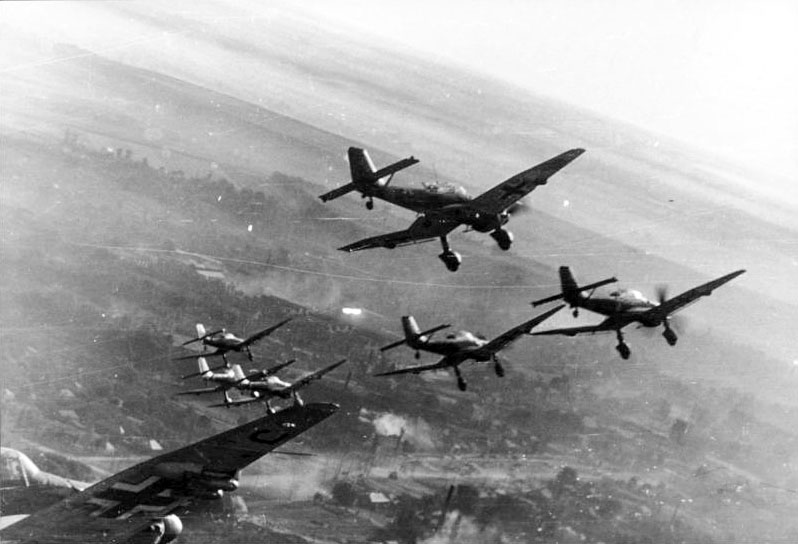
World War II opened in Europe when Germany invaded Poland on 1 September 1939, after a decade of Japanese war in China that many historians date from the 1937 Marco Polo Bridge clash. The Axis of Germany, Italy and Japan faced a widening Allied coalition led by the United Kingdom, the Soviet Union, the United States and China.
Scholarly tallies of the dead cluster around 70-85 million, a majority civilians, with the Soviet Union and China bearing the largest national losses. The conflict fused industrial total war, the Holocaust and other genocides, strategic bombing, and the first combat use of nuclear weapons at Hiroshima and Nagasaki in August 1945.
Surrender ceremonies in May and September 1945 did not restore the 1930s map. Occupation, the United Nations Charter, partitioned Germany and Korea, and a bipolar nuclear order followed. Anglophone memory still treats the war as the century's defining just-war story, even as scholarship stresses imperial continuities and the China theatre.
Span1939-1945 (Asia from 1937)
Deathsabout 70-85 million
CoalitionsAllies vs Axis
End in Europe8 May 1945
End in Asia2 Sep 1945
SettlementUN, occupation, Cold War
Profile
Scale
99
Intensity
97
Duration
58
Tech shift
98
Political impact
99
Cultural memory
100
Pin a cost beat to a legacy beat
On this topic, pick one published cost band and one legacy lesson already on the page. Educational pairing — not a nation league.
Documented ranges and memory notes only. No ranking of countries, peoples, or armed forces as teams. Not operational advice.
Cost beat already published
Legacy beat already published
WW2 cost and legacy - themes, not a nation league
Does pinning a cost beat to a legacy beat rank countries?
No. The pin only pairs two beats already on this topic. Scores browse themes. This atlas never ranks nations or peoples as teams.
Which cost bands can I pin on this page?
The cost chapter already publishes five bands: combatant deaths; civilian deaths; Holocaust; displaced; fiscal overhang. The 70-85 million death range is a scholarly band, not a census.
Which legacy lessons sit next to those bands?
Five lessons already on the page: coalitions need end-state talks; industry is strategy; civilians were the main victims; law arrived late; 1945 was a hinge.
Is this operational advice?
No. Documented ranges and memory notes only. Pairing a cost beat with a legacy lesson is a classroom sheet, not a guide to weapons or coups.
Pair one cost beat with one legacy lesson
On World War II, walk the first published cost band beside the first legacy lesson — theme teaching, not a nation league.
Name the first cost beat — The page already publishes Combatant deaths as a documented band.
Name the first legacy lesson — Beside it sits Coalitions need end-state talks from the legacy chapter.
Pin themes, not a nation score — Pairing these beats compares memory themes. This atlas never ranks countries or peoples as teams.
Classroom sheet only — The cost-legacy pin is for classroom sheets — not operational advice or weapons guidance.
Combatant deaths and Coalitions need end-state talks belong on the same teaching card for World War II.
Documented ranges and memory notes only. Not operational advice.
Classroom second theme pair on this war
On World War II, pair the second published cost band with the second legacy lesson — another theme card, never a nation league.
Name the second cost beat — The page already publishes Civilian deaths as a documented band.
Name the second legacy lesson — Beside it sits Industry is strategy from the legacy chapter.
Compare themes, not country scores — A second pair still compares memory themes. This atlas never ranks countries or peoples as teams.
Keep it on the classroom sheet — Pin both theme pairs for classroom sheets only — not operational advice or weapons guidance.
Civilian deaths and Industry is strategy belong on a second teaching card for World War II.
Documented ranges and memory notes only. Not operational advice.
Cost or lesson
Theme reading only. Not a nation league.
Deep introduction
A war of coalitions, industry and occupation
The Second World War was not one campaign but overlapping wars in Europe, Asia, Africa and at sea, bound by alliance diplomacy and factory output.
From regional wars to a world war
Japan's war in China and Italy's wars in Africa preceded the European general war. Germany's attack on the Soviet Union in June 1941 and Japan's strike on Pearl Harbor on 7 December 1941 fused those wars into a single global contest.
Lend-Lease, the Atlantic Charter and later the United Nations Declaration (1 January 1942) turned a set of bilateral fights into a coalition with shared -- if unequal -- aims.
Industrial mobilisation
Detroit, the Urals, the Ruhr, Osaka and the Midlands became as decisive as any river crossing. Shipping, oil, aluminium and ball bearings set the tempo of offensives.
Codebreaking at Bletchley Park and Station HYPO, radar, and the B-29 and V-2 programmes show how laboratories entered the order of battle without turning this page into a weapons manual.
Occupation and genocide
Nazi rule in Europe organised plunder, slave labour and the Holocaust: about six million Jews murdered, alongside millions of other targeted civilians. Japanese occupation in China and Southeast Asia produced mass death through massacre, famine and forced labour.
Resistance, collaboration and civil war inside occupied countries mean "the home front" was often a second front.
Settlement without restoration
Yalta and Potsdam framed occupation zones, while the Tokyo and Nuremberg tribunals tried a new language of crimes against peace and humanity. The 1945 UN Charter promised collective security that the Cold War immediately strained.
Korea was divided at the 38th parallel; China's civil war resumed; Eastern Europe entered Soviet hegemony. The map of 1946 was a new system, not a repaired 1938.
US material aid (from 1941) that supplied Britain, the USSR and others without immediate cash payment.
Unconditional surrender
Allied political demand, public from 1943, that Axis states yield without a negotiated bargain.
Second front
Soviet call for a major Western landing in Europe, answered in strength only in June 1944.
Area bombing
Night and daylight campaigns against cities and industry; morality and effect remain debated.
Occupation statute
Legal frames (Germany, Japan, Korea) that replaced sovereignty with Allied or UN authority.
Crimes against humanity
Nuremberg category for widespread attacks on civilians, later folded into international law.
Alliance management
Churchill, Roosevelt and Stalin disagreed on Poland, the Balkans and the date of a cross-Channel attack. The "Big Three" photographs hide a running argument about postwar order.
China's Chiang Kai-shek was a formal Allied leader whose theatre was chronically under-supplied; de Gaulle's Free French fought for recognition as much as for territory.
War economies
Germany's late total mobilisation under Speer contrasted with earlier Blitzkrieg improvisation. The US became the "arsenal of democracy"; the USSR moved plants east of the Urals after 1941.
Japan could not replace merchant tonnage once US submarines and mines closed the home islands' supply. Oil, not only valour, ended the Pacific war.
Afterlives in Asia
Hirohito remained emperor under US occupation; Korea did not get a unified trusteeship. Vietnam's 1945 declaration of independence was immediately contested by France.
These Asian endings, more than VE Day parades, set the wars of 1946-54.
99scaleEditorial 0-100 browsing score
97intensityEditorial 0-100 browsing score
58durationEditorial 0-100 browsing score
98techShiftEditorial 0-100 browsing score
World War II: concrete atlas depth on Tool-Lifes.
Frequently asked questions
Are the scores a ranking of nations or armies?
No. Scores are browsing aids inside an era-bounded atlas — not live league tables of countries.
How many people died?
Scholarly ranges centre on about 70-85 million dead, including combatants and civilians. The Soviet Union (about 24-27 million) and China (about 15-20 million, wide range) are the largest national totals. Precise counts remain impossible.
What was the Holocaust in this war?
Nazi Germany and collaborators murdered about six million Jews, using ghettos, shooting pits and killing centres, alongside mass murder of Roma, disabled people, Soviet POWs and others. It is documented as genocide within the wider war, not a side-effect.
Why did the Allies win?
No single cause. Coalition resources, Soviet manpower and industrial relocation, US production and sea power, intelligence, and Axis strategic overreach all matter. Historians argue about weights; they do not treat victory as destiny.
What ended the war in the Pacific?
Japan announced surrender on 15 August 1945 after the Hiroshima and Nagasaki bombings and the Soviet invasion of Manchuria; the formal instrument was signed on 2 September 1945 aboard USS Missouri. Debate continues on the relative weight of those shocks.
How did the war change Korea?
Japanese colonial rule collapsed in August 1945. US and Soviet occupation zones met at the 38th parallel, creating two Korean states by 1948 and the setting for the 1950-53 Korean War.
How does WWII compare with the Vietnam War on this atlas?
WWII (1939-45; China from 1937) ~70-85 million dead scholarly band. Vietnam 1955-75 fuses decolonisation and civil war under Cold War intervention. Open WWII vs Vietnam VS — never a nation league.
Why does it dominate cultural memory?
Scale, film, school mandates, surviving veterans into the late twentieth century, and a relatively clear aggressor narrative in the West. Memory is thinner for Bengal famine, forced labour in Asia, and colonial soldiers' returns.