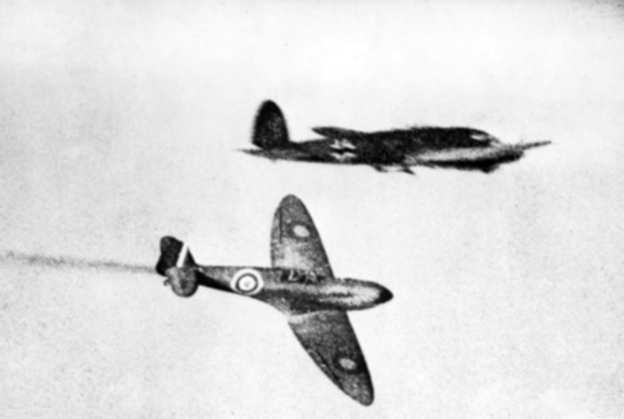
The 1940 air campaign in which the RAF denied Germany daylight control of southern England -- a prerequisite for any invasion scare, and a British memory engine.
Educational history. Casualty figures are documented ranges. This is not operational advice, a ranking of nations, or a how-to for weapons or coups.
The Battle of Britain, in RAF official dating, ran from 10 July to 31 October 1940: Kanalkampf over the Channel, then attacks on airfields and aircraft plants, then the turn toward London after 7 September. Hitler's invasion sketch (Sea Lion) required air superiority the Luftwaffe did not win in daylight.
Fighter Command under Dowding, with Park's 11 Group in the southeast, used Chain Home radar and a ground-controlled interception system that was as important as any Spitfire silhouette. RAF aircrew dead in the battle period are usually counted in the high hundreds; Luftwaffe aircrew losses were higher. Civilian deaths belong mainly to the Blitz ledger that overlapped and outlasted the official battle.
Churchill's "Few" sentence made this the British civic air war. English-speaking memory sometimes treats it as the war; it was a necessary 1940 survival, not 1945. Korean readers should hear it beside the later UN air war in 1950-53: radar and fighters as a defensive system, not as a how-to of interception.
Official span10 Jul-31 Oct 1940
RAF commandHugh Dowding / Keith Park
German aimAir superiority for Sea Lion talk
RadarChain Home
The FewFighter Command pilots
Blitz overlapNight bombing into 1941
Profile
Scale
32
Intensity
68
Duration
20
Tech shift
62
Political impact
70
Cultural memory
78
Pin a cost beat to a legacy beat
On this topic, pick one published cost band and one legacy lesson already on the page. Educational pairing — not a nation league.
Documented ranges and memory notes only. No ranking of countries, peoples, or armed forces as teams. Not operational advice.
Cost beat already published
Legacy beat already published
Cost or lesson
Theme reading only. Not a nation league.
Deep introduction
Radar, groups, and a political turn to London
The battle was an organisational win -- Dowding's system -- as much as a pilot-hero story, and it leaked into the Blitz the moment London burned.
After France
June 1940 left Britain expecting invasion. The Channel was a moat only if the air above it was contested. Sea Lion was a sketch that needed a sky.
Dowding had already fought to keep fighters in Britain during the French collapse -- a political-military preface.
Adlertag and airfields
August attacks on 11 Group fields (Biggin, Kenley, Hornchurch) were the dangerous week. Park's tactics -- meet them forward, do not empty the fields -- remain a historians' argument with Leigh-Mallory's Big Wing.
Pilot fatigue and the training pipeline were the real clock, not a single "hardest day" postcard.
London, 7 September
The Luftwaffe's turn to the capital eased pressure on the sector stations and opened the night Blitz. Whether this was revenge, a hoped-for RAF final battle, or both, it changed the campaign's object.
15 September -- later Battle of Britain Day -- became the ritual date.
Memory of the Few
The 1969 film, St Paul's in smoke, and the Capel-le-Ferne memorial taught a nation. Polish and Czech squadrons (303, 310) were late additions to popular English tellings that had been too English.
Memory of the Few stays dated: 1940-08-18 (Hardest day) in English Channel, southeast England, London approaches. Winston Churchill (Prime minister) is a named witness -- Wrote the Few and held the political war. The speeches are sources and myths together. Cost band: about 500-1,000 RAF aircrew dead in the battle period; Luftwaffe losses higher; civilian Blitz deaths are a linked but wider ledger. Encyclopedia, not a method.
A defensive campaign that made Overlord imaginable and gave English a "Few" vocabulary later wars borrowed.
See also
World War IIA 1940 campaign of the world war, not a separate war.
Normandy landingsWithout 1940 survival there is no 1944 launching island.
Fighter jetThe later jet age still cites 1940 as the political proof that air defence can be a nation's story -- not as a technical ancestor of jets.
Republic of Korea Armed ForcesROK air defence culture after 1953 is a different file; the comparison is "home sky as politics," not a copied RAF.
Key terms
Chain Home
The radar fence that fed the filter rooms.
Dowding system
Radar, telephone, sector control -- the real machine.
11 Group
Park's southeast group under the main attack.
Big Wing
Leigh-Mallory / Bader massing concept -- a bitter intramural fight.
Adlertag
13 August 1940, "Eagle Day."
Sea Lion
The invasion sketch that required a sky Germany did not win.
System over silhouette
Spitfire beauty is real and secondary. The filter room is the British invention that mattered.
Pilot replacement rates were a staff problem, not a poster problem.
Whose Few?
Poles, Czechs, New Zealanders, Canadians -- the roster was imperial and exile, not only Home Counties.
303 Squadron's score is now a standard corrective paragraph.
Battle vs Blitz
Official end-date 31 October does not end the night bombing. Teach two ledgers.
Keep Battle vs Blitz pinned to 1940-09-07 (London day raid): The turn to the capital; airfields breathe. Battle of Britain remains a 10 July-31 October 1940 (official RAF dates) file in English Channel, southeast England, London approaches, not a playbook.
32scaleEditorial 0-100 browsing score
68intensityEditorial 0-100 browsing score
20durationEditorial 0-100 browsing score
62techShiftEditorial 0-100 browsing score
Battle of Britain: concrete atlas depth on Tool-Lifes.
Frequently asked questions
Are the scores a ranking of nations or armies?
No. Scores are browsing aids inside an era-bounded atlas — not live league tables of countries.
How many died?
RAF Fighter Command aircrew dead in the battle period are usually given in the high hundreds (often cited around 500-1,000 depending on who is included). Luftwaffe aircrew losses were higher. Civilian Blitz deaths are a separate, larger urban ledger.
Did it stop an invasion?
It denied the daylight air superiority Sea Lion required. Whether Hitler would have launched even with that sky is a separate counterfactual. The battle made invasion implausible.
What was the Dowding system?
Radar reporting, filter rooms, and sector-controlled fighters -- an integrated air defence, historically described, not a modern C2 manual.
What was the Big Wing debate?
Whether to mass fighters (Leigh-Mallory) or intercept in smaller, earlier packets (Park). It became a personnel war that cost Dowding and Park their posts.
Who were the Few?
Churchill's name for Fighter Command pilots. The roster included many non-British airmen. Bomber and Coastal crews are often left out of the sentence.
Is the Battle of Britain the same as Normandy / D-Day?
No. Britain (official RAF dating 10 Jul-31 Oct 1940) was a defensive air campaign with Dowding Chain Home. Normandy was the 6 June 1944 Overlord landing. 1940 kept a launching island alive; not a rehearsal of Omaha or Sword. VS compares score axes, not a nation league.