At a glance
Carnation Revolution · taglineThe 25 April 1974 MFA coup that ended the Estado Novo with carnations in…
Carnation Revolution · Four people died when regime police fired on a crowdFour people died when regime police fired on a crowd. Caetano surrendered at…
Carnation Revolution · Intensity in this atlas is near the floor: a coup that refused aIntensity in this atlas is near the floor: a coup that refused a bloodbath at…
Carnation Revolution · paras 1A decade of African wars, a closed political system, and junior officers who…
Four people died when regime police fired on a crowd. Caetano surrendered at the Carmo barracks to General Spinola. The colonial wars in Angola, Mozambique and Guinea-Bissau -- the officers' wound -- ended in a rush of independences (1974-75) and in chaotic, sometimes violent decolonisations, especially Angola.
Carnation Revolution · tagline
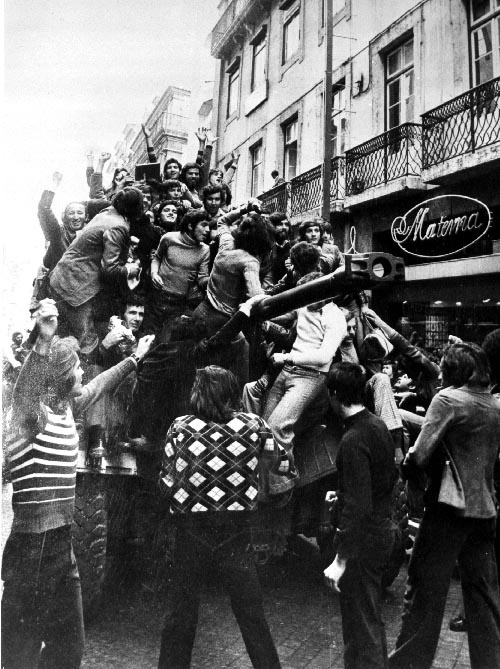
The 25 April 1974 MFA coup that ended the Estado Novo with carnations in rifle barrels -- a junta against a dictatorship, not a manual. In the early hours of 25 April 1974 the Portuguese Armed Forces Movement (MFA) overthrew Marcelo Caetano's Estado Novo, the dictatorship Salazar had built. A banned song, "Grandola, Vila Morena," played on the radio as a signal. Troops secured Lisbon with almost no fighting.
Carnation Revolution · Four people died when regime police fired on a crowd
Four people died when regime police fired on a crowd. Caetano surrendered at the Carmo barracks to General Spinola. The colonial wars in Angola, Mozambique and Guinea-Bissau -- the officers' wound -- ended in a rush of independences (1974-75) and in chaotic, sometimes violent decolonisations, especially Angola.
Carnation Revolution · Intensity in this atlas is near the floor: a coup that refused a
Intensity in this atlas is near the floor: a coup that refused a bloodbath at home. Political impact was real: democracy in Portugal, an end to Europe's last large colonial war, and a PREC (ongoing revolutionary process) that frightened NATO allies until the 1976 constitution. English memory is a pretty flower and a Eurovision-adjacent folk song. This page keeps the wars in Africa in the paragraph.
Carnation Revolution · paras 1
A decade of African wars, a closed political system, and junior officers who could not see a military victory produced the MFA. Spinola's book Portugal and the Future (1974) cracked public speech. Otelo Saraiva de Carvalho's operations plan moved units into Lisbon. The Carmo surrender was televised. Carnations were a civilian improvisation on a nearly bloodless seizure.
This explains a campaign, battle, or weapon in context. It is not a league of nations. It does not replace the full topic page.
Questions
- What is the next question after this?
- Intensity in this atlas is near the floor: a coup that refused a bloodbath at home. Political impact was real: democracy in Portugal, an end to Europe's last large colonial war, and a PREC (ongoing revolutionary process) that frightened NATO allies until the 1976 constitution. English memory is a pretty flower and a Eurovision-adjacent folk song. This page keeps the wars in Africa in the paragraph.
- Does this page rank people or nations?
- This explains a campaign, battle, or weapon in context. It is not a league of nations. It does not replace the full topic page.
- Where is the longer entry?
- A decade of African wars, a closed political system, and junior officers who could not see a military victory produced the MFA. Spinola's book Portugal and the Future (1974) cracked public speech. Otelo Saraiva de Carvalho's operations plan moved units into Lisbon. The Carmo surrender was televised. Carnations were a civilian improvisation on a nearly bloodless seizure.
Next question: Chile 1973 coup · Open the topic: Carnation Revolution
Why is "a single assassination headline" the wrong stop when reading the August mobilization in 1914? · Why is "a paper count of tanks" the wrong stop when reading the campaign in France in 1940? · Why is "the landing nickname alone" the wrong stop when reading the Inchon landing in 1950? · Why is "a body-count column" the wrong stop when reading the Tet offensive in 1968? · Why is "the battle nickname alone" the wrong stop when reading Austerlitz in 1805? · Why is "one casualty total" the wrong stop when reading Gettysburg in 1863? · 50 campaign reading notes