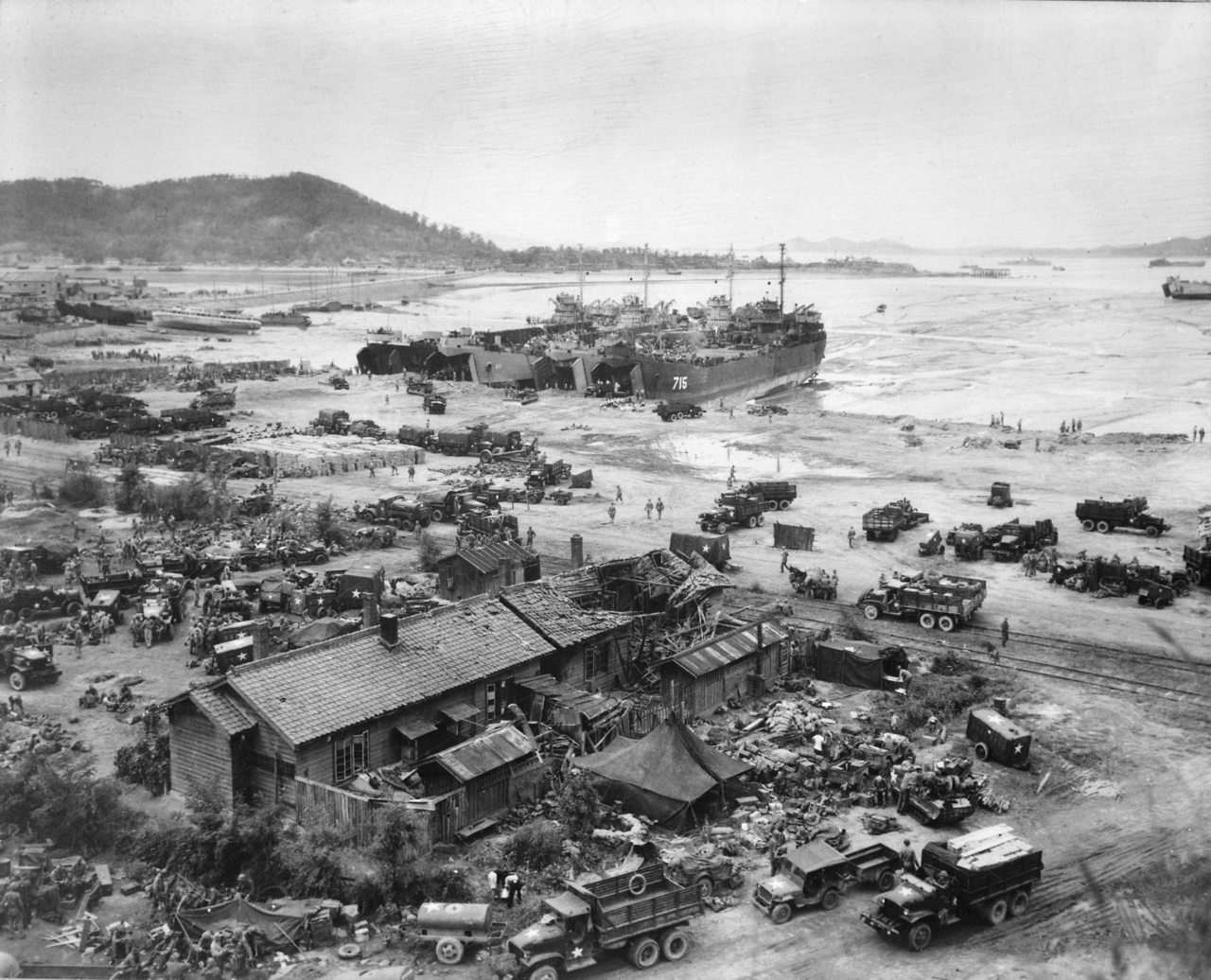
The 15 September 1950 UN amphibious landing that cut KPA supply to the Pusan Perimeter and retook Seoul -- a tide-table gamble, not the end of the Korean War.
Educational history. Casualty figures are documented ranges. This is not operational advice, a ranking of nations, or a how-to for weapons or coups.
Operation Chromite put X Corps ashore at Inchon on 15 September 1950, far behind the Korean People's Army fighting on the Pusan Perimeter. MacArthur had forced the plan through sceptical JCS and Navy voices: the harbour's tidal range (among the world's largest), mudflats, and seawalls made it a bad textbook beach -- and therefore, he argued, lightly held.
Wolmi-do fell in the morning; the evening tide put Marines and soldiers onto the city. Kimpo airfield and the Han crossings opened the fight for Seoul, declared recaptured on 28 September. UN and ROK dead in the Inchon-Seoul operation are usually given in the hundreds; KPA losses in dead and captured were much higher. The landing wrecked KPA logistics in the south.
Chromite did not end the war. The UN drive across the 38th parallel and toward the Yalu invited Chinese intervention. For Korean readers this is a national-capital story as much as a MacArthur story: Seoul's second liberation in three months, and a reminder that operational brilliance can widen a war. Anglophone memory treats Inchon as the "clever landing" between two world-war amphibious myths (Overlord, Pacific islands).
Landing15 Sep 1950
NameOperation Chromite
TideExtreme Inchon range
Seoul retaken28 Sep 1950
CommanderMacArthur / Almond / Doyle
SequelDrive north, then China
Profile
Scale
24
Intensity
64
Duration
10
Tech shift
45
Political impact
66
Cultural memory
58
Pin a cost beat to a legacy beat
On this topic, pick one published cost band and one legacy lesson already on the page. Educational pairing — not a nation league.
Documented ranges and memory notes only. No ranking of countries, peoples, or armed forces as teams. Not operational advice.
Cost beat already published
Legacy beat already published
Cost or lesson
Theme reading only. Not a nation league.
Deep introduction
Tides, a seawall, and a capital
Inchon was a harbour problem, a political deadline (retake Seoul), and a strategic temptation to go north.
Why Inchon
A landing at Kunsan or closer to Pusan would have been orthodox. Inchon promised to cut the Seoul-Pusan axis and collapse the KPA from the rear. The price was hydrography.
Admiral Doyle's staff turned tide tables into a two-pulse landing (morning Wolmi, evening city).
15-19 September
Naval gunfire and carrier air prepared Wolmi-do. Marines climbed seawalls. The city fight was short compared with Seoul's street week.
Almond's X Corps -- Marines and 7th Infantry, with ROK units -- was a MacArthur instrument as much as a joint team.
Seoul, 28 September
Syngman Rhee and MacArthur's ceremony in the damaged capital was political theatre on a clock. The KPA in the south was already breaking toward the parallel.
Atrocities and civilian harm in the recapture week belong in the ledger -- a Korean city, not an empty stage.
The northward sequel
Success licensed the UN crossing of the 38th. China's warning was discounted. Inchon's afterlife is the Yalu as much as the seawall.
Truman would fire MacArthur in April 1951 for a different argument -- but Chromite made the general politically almost untouchable for a season.
Almond's landing force -- Marines, 7th ID, ROK attachments.
Wolmi-do
The island taken on the morning tide.
Seawall
The urban waterfront obstacle that replaced a sandy beach.
Yellow Sea tides
Extreme range that set a two-pulse plan.
38th parallel sequel
The political line the success tempted the UN to cross.
Hydrography as strategy
Tide tables were the plan. A "bold general" story that omits the moon and the mud is a poster.
Doyle's sailors are under-photographed beside MacArthur's corncob.
Korean agency
ROK troops and Seoul civilians are not extras in a US Marine film. The capital was theirs.
Rhee's ceremony was a political act in a war that was already a civil war.
Success as temptation
The best operational day of 1950 licensed the worst strategic month -- the race to the Yalu.
A landing can win a campaign and lose the next decision.
24scaleEditorial 0-100 browsing score
64intensityEditorial 0-100 browsing score
10durationEditorial 0-100 browsing score
45techShiftEditorial 0-100 browsing score
Battle of Inchon: concrete atlas depth on Tool-Lifes.
Frequently asked questions
Are the scores a ranking of nations or armies?
No. Scores are browsing aids inside an era-bounded atlas — not live league tables of countries.
How many died?
UN/ROK killed in the Inchon-Seoul operation are usually given in the hundreds. KPA dead and captured were much higher. Civilian deaths in Seoul's recapture are part of a wider 1950 urban ledger -- use ranges, not a fake precision.
Why did it work?
Surprise, naval/air preparation, KPA overstretch in the south, and a plan fitted to tides. It was not magic and not costless.
Why was the Navy sceptical?
Tides, mudflats, channels, and seawalls -- Inchon was a hydrographic nightmare on paper. The sceptics were not cowards; they were sailors who could read a chart.
Did it end the Korean War?
No. It ended the first campaign. The war continued until 27 July 1953, after Chinese intervention.
Who commanded?
MacArthur at UNC; Admiral Doyle afloat; General Almond (X Corps); Marine generals (Smith and others) on the landing force; ROK units under the same operation.
How does it relate to D-Day?
Both are amphibious coalition operations studied in staff colleges. Overlord was a build-up across a narrow sea against a fortified coast; Inchon was a surprise into a tidal city harbour. Do not copy either as a template.
Is this a landing how-to?
No. It is a historical battle file. Tide tables here are 1950 facts, not a current assault guide.