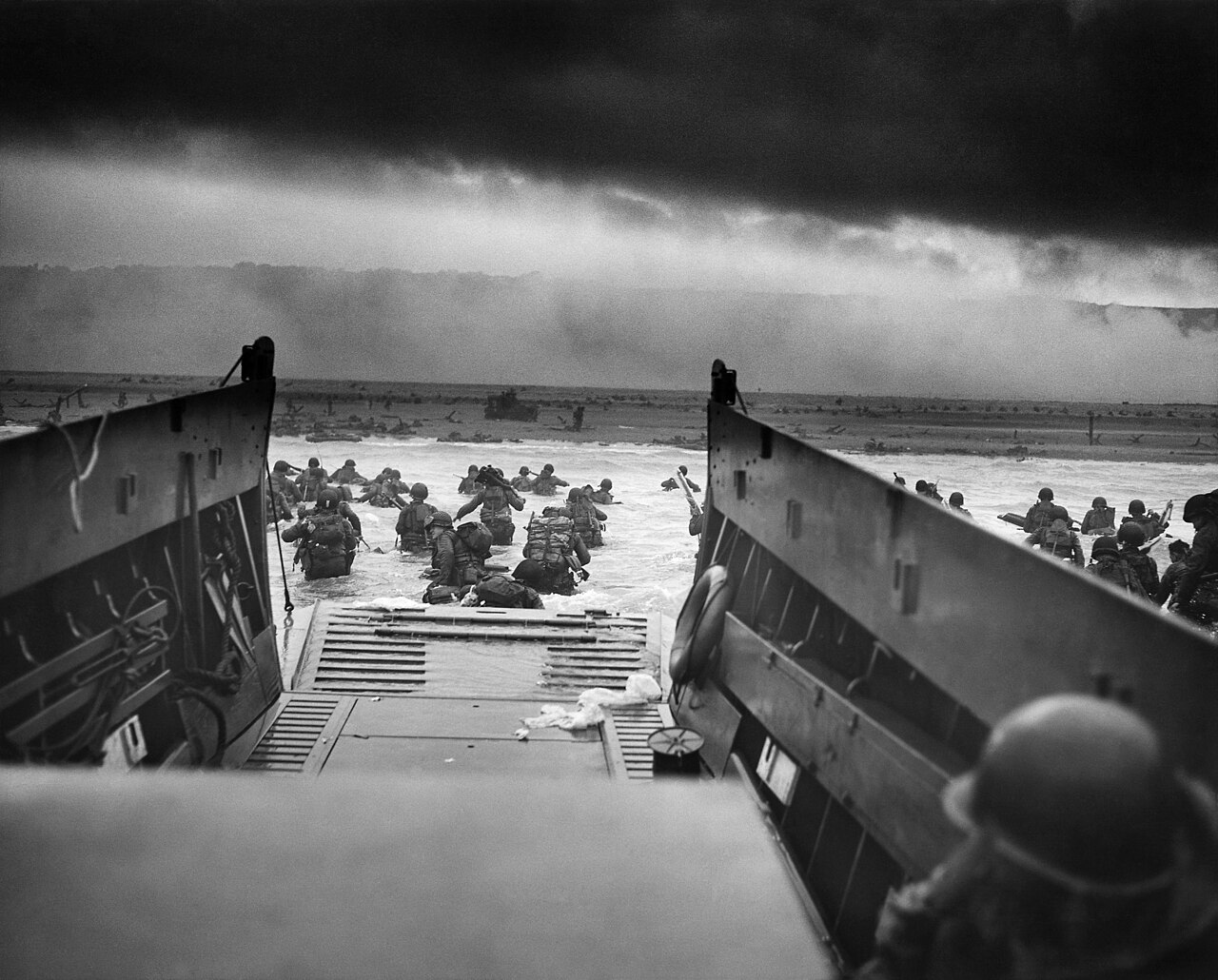
Operation Overlord began in the dark of 6 June 1944 with airborne drops and then five beach assaults: Utah and Omaha (US), Gold and Sword (British), Juno (Canadian). Eisenhower held supreme Allied command; Montgomery ran the ground battle. The Atlantic Wall did not stop the landing; it made Omaha famous.
The campaign that followed -- Caen, the bocage, Saint-Lo, Operation Cobra, the Falaise pocket -- lasted into August. Allied and German casualties in Normandy run into the hundreds of thousands; French civilian dead from bombing and fighting number in the tens of thousands in published studies. Paris was liberated on 25 August 1944.
In English-speaking memory D-Day outranks almost every other 1944 day, including the larger Soviet Operation Bagration. That imbalance is the memory story. For Korean War veterans, Overlord was the amphibious textbook their instructors still cited when Inchon was planned -- a lineage of staff colleges, not of beaches.
D-Day6 Jun 1944
BeachesUtah, Omaha, Gold, Juno, Sword
CommandEisenhower / Montgomery
BreakoutCobra, late Jul 1944
ParisLiberated 25 Aug 1944
CiviliansThousands of French dead in the campaign
Profile
Scale
52
Intensity
84
Duration
18
Tech shift
58
Political impact
78
Cultural memory
92
Pin a cost beat to a legacy beat
On this topic, pick one published cost band and one legacy lesson already on the page. Educational pairing — not a nation league.
Documented ranges and memory notes only. No ranking of countries, peoples, or armed forces as teams. Not operational advice.
Cost beat already published
Legacy beat already published
Cost or lesson
Theme reading only. Not a nation league.
Deep introduction
A coalition landing and a two-month inland war
Overlord was a shipping, deception and air-superiority problem that became a hedgerow war and then a breakout -- and then a pilgrimage industry.
Deception and shipping
Fortitude kept German eyes on Calais. Mulberry harbours and PLUTO were engineering as strategy. The Channel was the first enemy.
Air superiority over the beachhead was a prerequisite, not a bonus.
Six June
Airborne at Pegasus, Sainte-Mere-Eglise, and the flanks; Rangers at Pointe du Hoc; Canadian and British fights inland from Juno and Gold. Omaha's bluffs created the US icon.
Rommel was in Germany for his wife's birthday -- a famous absence, not a full explanation of German failure.
Bocage to Falaise
Caen took weeks, not a day. Cobra (25 July) broke the west. The Falaise-Argentan pocket (August) wrecked German Army Group B but did not catch everyone.
French villages paid for the liberation in rubble -- a cost English beach films often skip.
Memory beaches
The American cemetery at Colleville, the British at Bayeux, the Canadian at Beny-sur-Mer, and Caen's memorial are a four-nation ritual landscape. Saving Private Ryan (1998) recut Omaha for a generation that had not known veterans as young men.
Memory beaches stays dated: 1944-06-06 (D-Day) in Normandy, France -- five beaches and the bocage inland. Erwin Rommel (Army Group B) is a named witness -- Wanted the fight on the beaches; lost the argument and the campaign; later the 20 July shadow. Cost band: D-Day: thousands dead; Normandy campaign: about 200,000+ Allied and German casualties, plus French civilians. Encyclopedia, not a method.
D-Day is a 1944 hinge, an amphibious ancestor of Inchon, and a memory giant that can hide the Eastern Front.
See also
World War IIOverlord is a campaign of the Second World War, not a separate war.
Battle of InchonA later amphibious surprise; staffs cited Overlord's build-up problem, not its beaches copied.
Battle of Britain1940 air victory was a prerequisite for any later cross-Channel thought.
Battle of StalingradThe other 1942-43 turn English readers should keep beside 6 June.
Key terms
Overlord
The overall invasion of north-west Europe.
Neptune
The naval/landing slice on 6 June.
Atlantic Wall
German coastal fortifications -- uneven, famous, insufficient.
Mulberry
Artificial harbours towed to the coast.
Fortitude
Deception plan pinning Germans on Calais.
Cobra
US breakout operation, late July 1944.
Coalition beaches
Five national colours on one tide table. Canadians at Juno are still under-shown in some US films.
Montgomery versus Bradley is a command-memory war that outlived the bocage.
French civilians
Bomber Command and the USAAF wrecked towns to isolate the battlefield. Liberation was not free.
Caen's ruins are as much the campaign as Omaha's sand.
Staff-college afterlife
Inchon, later amphibious doctrine, and every "D-Day of X" headline -- a word that escaped 1944.
Keep Staff-college afterlife pinned to 1944-06-12 (Beaches linked): A continuous lodgement. Normandy landings remains a 6 June 1944 (landings); campaign to Aug 1944 file in Normandy, France -- five beaches and the bocage inland, not a playbook.
52scaleEditorial 0-100 browsing score
84intensityEditorial 0-100 browsing score
18durationEditorial 0-100 browsing score
58techShiftEditorial 0-100 browsing score
Normandy landings: concrete atlas depth on Tool-Lifes.
Frequently asked questions
Are the scores a ranking of nations or armies?
No. Scores are browsing aids inside an era-bounded atlas — not live league tables of countries.
How many died on 6 June?
Allied dead on D-Day are usually given in the thousands (often about 4,000+ killed, with wider casualty figures higher). German and French civilian deaths add more. Campaign totals are much larger.
Why Normandy, not Calais?
Calais was closer and more obvious -- hence Fortitude. Normandy offered space and a deception payoff.
What was Omaha?
The US beach under the highest bluffs, where the first waves took the worst punishment. It is not the whole of D-Day.
Who commanded?
Eisenhower (SHAEF), Montgomery (ground), Bradley (US First Army), Ramsay (navy), Leigh-Mallory (air) -- a coalition staff.
Did D-Day win the war?
It opened a Western Front that Germany could not resource beside the east. The war still had eleven months and a Soviet drive from the other side.
Is D-Day the same air war as the Battle of Britain?
No. D-Day is 6 June 1944 Overlord. Britain was 1940 daylight air defence. Related as prerequisite island, not the same battle. Never a nation league.
Why is it so famous in English?
It was "our" landing: US, UK, Canada. Film, cemeteries, and school trips did the rest. Bagration the same month was larger and less filmed in English.