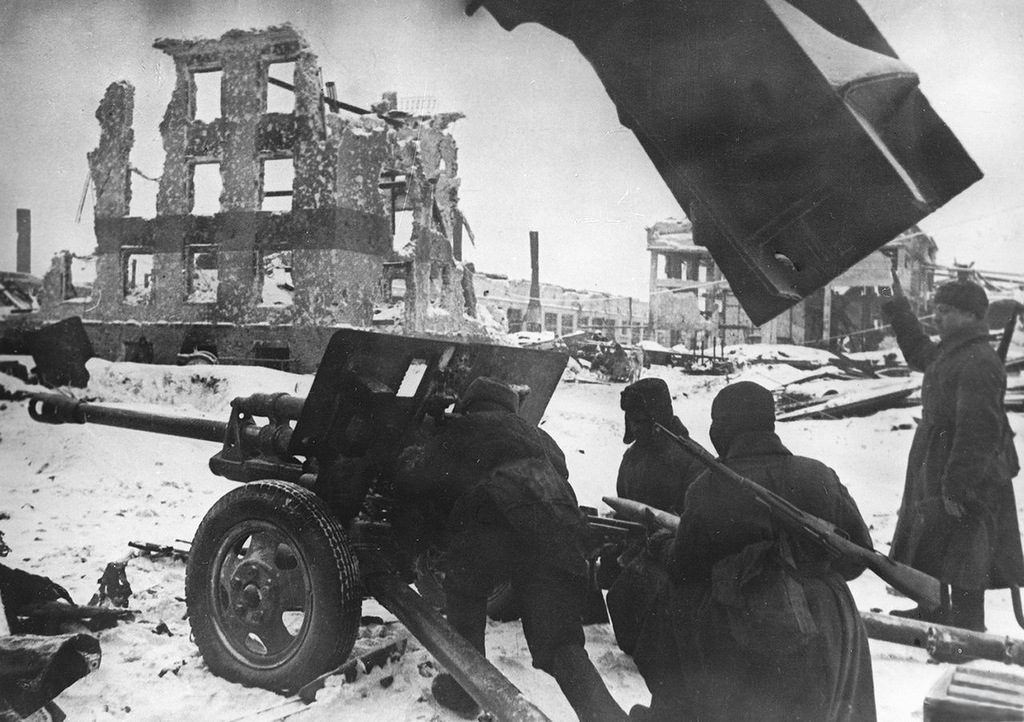
The Battle of Stalingrad ran from the German 6th Army's approach and the 23 August 1942 air raid to Field Marshal Paulus's surrender on 2 February 1943. Hitler had made the city that bore Stalin's name a political object; Stalin forbade retreat with Order No. 227 ("Not one step back").
Street fighting in the ruins, the factory district, and Mamayev Kurgan produced casualty totals in a band of about 1.7-2 million killed, wounded and captured on both sides -- among the costliest single battles ever recorded. The Soviet encirclement (Operation Uranus, 19 November 1942) trapped the 6th Army when the Romanian and Italian flanks collapsed.
Relief (Winter Storm) failed. The airlift could not supply a pocket. The surrender of a German field army on the Volga ended the myth of unbroken Wehrmacht success in the east and became the Soviet -- and later Russian -- patriotic hinge, taught in English as the Eastern Front's turning point beside Midway and El Alamein.
Span23 Aug 1942-2 Feb 1943
CityStalingrad / Volgograd
German 6th ArmySurrendered Feb 1943
OperationUranus (19 Nov 1942)
Casualtiesabout 1.7-2 million
SymbolEastern Front turn
Profile
Scale
48
Intensity
96
Duration
22
Tech shift
38
Political impact
72
Cultural memory
86
Pin a cost beat to a legacy beat
On this topic, pick one published cost band and one legacy lesson already on the page. Educational pairing — not a nation league.
Documented ranges and memory notes only. No ranking of countries, peoples, or armed forces as teams. Not operational advice.
Cost beat already published
Legacy beat already published
Cost or lesson
Theme reading only. Not a nation league.
Deep introduction
A city, a pocket, a political name
Stalingrad was a street war that became an encirclement, then a starvation, then a surrender -- and a memory industry on a hill.
Why the Volga
Case Blue (1942) aimed at oil and the Caucasus. The city on the river was a transport hinge and a name. Hitler and Stalin both refused to treat it as optional.
Chuikov's 62nd Army held rubble. Zhukov and Vasilevsky shaped the wider counterstroke.
Uranus
The 19 November attack hit the weaker allied armies on the flanks, not the German urban spearhead. Within days the pocket closed.
Manstein's relief from the south could not break in; the airlift undercounted calories and ammunition.
The pocket
Winter, disease, and Hitler's no-retreat order finished what Uranus began. Paulus, newly promoted to field marshal, surrendered rather than die by the implied script.
Soviet prisoners of the 6th Army died in huge numbers after the battle -- a cost often omitted in German memoir.
Memory hill
Mamayev Kurgan's monument complex is a Soviet cathedral of the war. English readers meet the battle through Beevor, German memoirs, and Enemy at the Gates -- a thin film beside a thick Russian ritual.
Memory hill stays dated: 1942-11-19 (Uranus) in Stalingrad (Volgograd) on the Volga, southern USSR. Aleksandr Vasilevsky (Stavka) is a named witness -- The other brain of the encirclement -- less photographed than Zhukov, as important on the files. Cost band: about 1.7-2 million casualties, scholarly range (killed, wounded, captured). Encyclopedia, not a method.
The Volga pocket sits beside Kursk, Midway and the wider Second World War in this atlas.
See also
World War IIThe battle is a hinge of the European war, not a separate war.
Battle of KurskThe 1943 sequel: Germany's last strategic offensive in the east.
Normandy landingsThe 1944 western opening that English memory sometimes treats as the only turn -- Stalingrad is the corrective.
United States militaryLend-Lease trucks and food in the Soviet rear are the US industrial footnote, not a US battle.
Key terms
Case Blue
1942 German summer offensive toward the Don, Volga and Caucasus.
Order 227
Stalin's July 1942 "not one step back" discipline order.
Uranus
19 November 1942 Soviet encirclement operation.
Winter Storm
Manstein's failed December relief.
6th Army
Paulus's formation that died in the pocket.
Mamayev Kurgan
The hill and later monument complex.
Name as strategy
Hitler and Stalin both made a word -- Stalingrad -- into a military object. That is politics, not operational necessity alone.
Renaming the city Volgograd (1961) did not rename the battle in world memory.
Allied flanks
Romanian, Italian and Hungarian armies paid for German overstretch -- a coalition fact German memoirs long minimised.
The pocket was a German decision about who held the urban ruins.
After the cameras
German POWs' death march into camps is part of the ledger. So is the city's civilian remnant under bombing.
English film prefers snipers; the archives prefer hunger.
48scaleEditorial 0-100 browsing score
96intensityEditorial 0-100 browsing score
22durationEditorial 0-100 browsing score
38techShiftEditorial 0-100 browsing score
Battle of Stalingrad: concrete atlas depth on Tool-Lifes.
Frequently asked questions
Are the scores a ranking of nations or armies?
No. Scores are browsing aids inside an era-bounded atlas — not live league tables of countries.
How many casualties?
About 1.7-2 million killed, wounded and captured on both sides is a common published band. Precise killed-only figures vary by method.
Why did Germany lose the 6th Army?
Overextended flanks, a successful Soviet encirclement, a failed relief, an inadequate airlift, and a political no-retreat order.
Was it the turning point of the world war?
It was the Eastern Front's great turn. Midway, Alamein and later Kursk and Overlord are other turns. Serious histories keep several hinges.
Who commanded?
Paulus (6th Army); Chuikov (62nd Army) in the city; Zhukov and Vasilevsky at the Stavka level; Manstein on the relief attempt; Hitler and Stalin as political commanders.
What was Uranus?
A double envelopment of the German urban force by attacking the weaker armies on the Don flanks.
How is it remembered in Russia?
As a sacred victory: 2 February, Mamaev Kurgan, and a city that kept the battle's name in speech after it lost it on maps.
Is this a guide to urban combat?
No. It is a historical account of a named battle. It does not teach city fighting.