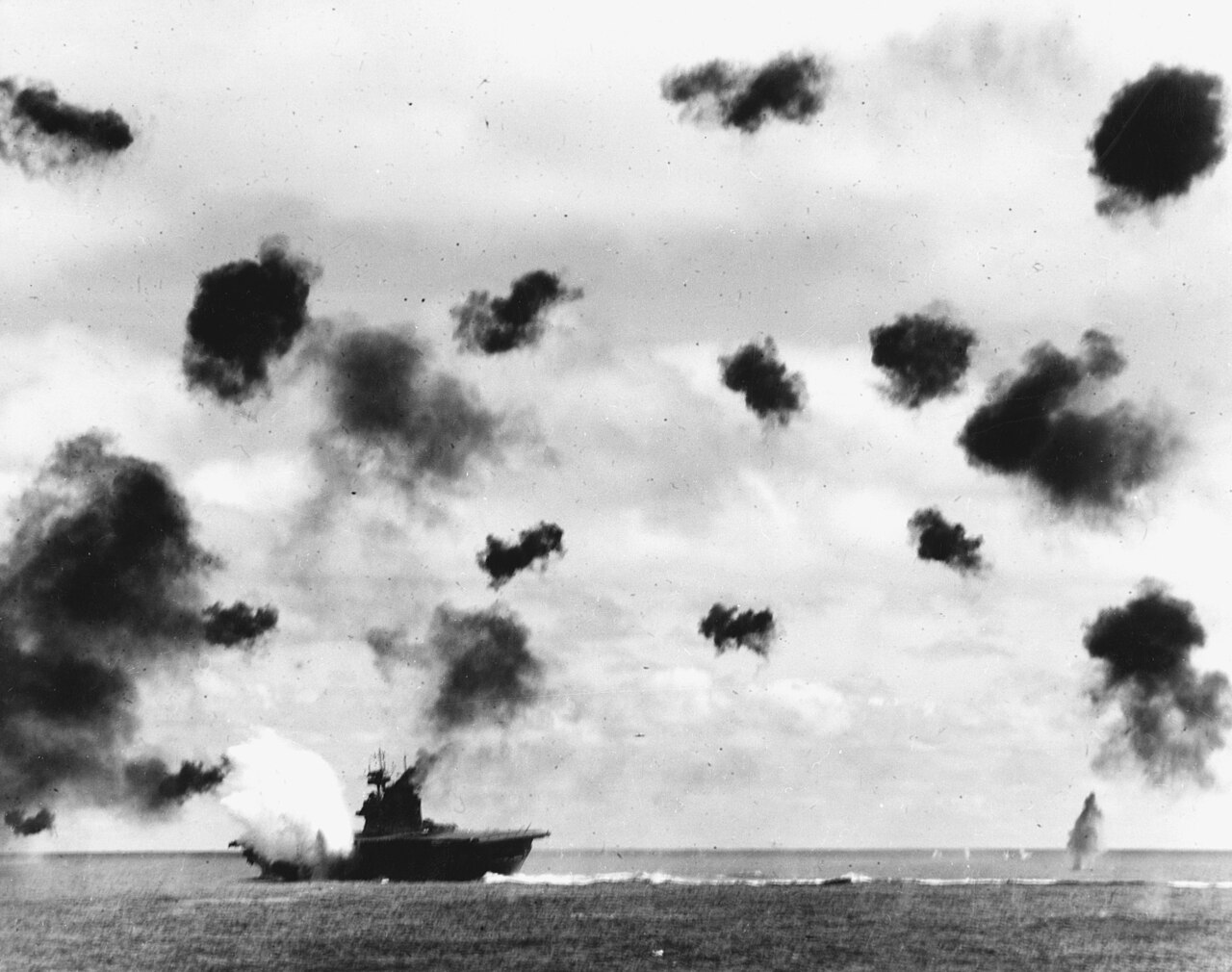
The Battle of Midway (4-7 June 1942) was a carrier duel in the central Pacific, six months after Pearl Harbor. Admiral Yamamoto sought to draw out and destroy the US Pacific Fleet by seizing Midway Atoll. Station HYPO in Hawaii had broken enough of the JN-25 system to know the objective -- the famous "AF" water-trap.
On 4 June, US dive bombers from Enterprise and Yorktown caught Japanese carriers with armed aircraft on deck. Akagi, Kaga, Soryu and, later, Hiryu were lost. Yorktown was crippled and sunk on 7 June. Japanese dead are usually given around 3,000; US dead a few hundred -- a lopsided butcher's bill for a few hours of dive-bombing.
Midway did not end the Pacific war; Guadalcanal and 1944 still lay ahead. It ended Japan's run of carrier initiative. English-language memory -- helped by the 1976 and 2019 films -- treats it as the Pacific's Stalingrad: a turn, not a finish. Korean readers should pair it with Tsushima (1905): two decisive naval days that recast who could project power in these waters.
Dates4-7 Jun 1942
US carriersEnterprise, Hornet, Yorktown
Japanese loss4 fleet carriers sunk
CodebreakingStation HYPO / AF
US deadabout 300+
Japanese deadabout 3,000
Profile
Scale
28
Intensity
70
Duration
8
Tech shift
72
Political impact
68
Cultural memory
74
Pin a cost beat to a legacy beat
On this topic, pick one published cost band and one legacy lesson already on the page. Educational pairing — not a nation league.
Documented ranges and memory notes only. No ranking of countries, peoples, or armed forces as teams. Not operational advice.
Cost beat already published
Legacy beat already published
Cost or lesson
Theme reading only. Not a nation league.
Deep introduction
Code, carriers, and a morning in June
Midway was an intelligence success that still had to be converted by dive bombers -- and by luck of timing that historians still argue about.
After Coral Sea
May 1942 left Yorktown damaged and Japan short of a clean win. Yamamoto planned a complex operation with feints at the Aleutians. Complexity was itself a risk.
Nimitz, advised by Rochefort's HYPO, concentrated three carriers northeast of Midway.
The morning
Nagumo's rearming cycle -- land bombs versus torpedoes after the Midway strike -- is the operational hinge in most English accounts. US torpedo squadrons were slaughtered; their sacrifice pulled Japanese air cover down.
McClusky's Enterprise dive bombers and Leslie's Yorktown group found the carriers in a brief, decisive window.
Hiryu and Yorktown
Hiryu's counterstrike fatally wounded Yorktown. US aircraft then found Hiryu. The Japanese surface fleet never got its night battle.
Airmen and sailors, not battleships, had decided a fleet action -- a doctrinal shock for both navies' older officers.
After the turn
Japan could still win local fights; it could not replace those four air groups quickly. The US could replace Yorktown and more. That industrial sentence is the rest of the Pacific war in miniature.
After the turn stays dated: 1942-06-04-am (Midway strike) in Midway Atoll, central Pacific. Raymond A. Spruance (TF 16) is a named witness -- Took the fight when Halsey was ill; later the cautious-or-wise debate of US naval memory. Cost band: about 3,000 Japanese and about 300+ US dead, usual published band. Encyclopedia, not a method.
A 1942 Pacific hinge that belongs beside Tsushima, the wider Second World War, and later carrier history.
See also
World War IIMidway is a Pacific campaign of the world war.
Battle of TsushimaThe other decisive naval day in this atlas -- 1905, different weapons, same regional question of who commands the sea.
Aircraft carrierMidway is the type-battle of the carrier age in English memory.
Battle of BritainThe other 1940s air-defence-plus-intelligence victory in Anglophone myth -- different domain, similar "few" rhetoric.
Key terms
JN-25 / AF
The broken code and the Midway water-trap that confirmed the target.
Kido Butai
Nagumo's carrier striking force -- four fleet carriers at Midway.
Dive bomber
The aircraft type that decided 4 June -- named, not instructed.
Yorktown repair
Pearl Harbor's 72-hour patch that put a third US carrier in the fight.
Aleutian feint
A simultaneous northern operation that split Japanese attention.
Air group
The irreplaceable trained men Japan lost with the ships.
Intelligence as a force
HYPO did not sink carriers; it put three US decks in the right ocean square. That distinction matters.
The "AF" story is true enough to teach and tidy enough to mythologise -- keep both sentences.
Timing luck
Historians still argue how much Nagumo's rearming, cloud, and McClusky's search path were skill versus chance.
A serious account keeps the argument open.
Industry after the day
Japan lost irreplaceable air groups. The US launched more decks. Midway's meaning is partly a shipyard story.
Keep Industry after the day pinned to 1942-06-04 (Dive bombers hit): Three carriers fatally struck in minutes. Battle of Midway remains a 4-7 June 1942 file in Midway Atoll, central Pacific, not a playbook.
28scaleEditorial 0-100 browsing score
70intensityEditorial 0-100 browsing score
8durationEditorial 0-100 browsing score
72techShiftEditorial 0-100 browsing score
Battle of Midway: concrete atlas depth on Tool-Lifes.
Frequently asked questions
Are the scores a ranking of nations or armies?
No. Scores are browsing aids inside an era-bounded atlas — not live league tables of countries.
How many died?
About 3,000 Japanese and a few hundred Americans is the usual published band. The lopsidedness is the point -- and still a band.
Did codebreaking win the battle?
It placed the US fleet. Dive bombers and Japanese timing errors still had to convert the placement. Both are true.
What did Japan lose?
Four fleet carriers and most of their air groups -- the offensive core of the Pearl Harbor force.
Did it end the Pacific war?
No. Guadalcanal began in August 1942. Japan remained dangerous for years.
Who commanded?
Nimitz (Pacific Fleet), Fletcher and Spruance at sea; Yamamoto and Nagumo on the Japanese side; Rochefort at HYPO.
How does it compare to Tsushima?
Both were short, decisive fleet actions that recast regional naval hierarchy. Weapons, states, and morals differ. Comparison is about decision-at-sea, not about copying Togo or Spruance.