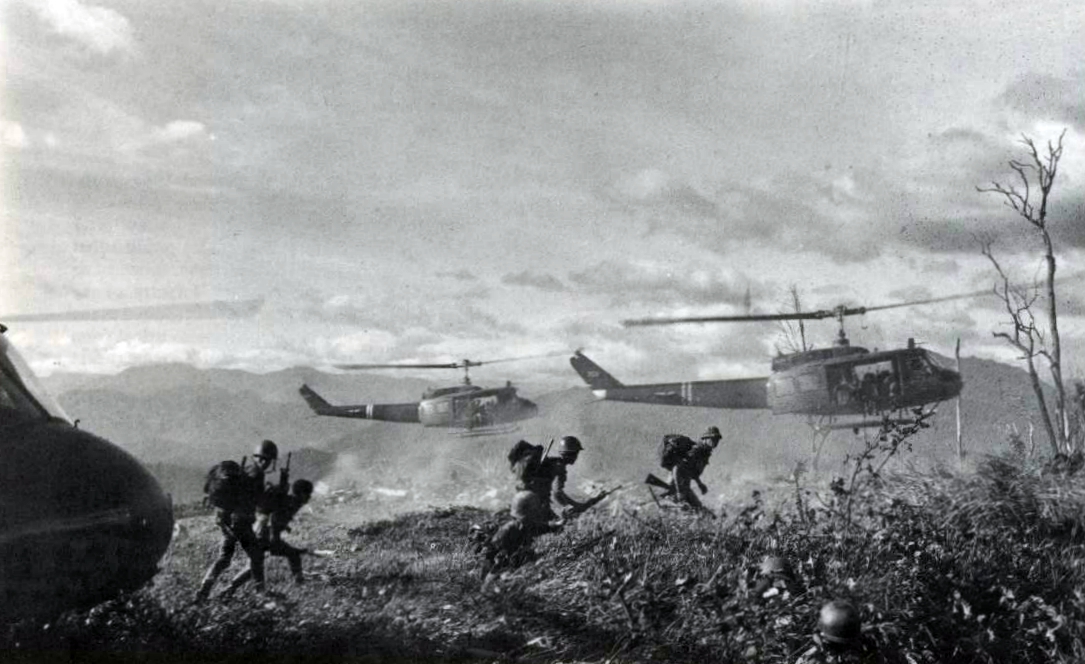
The Vietnam War, or Second Indochina War, grew out of the First Indochina War (1946-54) and the 1954 Geneva partition at the 17th parallel. Ngo Dinh Diem's Republic of Vietnam in the south and Ho Chi Minh's Democratic Republic in the north never held the promised nationwide elections. By the late 1950s an insurgency -- the National Liberation Front -- was fighting the southern state with northern support.
The United States moved from advisers to a bombing campaign (Rolling Thunder, 1965) and a peak of more than 500,000 troops. The Tet Offensive (January 1968) failed militarily for the NLF/PAVN and succeeded politically in the US. Vietnamization, the 1970-71 Cambodian and Laotian campaigns, and the 1973 Paris Accords preceded the final northern offensive. Saigon fell on 30 April 1975.
Scholarly estimates of Vietnamese dead run from about 1.3 to 3.8 million, including civilians; US military deaths are about 58,000, with Australian, South Korean, Thai and other allied dead in the thousands. Agent Orange, unexploded ordnance and a refugee diaspora are part of the bill. In English-speaking countries this war -- not Korea -- became the template for arguing about intervention, media and veterans' welcome.
Span1955-1975 (core)
US combat troops1965-1973
Vietnamese deathsabout 1.3-3.8 million
US deathsabout 58,000
Paris Accords27 Jan 1973
Saigon falls30 Apr 1975
Profile
Scale
58
Intensity
72
Duration
68
Tech shift
60
Political impact
74
Cultural memory
82
Pin a cost beat to a legacy beat
On this topic, pick one published cost band and one legacy lesson already on the page. Educational pairing — not a nation league.
Documented ranges and memory notes only. No ranking of countries, peoples, or armed forces as teams. Not operational advice.
Cost beat already published
Legacy beat already published
Cost or lesson
Theme reading only. Not a nation league.
Deep introduction
Decolonisation, partition and a televised intervention
Vietnam was a Vietnamese civil and revolutionary war that the US, China and the USSR internationalised -- and that Laos and Cambodia paid for as sideshows that were not sideshows.
From Dien Bien Phu to two Vietnams
The 1954 French defeat at Dien Bien Phu and the Geneva Accords created a "temporary" partition. Diem, with US backing, refused elections that Ho was expected to win. Nation-building in the south was a police and landlord war as much as a development project.
The Ho Chi Minh trail through Laos and Cambodia was a logistics system, not a metaphor. Hanoi's decision for armed reunification was made in stages, not in a single 1959 telegram.
Americanisation
After the 1964 Gulf of Tonkin incident and resolution, Johnson chose open bombing and ground combat in 1965 rather than withdrawal or a wider war with China. Search-and-destroy, free-fire zones, and the CORDS pacification effort were parallel theories of the same war.
ROK, Australian, New Zealand, Thai and Philippine forces fought as allies. Their stories are thinner in US film than in their own memorials -- especially the large ROK expeditionary corps.
Tet to Paris
Tet 1968 attacked cities, including the US embassy compound in Saigon. Militarily the offensive was destroyed; on US television it ended the promise of a short war. Johnson declined to run again. Nixon's Vietnamization and secret bombing of Cambodia widened the regional map.
The 27 January 1973 accords withdrew US combat forces and left two Vietnamese armies in place. That was a pause, not a settlement.
1975 and after
The northern spring offensive of 1975 collapsed the ARVN in weeks. Reunification, re-education camps, the boat-people exodus, and wars with the Khmer Rouge and China (1979) were the aftershocks.
In the US, the Wall (1982) recast veterans' memory. In Vietnam the war is the American War -- one chapter of a longer independence struggle.
Fighter jetAir power from Rolling Thunder to Linebacker II is a central, contested tool of this war.
Military drone (UCAV)Later remotely piloted aircraft were sold in part as a way not to "do another Vietnam" with conscripts -- a political claim, not a technical manual.
Key terms
17th parallel
Geneva 1954 partition line; a political fiction that became a front.
NLF / Viet Cong
Southern insurgent front allied with Hanoi -- the name "Viet Cong" is a southern/US label.
Rolling Thunder
1965-68 bombing campaign against the north; historically described, not instructed.
Vietnamization
Nixon policy of transferring combat to ARVN while withdrawing US troops.
Ho Chi Minh trail
Logistic corridor through Laos and Cambodia supplying the southern war.
Paris Accords
27 January 1973 agreement that ended US combat without ending the Vietnamese war.
Vietnamese politics
Land, Catholicism, Buddhism, and the northern party-state matter more than any US doctrine pamphlet. Diem's 1963 fall and the revolving generals were a southern political crisis, not only a US management failure.
The war killed more Vietnamese than foreigners; any account that starts with helicopters has started in the wrong country.
Media and legitimacy
Nightly US television, the Pentagon Papers (1971), and the draft made this the first US war lost in living rooms as well as in the Central Highlands.
Censorship was lighter than in 1943; that fact became part of later "lessons" -- some of them myths about media "losing" the war.
Regional wreckage
Cambodia's slide toward the Khmer Rouge and Laos's bombing density are not footnotes. The 1979 Sino-Vietnamese war showed that "communist" was not a single camp.
Unexploded ordnance still kills in the three states.
58scaleEditorial 0-100 browsing score
72intensityEditorial 0-100 browsing score
68durationEditorial 0-100 browsing score
60techShiftEditorial 0-100 browsing score
Vietnam War: concrete atlas depth on Tool-Lifes.
Frequently asked questions
Are the scores a ranking of nations or armies?
No. Scores are browsing aids inside an era-bounded atlas — not live league tables of countries.
How many died?
Vietnamese deaths are estimated in a wide band, about 1.3-3.8 million, including civilians. US military deaths are about 58,220. Australian deaths are 521. ROK deaths are about 5,000. Figures for Laos and Cambodia add more.
Why did the US fight?
Containment, the domino metaphor, alliance credibility, and domestic politics. The Gulf of Tonkin Resolution (1964) was the legal hinge. Historians disagree on when -- if ever -- a cheaper political settlement was available.
What was Tet?
A coordinated January 1968 offensive against southern cities. Communist forces took heavy losses; US and ARVN held the towns. US public support cracked because official optimism had been so high.
Did the US lose on the battlefield?
US and ARVN forces won most set-piece fights and still failed to secure a southern state that could survive without them. That is a political-military defeat, not a simple scoreboard of firefights.
What were the Paris Accords?
A January 1973 ceasefire and US withdrawal deal that left northern troops in the south. Congress later cut aid. In 1975 the south collapsed.
Is Vietnam a smaller WWII on this atlas?
No. Different theme family. Use WWII vs Vietnam VS for axes — never rank nations as teams.
What is Agent Orange in this history?
A US herbicidal programme whose health and ecological effects remain a diplomatic and medical afterlife -- recorded here as consequence, not as a method to copy.