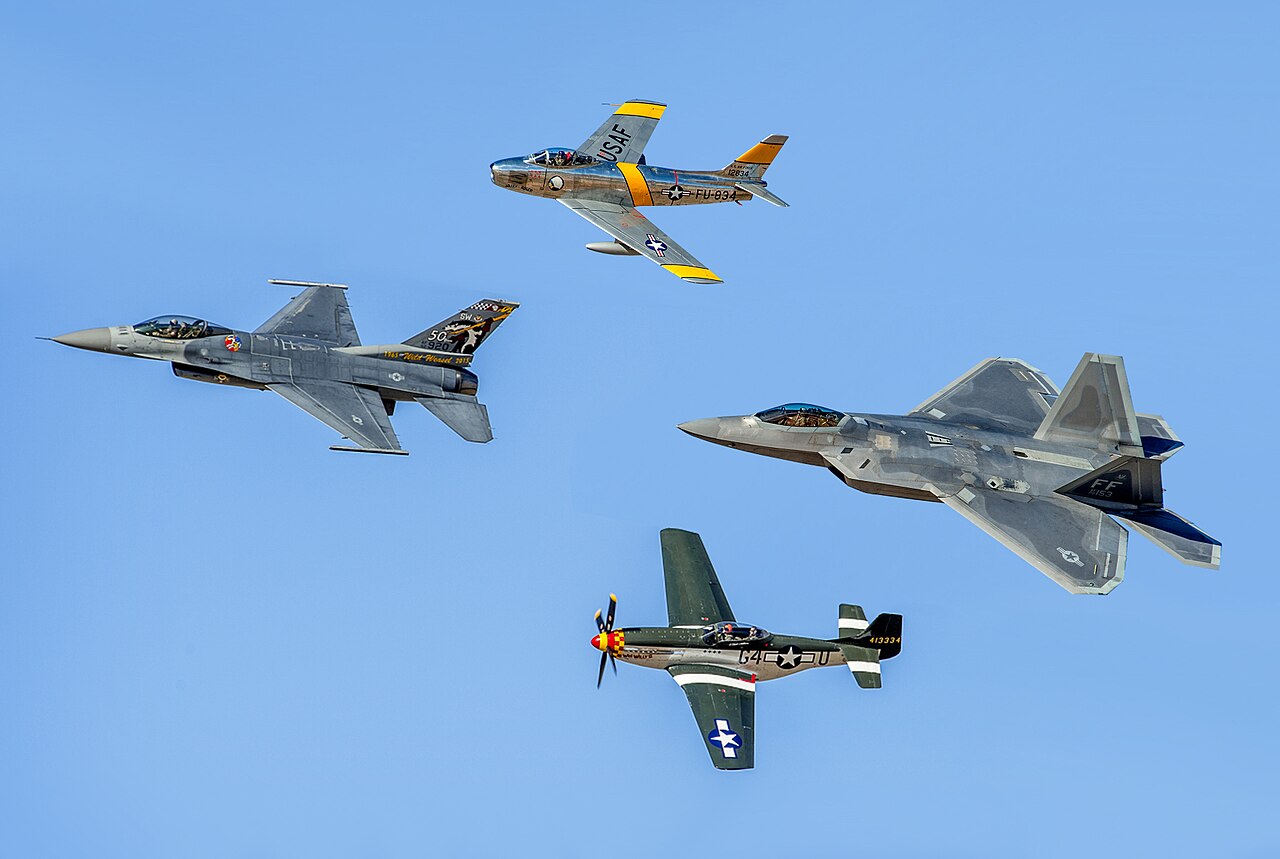
Fighter aircraft began as gun-armed scouts in 1915-18. The jet fighter arrived in combat in 1944 with the Messerschmitt Me 262 -- late, few, and unable to change 1945. The Gloster Meteor and then a flood of 1950s types (F-86, MiG-15) made the Korean War the first large jet-versus-jet campaign, in the northwest "MiG Alley."
Generations (a later marketing-and-staff word) run from those first jets through Mach-2 types (MiG-21, F-4), agile 1970s designs, and low-observable types. This page names that history. It does not teach how to fly, fight, or build a jet. Export politics -- who may buy which type -- is as important as wing shape.
English memory is Top Gun, the Battle of Britain's propeller Few retroactively jet-washed, and museum rows at Duxford. Korean memory is MiG Alley, the F-86, and a long climb toward KF-21 as industry. TechShift in this atlas is among the highest of the weapon types.
First jets in fightMe 262, 1944
KoreaMiG Alley, 1950-53
Century seriesUS 1950s types
Delta / MiG-21A world export silhouette
Stealth eraLate Cold War onward -- historically
ROKF-86 then F-4/F-16/KF-21 path
Profile
Scale
48
Intensity
50
Duration
72
Tech shift
88
Political impact
52
Cultural memory
68
Pin a cost beat to a legacy beat
On this topic, pick one published cost band and one legacy lesson already on the page. Educational pairing — not a nation league.
Documented ranges and memory notes only. No ranking of countries, peoples, or armed forces as teams. Not operational advice.
Cost beat already published
Legacy beat already published
Cost or lesson
Theme reading only. Not a nation league.
Deep introduction
From a late German jet to an export politics
The fighter jet is a training-and-industry system that happens to have wings -- told as history.
1944-53
Me 262 and Meteor as footnotes to 1945; MiG-15 vs F-86 as the first mass jet fight. Soviet pilots in Korea are part of the record.
Sabre aces and MiG Alley maps are memory; the Yalu was a political border as much as a flight line.
1954-75
Century Series, MiG-21, and Vietnam's painful US relearning of guns and training (Topgun as a school, historically named).
Export MiG-21s became a Third World silhouette.
1976-91
F-15, F-16, MiG-29, Su-27 -- the late Cold War pair. Israel's 1982 Bekaa is a named air-war date in staff talk -- history, not a playbook.
ROK F-4/F-16 purchases are alliance-industrial facts.
After 1991
Stealth types and the KF-X/KF-21 Korean project as an industrial-national story. Drones recast some missions -- see the drone page. No current tactics here.
After 1991 stays dated: 1965-73 (Vietnam air war) in From Me 262 skies to MiG Alley to later air forces. James Jabara (US ace (Korea)) is a named witness -- The first US jet ace in popular telling -- a MiG Alley name. Cost band: not a war -- aircrew and civilian deaths sit on the war pages that used the type. Encyclopedia, not a method.
A type born late in 1944, proven as a mass fight in Korea, and industrialised in every alliance.
See also
Korean WarMiG Alley is the type's first mass combat.
Battle of BritainThe propeller political ancestor in English myth -- different machine, similar "home sky" politics.
Military drone (UCAV)A later remotely piloted cousin that recast some fighter missions -- historically.
Lockheed MartinF-16/F-35 industrial politics as a cousin page.
Key terms
Me 262
First operational jet fighter, 1944 -- too few, too late.
MiG Alley
Northwestern Korea, 1950-53 jet fights.
Generation (fighter)
A later classification habit -- useful and marketing-soaked.
BVR
Beyond-visual-range missiles as a historical shift -- named, not instructed.
Topgun
US Navy fighter school after Vietnam -- an institution, not a film.
KF-21
ROK indigenous fighter project -- industrial history.
Training is the type
Vietnam showed that a fast jet without a school is a slogan. Named historically.
Pilot hours are a national industrial product.
Export as strategy
Who gets the type is a treaty. Offsets and local assembly (ROK included) are the politics.
This is not a catalogue for buyers.
Korea first
The first large jet-vs-jet war was over the Yalu approaches -- a Korean-atlas fact English Battle-of-Britain talk should not hide.
Keep Korea first pinned to 1976-86 (F-15/F-16 / Su-27): Late Cold War types. Fighter jet remains a 1944-present (jets; fighters from 1915) file in From Me 262 skies to MiG Alley to later air forces, not a playbook.
48scaleEditorial 0-100 browsing score
50intensityEditorial 0-100 browsing score
72durationEditorial 0-100 browsing score
88techShiftEditorial 0-100 browsing score
Fighter jet: concrete atlas depth on Tool-Lifes.
Frequently asked questions
Are the scores a ranking of nations or armies?
No. Scores are browsing aids inside an era-bounded atlas — not live league tables of countries.
What was MiG Alley?
The airspace over northwestern North Korea where MiG-15s and UN jets (especially F-86s) fought. Soviet pilots flew in significant numbers under thin cover.
What does "fourth generation" mean?
A later staff-and-industry label for 1970s-80s types (F-15, F-16, MiG-29). It is a convenience, not a law of physics.
Did Top Gun invent modern fighter training?
The film invented a brand. The Navy Fighter Weapons School was a post-Vietnam institutional reply -- historically named, not a syllabus here.
How does the ROK fit?
F-86 in the war's later years and after; then F-4, F-16, F-15K, and the KF-21 project. See ROK military and Hanwha/KAI industrial stories.
Are fighters obsolete because of drones?
Some missions moved. History does not yet show a simple funeral. See the military-drone page. No current umpire ruling here.
Why so high on techShift?
From piston to jet to missiles to low-observable types in one human lifetime -- a steep curve relative to this atlas.