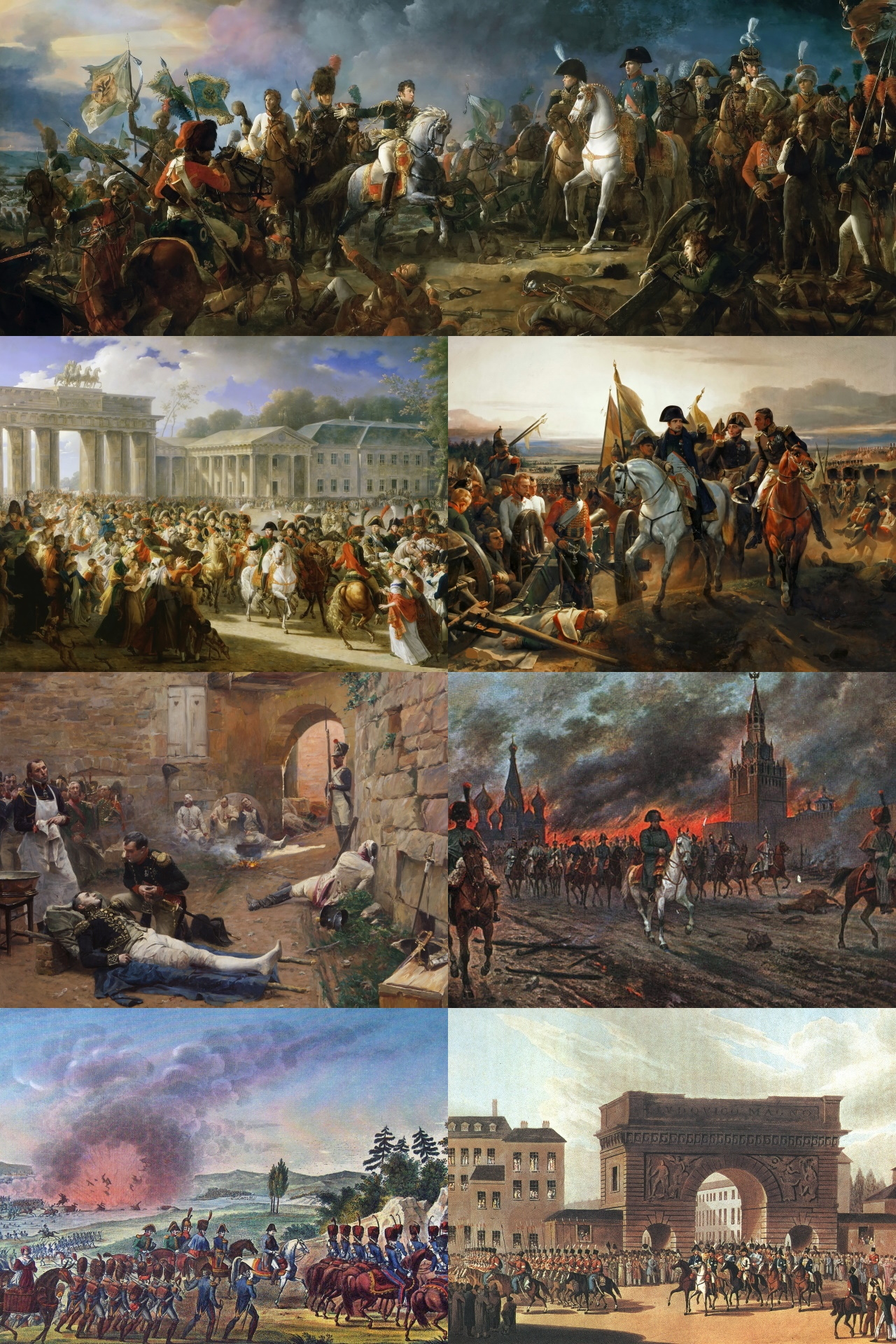
The Napoleonic Wars (usually dated 1803-1815) continued the French Revolutionary Wars that began in 1792. After the brief Peace of Amiens, Britain and France returned to war; seven coalitions formed and broke around Napoleon's France. Austerlitz (1805) wrecked the Third Coalition; Jena (1806) smashed Prussia; the 1808-14 Peninsular War bled France in Spain and Portugal.
The 1812 invasion of Russia destroyed the Grande Armee through battle, weather and distance. Leipzig (16-19 October 1813), the "Battle of the Nations," forced Napoleon back to France. He abdicated in 1814, returned from Elba in the Hundred Days, and lost at Waterloo on 18 June 1815 to Wellington and Blucher.
Deaths are estimated at about 3.5-6 million, including civilians and the Caribbean and Egyptian sideshows. The Congress of Vienna (1814-15) restored a conservative order that still had to live with the Code Napoleon, conscription, and British naval supremacy. English memory centres Trafalgar and Waterloo; French and German memories centre other dates.
Core span1803-1815
Deathsabout 3.5-6 million
Austerlitz2 Dec 1805
Russia invasion1812
Leipzig16-19 Oct 1813
Waterloo18 Jun 1815
Profile
Scale
70
Intensity
68
Duration
55
Tech shift
48
Political impact
78
Cultural memory
75
Pin a cost beat to a legacy beat
On this topic, pick one published cost band and one legacy lesson already on the page. Educational pairing — not a nation league.
Documented ranges and memory notes only. No ranking of countries, peoples, or armed forces as teams. Not operational advice.
Cost beat already published
Legacy beat already published
Cost or lesson
Theme reading only. Not a nation league.
Deep introduction
Coalitions, conscription and a European settlement
Napoleon did not invent coalition war, but he forced Europe to invent mass armies and a diplomatic congress system to contain France.
From revolution to empire
Valmy (1792) and the levee en masse created a new French war machine. Napoleon's 1796-97 Italian campaign and the 1798-1801 Egyptian expedition made him first a general, then a political necessity. The 18 Brumaire coup (1799) and the 1804 imperial coronation changed the regime without ending the war with Britain.
Amiens (1802) was a pause. Malta, trade, and mutual distrust reopened the war in 1803.
The grand victories
Ulm and Austerlitz (1805), Jena-Auerstedt (1806), and Friedland (1807) made Napoleon master of the German lands and imposed Tilsit on Russia. The Continental System tried to blockade Britain by land -- an economic war that created smugglers and enemies.
Spain from 1808 was different: a popular war, a British army under Wellington, and a drain Napoleon never sealed.
Overreach
The 1812 Russian campaign -- Borodino, Moscow, the retreat -- is the operational catastrophe. 1813 in Germany became a war of nations; Sweden, Prussia, Austria and Russia coordinated better than in 1805.
The 1814 campaign in France showed Napoleon's remaining skill and his remaining shortage of men and horses.
Vienna and St Helena
The Congress of Vienna redrew Germany and Italy, restored Bourbons, and created a concert that managed crises until the Crimean War. Napoleon died on St Helena in 1821.
The legend (bulletins, paintings, the Invalides tomb) became a political resource for later French regimes -- and a British national story about sea power and the square at Waterloo.
Waterloo closes the era; the Royal Navy paid for Britain's part; later total wars inherited conscription more than musket drill.
See also
Battle of WaterlooThe 18 June 1815 battle that ended the Hundred Days and the imperial project.
Royal NavyTrafalgar and blockade were Britain's decisive contribution -- sea power as grand strategy.
World War IMass conscription and coalition diplomacy are Napoleonic inheritances taught in later staff colleges.
American Civil WarA later industrial civil war; comparison is about mass armies, not about Napoleonic tactics copied wholesale.
Key terms
Levee en masse
1793 French mass conscription -- the demographic basis of later Napoleonic armies.
Continental System
Napoleon's blockade of British trade, imposed on Europe, widely evaded.
Grande Armee
The multinational field army of the imperial peak, destroyed as a tool in 1812.
Peninsular War
1808-14 in Spain and Portugal -- Wellington's war and a Spanish popular war.
Hundred Days
Napoleon's 1815 return from Elba to Waterloo.
Concert of Europe
Post-1815 great-power management system associated with Metternich and Castlereagh.
Law and occupation
The Civil Code, metric measures, and the abolition of some feudal residues travelled with French armies. Occupation also meant conscripts and taxes -- the dual export.
German and Italian later unifications used both the administrative modernisation and the nationalist backlash Napoleon created.
Sea versus land
Britain could not beat Napoleon in 1805-07 on the Elbe; Napoleon could not beat Britain at sea after Trafalgar. The war was a stalemate of elements until 1812 broke the land empire.
Privateers, colonial seizures, and the Haitian Revolution (independence 1804) were Atlantic chapters, not extras.
Memory wars
Bonapartist legend versus British "Corsican ogre" cartoons still structure museum labels. Russian 1812 is a patriotic epic of its own (Tolstoy, Tchaikovsky).
Waterloo tourism is a Belgian industry with three national stories on one ridge.
70scaleEditorial 0-100 browsing score
68intensityEditorial 0-100 browsing score
55durationEditorial 0-100 browsing score
48techShiftEditorial 0-100 browsing score
Napoleonic Wars: concrete atlas depth on Tool-Lifes.
Frequently asked questions
Are the scores a ranking of nations or armies?
No. Scores are browsing aids inside an era-bounded atlas — not live league tables of countries.
How many died?
About 3.5-6 million is a working scholarly band, including combatants and civilians, with wide uncertainty for 1812 and for disease.
Was Napoleon a revolutionary or a monarch?
Both: he locked in some revolutionary legal gains, restored hierarchy, and crowned himself. The wars spread both the Code and reaction.
Why did Britain stay at war so long?
Trade, naval security, and a refusal to accept a French hegemony on the Scheldt and in the Channel. Subsidies to allies were Britain's land strategy as much as Wellington's army.
What was the Continental System?
A ban on British goods in French-controlled Europe. It hurt neutrals and allies, encouraged Russia's break, and never starved Britain into peace.
How did 1812 matter?
The Russian campaign destroyed the Grande Armee as a political instrument. Without it, Leipzig and 1814 are hard to imagine at that speed.
What did Vienna settle?
Borders, a German confederation, restored dynasties, and a habit of congress diplomacy. It did not restore 1789's social world.
Why is Waterloo so famous in English?
It was the last battle, fought with a British-led allied army, within reach of London newspapers. Leipzig was larger; Trafalgar was more strategically decisive for Britain.