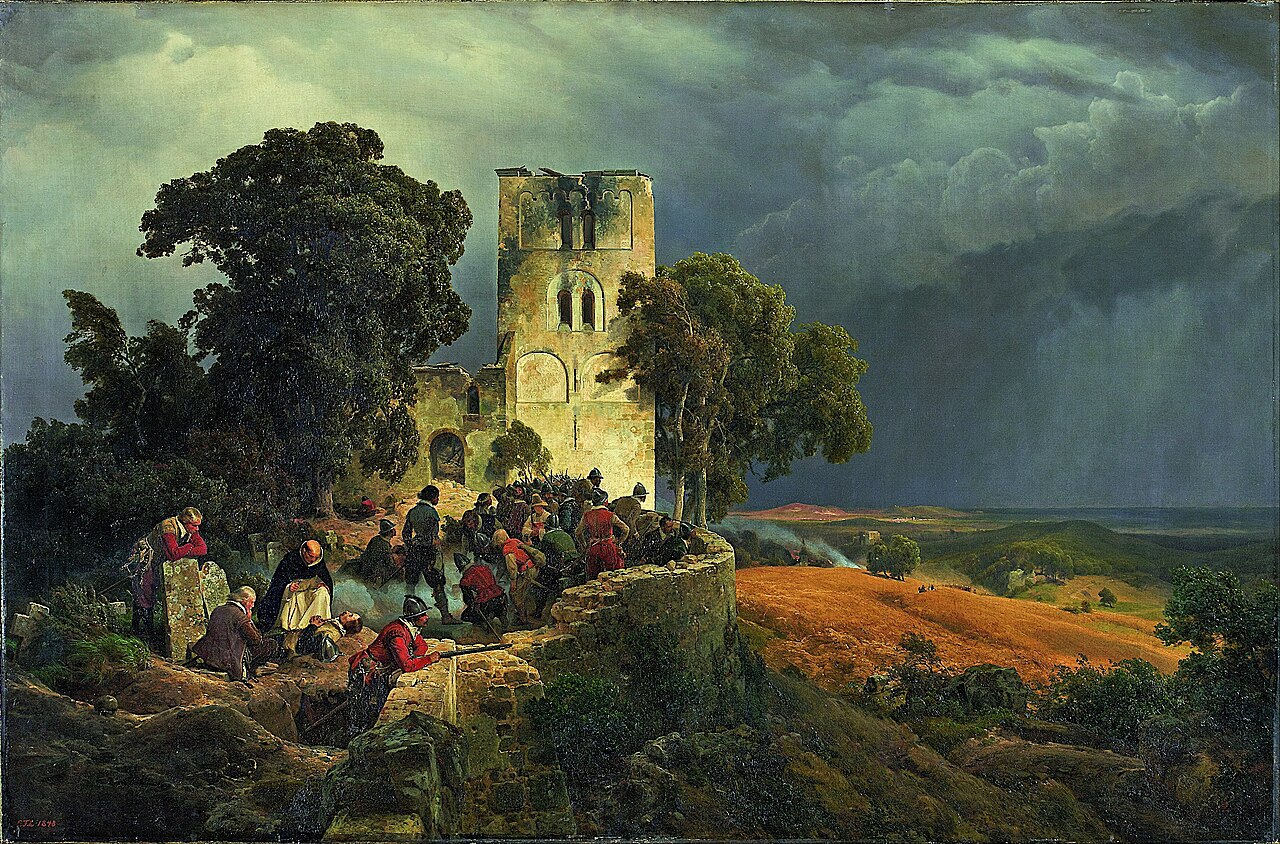
The Thirty Years' War opened with the Defenestration of Prague on 23 May 1618, when Bohemian Protestant estates threw Habsburg officials from a window. What began as a Bohemian revolt inside the Holy Roman Empire became a European war as the Palatinate, Denmark, Sweden and France entered against the Habsburgs and the Catholic League.
About 4-8 million people died in the Empire, scholarly range -- a demographic disaster in parts of Germany from battle, typhus, famine and marauding armies that lived off the land. Magdeburg's 1631 sack became the emblem of civilian horror. Gustavus Adolphus of Sweden won at Breitenfeld (1631) and died at Lutzen (1632).
The Peace of Westphalia (Munster and Osnabruck, 24 October 1648) resettled religion in the Empire, recognised Dutch and Swiss facts, and became a later textbook label for "sovereignty." English memory is thinner than for Waterloo or 1914; German local memory of emptied villages is thicker.
Span1618-1648
Deaths (Empire)about 4-8 million
Defenestration23 May 1618
Gustavus diesLutzen 1632
Westphalia24 Oct 1648
PrincipleCuius regio, plus new balances
Profile
Scale
45
Intensity
75
Duration
60
Tech shift
30
Political impact
70
Cultural memory
48
Pin a cost beat to a legacy beat
On this topic, pick one published cost band and one legacy lesson already on the page. Educational pairing — not a nation league.
Documented ranges and memory notes only. No ranking of countries, peoples, or armed forces as teams. Not operational advice.
Cost beat already published
Legacy beat already published
Cost or lesson
Theme reading only. Not a nation league.
Deep introduction
Confession, mercenaries and a peace that named a system
1618-1648 was several wars stacked: Bohemian, Palatine, Danish, Swedish and French-Habsburg -- paid for by German civilians.
Bohemia to White Mountain
The 1618 revolt and Frederick V's brief winter kingship ended at White Mountain (8 November 1620). Habsburg reconquest brought forced re-Catholicisation and exile -- a Bohemian tragedy that later Czech memory never treated as a German footnote.
The war then spilled to the Palatinate and the Rhine.
Danish and Swedish interventions
Christian IV's Danish war (1625-29) failed. Gustavus Adolphus landed in 1630, won Breitenfeld, and made Sweden a great power before dying at Lutzen. His chancellor Oxenstierna kept Sweden in the war.
Albrecht von Wallenstein's imperial armies -- raised as a private-public enterprise -- showed how the war was financed by plunder as much as by tax.
French entry
Richelieu's France, a Catholic monarchy, funded Protestants and then entered openly in 1635 against the Habsburgs. The last decade was a great-power war with a German address.
Rocroi (1643) marked Spanish tercios' decline; the Empire was already a graveyard of villages.
Westphalia
Two treaties in 1648: Osnabruck (with Sweden) and Munster (with France). Cuius regio eius religio was adjusted; Calvinism gained recognition; the Emperor's power inside the Empire shrank.
Later IR theory turned "Westphalia" into a myth of the sovereign state. The documents were messier: a German constitutional peace plus French and Swedish guarantees.
The Thirty Years' War is the early-modern cousin of later coalition wars -- and a lesson in what "peace of exhaustion" looks like.
See also
World War IAnother general European war that mixed ideology, alliance and a peace that became a theory -- comparison, not equation.
Napoleonic WarsLater coalition wars on some of the same German roads, with conscription instead of mercenary enterprise.
Iran-Iraq WarA later long war of exhaustion on a different map -- included here as a reminder that multi-year wars can stall without a "Westphalia".
Mongol conquestsAn earlier Eurasian catastrophe; the Thirty Years' War is regional and confessional, not a steppe empire -- a contrast in this atlas.
Key terms
Defenestration of Prague
23 May 1618: the Bohemian spark -- officials thrown from the Hradcany window.
Catholic League / Protestant Union
Prewar armed camps inside the Empire that the war then outgrew.
Cuius regio eius religio
1555 Augsburg rule (prince's religion binds the territory), adjusted in 1648.
Military enterprise
Wallenstein-style armies funded by contributions extracted from land.
Westphalia
1648 treaties of Munster and Osnabruck -- later a theory-label as much as a document.
Magdeburg
1631 sack -- the war's most cited civilian atrocity in Protestant print.
Religion and interest
Confession structured early coalitions; French policy showed that interest could override confession. The war cannot be reduced to "Catholics vs Protestants" after 1635.
Locally, forced conversion and exile were still religious facts.
The army as a plague
Troops lived by "contributions." A passing army could empty a district as surely as a battle. This is why death estimates dwarf battle lists.
Mercenary identity was often multinational; "Swedish" or "imperial" named the paymaster more than the birthplace.
A peace that became a myth
Westphalia settled the Empire. Nineteenth- and twentieth-century lawyers turned it into the birthday of sovereignty. Historians keep pulling the myth back to the clauses.
The Dutch Republic's recognition was a European fact the Spanish had already half-accepted.
45scaleEditorial 0-100 browsing score
75intensityEditorial 0-100 browsing score
60durationEditorial 0-100 browsing score
30techShiftEditorial 0-100 browsing score
Thirty Years' War: concrete atlas depth on Tool-Lifes.
Frequently asked questions
Are the scores a ranking of nations or armies?
No. Scores are browsing aids inside an era-bounded atlas — not live league tables of countries.
How many died?
In the Holy Roman Empire, about 4-8 million is a working band -- a huge share of some territories. Battle deaths were a minority beside famine and disease.
Was it only a religious war?
It began as a Bohemian and imperial confessional crisis. It became a European great-power war, especially after France entered against the Habsburgs.
What was Westphalia?
Two 1648 treaties that resettled religion and imperial constitution and involved France and Sweden as guarantors. Later "Westphalian sovereignty" is a simplified teaching story.
Who was Gustavus Adolphus?
King of Sweden, victor at Breitenfeld (1631), killed at Lutzen (1632). He made Sweden a Baltic great power and a Protestant military model in later myth.
Why is English memory thin?
England was not a main belligerent (though it had earlier Palatine ties). The war left no poppy ritual in London. Germany kept the demographic scar.
What did it do to Germany?
Some regions lost a third or more of their people (local studies vary). Political fragmentation of the Empire was confirmed; economic recovery took decades.
Is "Westphalian system" accurate?
As a nickname for later interstate law, it is a shorthand. As a description of 1648's text, it overstates novelty and understates the Empire's remaining web of law.