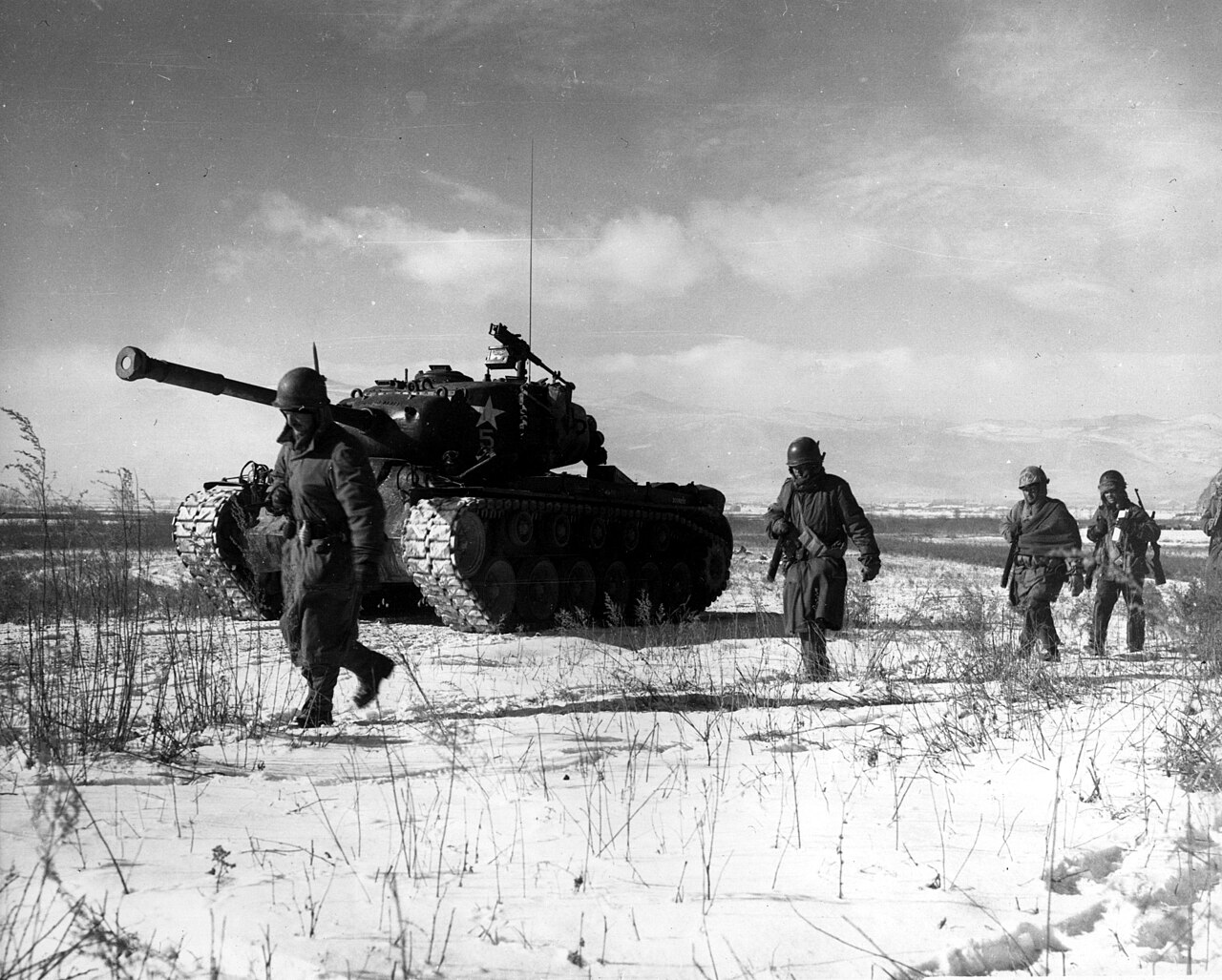
The Korean War began before dawn on 25 June 1950 when the Korean People's Army crossed the 38th parallel, the 1945 US-Soviet occupation line that had already produced two states in 1948: the Republic of Korea under Syngman Rhee and the Democratic People's Republic under Kim Il-sung. The UN Security Council, with the Soviet seat empty, created a US-led United Nations Command.
The front raced the length of the peninsula: the Pusan Perimeter, the 15 September 1950 Inchon landing, the UN drive to the Yalu, and Chinese People's Volunteer intervention from October 1950. Seoul changed hands four times. An armistice signed at Panmunjom on 27 July 1953 created the DMZ near the 38th parallel -- and no peace treaty has followed.
Scholarly estimates put Korean civilian deaths in a band of about 2-3 million, with ROK military deaths around 137,000 and US military deaths about 36,000; Chinese military deaths are often given in a wide 180,000-400,000 range. For Koreans it is 6-25, not a "forgotten war." For US, British, Australian, Canadian and other UN veterans it became the war between 1945 and Vietnam -- under-taught, heavily memorialised only later.
Fighting25 Jun 1950-27 Jul 1953
ArmisticePanmunjom, no peace treaty
Korean civiliansabout 2-3 million dead
ROK military deadabout 137,000+
US deadabout 36,000
Chinese deadabout 180-400 thousand, range
Profile
Scale
62
Intensity
78
Duration
72
Tech shift
55
Political impact
80
Cultural memory
70
Pin a cost beat to a legacy beat
On this topic, pick one published cost band and one legacy lesson already on the page. Educational pairing — not a nation league.
Documented ranges and memory notes only. No ranking of countries, peoples, or armed forces as teams. Not operational advice.
Cost beat already published
Legacy beat already published
Cost or lesson
Theme reading only. Not a nation league.
Deep introduction
A civil war that became a coalition war
Korea in 1950-53 was at once a Korean civil war, a UN police action, and the first hot war of the Cold War, fought to a draw that still defines the peninsula.
Two states, one peninsula
Japanese colonial rule ended in August 1945. US troops occupied south of the 38th parallel, Soviet troops the north. Separate elections and the 1948 founding of the ROK and DPRK made partition political, not only military.
Border raids and the 1948-49 guerrilla war on Jeju and in the southern mountains were already killing Koreans before the conventional invasion of June 1950. Kim Il-sung obtained Stalin's and Mao's assent after months of lobbying.
Collapse, Inchon, and the Yalu
ROK and the first US task forces were driven into a corner at Pusan by August. MacArthur's Inchon landing (Operation Chromite, 15 September) cut the KPA's supply and enabled the recapture of Seoul on 28 September.
UN forces then crossed the 38th parallel and drove toward the Yalu. Chinese intervention from mid-October, formalised as the People's Volunteer Army under Peng Dehuai, reversed the war again in the winter of 1950-51.
Stalemate and air war
Ridgway restabilised the Eighth Army in early 1951. After Seoul's last recapture, the front settled near the parallel. Talks that began at Kaesong in July 1951 moved to Panmunjom and dragged for two years, hung up on POWs and the line of demarcation.
US air power destroyed northern cities and infrastructure; MiG Alley saw the first large jet-versus-jet war. Neither bombing nor ground offensives (Heartbreak Ridge, Pork Chop Hill) broke the political deadlock.
Armistice without peace
The 27 July 1953 agreement created the Military Demarcation Line, the DMZ, and the Neutral Nations Supervisory Commission. Syngman Rhee opposed the armistice; the ROK did not sign it, though it pledged cooperation.
A political conference at Geneva in 1954 failed to unify Korea. The US-ROK Mutual Defense Treaty (1953) and a continuous UN Command legal shell remain. Families divided by the front are a living archive.
Inchon, the ROK armed forces, Vietnam, and the 1979 Seoul coup all sit on paths that run through 1950-53.
See also
Battle of InchonThe 15 September 1950 landing reversed the first campaign and made MacArthur's legend -- and his later fall.
Republic of Korea Armed ForcesThe ROK Army was rebuilt in this war from a collapsing constabulary into a mass conscript force.
Vietnam WarA later hot Cold War in Asia, fought with Korean War veterans in the US command and with ROK expeditionary forces.
12 December 1979 coupThe 12 December 1979 coup happened in a ROK state still structured by the 1953 armistice and garrison politics.
Key terms
38th parallel
1945 occupation line that became a political border and, after 1953, a nearby but not identical DMZ.
United Nations Command
US-led coalition authorised by UNSC resolutions 83 and 84; still exists as a legal structure.
Pusan Perimeter
August-September 1950 defensive arc in the southeast that kept the ROK in the war.
People's Volunteer Army
Chinese expeditionary force (October 1950-) that reversed the UN drive to the Yalu.
Panmunjom
Village where armistice talks and the 27 July 1953 signing took place; later the JSA.
DMZ
Demilitarized zone about 4 km wide along the Military Demarcation Line -- among the most fortified borders on earth.
Korean agency
This was not only a US-China proxy war. Rhee and Kim had unification strategies; both committed atrocities (including mass political killings) that later truth commissions documented in the south.
Paik Sun-yup and other ROK commanders matter as much as MacArthur for the ground war after 1951.
Coalition war
Britain, Australia, Canada, Turkey, the Philippines, Ethiopia and others sent combat units. Their cemeteries at Busan (UN Memorial Cemetery) are a second map of the war.
Naval blockade and carrier air from UN ships were constant; the war was never only ridges.
Unfinished war
No peace treaty, occasional clashes (1966-69, 2010 Yeonpyeong, 2010 Cheonan), and family reunions as rare state theatre. The 2018-19 diplomacy briefly raised a peace-treaty hope that receded.
For a Korean audience the war is a present tense: conscription, civil defence drills, and divided families.
62scaleEditorial 0-100 browsing score
78intensityEditorial 0-100 browsing score
72durationEditorial 0-100 browsing score
55techShiftEditorial 0-100 browsing score
Korean War: concrete atlas depth on Tool-Lifes.
Frequently asked questions
Are the scores a ranking of nations or armies?
No. Scores are browsing aids inside an era-bounded atlas — not live league tables of countries.
How many people died?
Korean civilian deaths are often estimated at about 2-3 million. ROK military deaths are about 137,000; DPRK military deaths are less certain. US deaths are about 36,000. Chinese deaths are cited in a wide scholarly range, often 180,000-400,000. All figures are ranges, not precise censuses.
Why did the United Nations intervene?
The US took the war to the Security Council. Resolutions 83 and 84 (June-July 1950) recommended members assist the ROK. The Soviet Union was boycotting the Council over China's seat, so it did not veto. Sixteen countries sent combat forces; others sent medical units.
What was Inchon?
A surprise amphibious landing on 15 September 1950 at a port with extreme tides, designed to cut KPA supply lines to the Pusan Perimeter. It succeeded operationally and led to Seoul's recapture. It did not end the war, because the UN then drove north and China entered.
Why did China enter?
As UN forces approached the Yalu and the DPRK neared collapse, Mao's government -- after debate -- sent the People's Volunteer Army from mid-October 1950. Chinese accounts stress defending the border and supporting a socialist ally; UN accounts stress surprise and winter retreats from the north.
Who were the main commanders?
MacArthur (until relieved 11 April 1951), then Ridgway and Clark for the UN; Rhee and ROK chiefs including Chung Il-kwon and Paik Sun-yup; Kim Il-sung and Choi Yong-kun in the north; Peng Dehuai for Chinese forces. Truman's relief of MacArthur is a central civil-military episode.
Why is it called forgotten in English?
It sat between the larger memorial machines of 1939-45 and Vietnam, produced an armistice rather than a parade, and was poorly taught. Koreans call it 6-25 or use state names that never implied forgetting.
What did the war change in Korea?
It destroyed much of the peninsula's capital stock, hardened two antagonistic states, created the DMZ, bound the ROK to a US alliance and conscript military, and left a diaspora and divided families. South Korea's later growth happened on this security foundation, not instead of it.