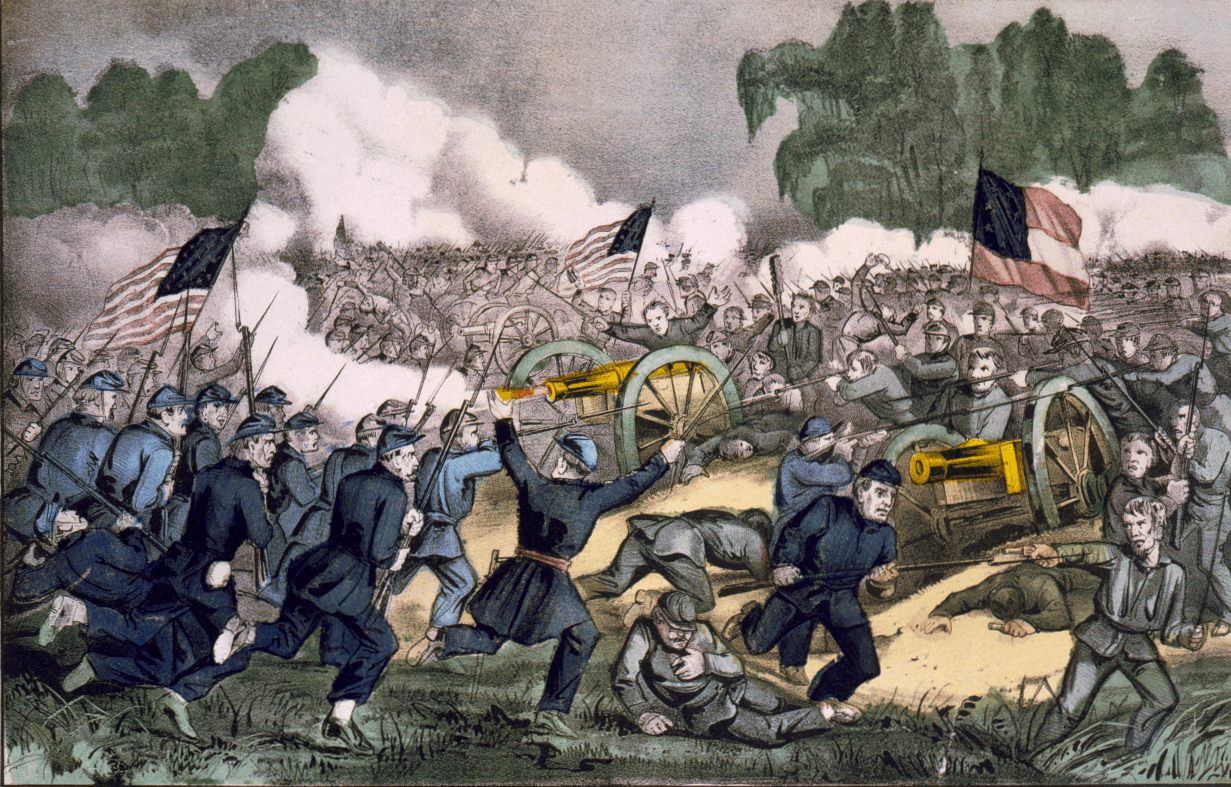
The American Civil War began with the Confederate attack on Fort Sumter on 12 April 1861, after eleven slaveholding states seceded following Abraham Lincoln's election. The Confederate States claimed independence; the United States fought to preserve the Union. Slavery was the structural cause; union and emancipation became the war's joint political end-state after 1863.
About 620,000-850,000 people died, scholarly range -- more US dead than in the two world wars combined for American forces. Industrial railroads, rifled muskets, and a Union naval blockade made it a modern war on a continental map. Gettysburg (1-3 July 1863) and Vicksburg (4 July 1863) were the twin hinges; Appomattox (9 April 1865) ended the main Confederate army.
The 13th, 14th and 15th Amendments recast the Constitution. Reconstruction (1865-77) was a second political war that white supremacist "Redemption" later rolled back. English-speaking memory outside the US treats this as the great American epic; inside the US it remains a live argument about flags, statues and school books.
Span12 Apr 1861-9 Apr 1865
Deathsabout 620-850 thousand
Emancipation1 Jan 1863 (proclamation)
Gettysburg1-3 Jul 1863
Appomattox9 Apr 1865
Amendments13th-15th
Profile
Scale
42
Intensity
80
Duration
40
Tech shift
52
Political impact
76
Cultural memory
85
Pin a cost beat to a legacy beat
On this topic, pick one published cost band and one legacy lesson already on the page. Educational pairing — not a nation league.
Documented ranges and memory notes only. No ranking of countries, peoples, or armed forces as teams. Not operational advice.
Cost beat already published
Legacy beat already published
Cost or lesson
Theme reading only. Not a nation league.
Deep introduction
Union, emancipation and an industrial republic
The Civil War was a political war about a slaveholding republic that became, through arms and amendments, a different constitution -- then a contested memory.
Secession winter
Lincoln's 1860 election, without southern electoral votes, triggered secession conventions. The Confederate constitution explicitly protected slavery. Sumter forced the upper South to choose; Virginia's departure put the war's capital pair -- Washington and Richmond -- a hundred miles apart.
Border states (Kentucky, Maryland, Missouri) were a campaign of politics as much as of armies.
From limited war to emancipation
Lincoln's early aim was union. The 1 January 1863 Emancipation Proclamation, tied to the Antietam moment, made freedom a Union war aim for Confederate-held territory and opened large-scale Black enlistment in USCT regiments.
Britain and France stayed out; the cotton famine did not buy Confederate recognition once emancipation recast the war's meaning abroad.
Two theatres
In the east, Lee's Army of Northern Virginia won famous battles and lost the war. In the west, Grant and the rivers -- Forts Henry and Donelson, Shiloh, Vicksburg -- cut the Confederacy. Sherman's 1864 Atlanta campaign and March to the Sea were political warfare against a slaveholding society's capacity.
The Union blockade and the new naval ironclads (Monitor and Virginia, 1862) were a technology sideshow with a strategic effect: the South could not export its way to victory.
Reconstruction's unfinished war
Lincoln was murdered on 14 April 1865. Andrew Johnson and then Radical Republicans fought over the terms of southern readmission. The Ku Klux Klan and "Redeemer" governments used terror to restore white rule after federal troops left in 1877.
The war's legal victory (amendments) and its social defeat (Jim Crow) are both part of the same file.
The US Civil War sits beside other civil conflicts in this atlas and beside the industrial weapons it helped normalise.
See also
Chinese Civil WarAnother continental civil war that decided a state's social system -- different century, same stakes of who governs the peasantry and the cities.
World War IRifled weapons, rail and mass mobilisation here preview 1914's industrial killing, without matching its global scale.
TankIronclads and industrial production -- not tanks -- were this war's machines; the later tank age still cites Civil War rail and industry as ancestors of mobilisation.
United States militaryThe Union army and navy are the institutional ancestors of the modern US force, after a tiny antebellum establishment.
Key terms
Secession
State conventions claiming to leave the Union; the US government treated it as rebellion, not a legal exit.
Emancipation Proclamation
1 January 1863 executive act freeing enslaved people in rebel-held areas and allowing Black enlistment.
Anaconda Plan
Scott's early concept: blockade and Mississippi control to squeeze the Confederacy.
USCT
United States Colored Troops -- about 180,000 Black soldiers in Union service.
Reconstruction
1865-77 federal attempt to rebuild southern politics on the amendments.
Lost Cause
Postwar Confederate memory ideology that downplayed slavery and recast the war as states' rights romance.
Slavery as cause
Historians' near-consensus: without slavery there is no secession. States' rights language was the rights of slave states. Contemporary declarations of secession said so.
Teaching fights in US states still try to reopen a closed scholarly question.
Industrial advantage
Union population, rail mileage and factories were not automatic victory -- they had to be organised (Lincoln, Stanton, the draft riots of 1863).
Confederate interior lines and defensive war almost offset the gap until 1864 attrition under Grant.
Memory after Appomattox
Reunion culture among white veterans often excluded Black freedom. The Lost Cause built monuments into the twentieth century; removal debates are a twenty-first-century campaign.
Juneteenth (19 June 1865 news of freedom in Texas) is now a US federal holiday -- a late official correction.
42scaleEditorial 0-100 browsing score
80intensityEditorial 0-100 browsing score
40durationEditorial 0-100 browsing score
52techShiftEditorial 0-100 browsing score
American Civil War: concrete atlas depth on Tool-Lifes.
Frequently asked questions
Are the scores a ranking of nations or armies?
No. Scores are browsing aids inside an era-bounded atlas — not live league tables of countries.
How many died?
About 620,000 was the long-standard military estimate; recent work (Hacker and others) suggests around 750,000, with a published band reaching about 850,000 when some civilian deaths are considered. Disease killed more than combat.
Was it about slavery?
Yes, as the cause of secession. Lincoln's initial public aim was union; emancipation became a war aim in 1862-63. Both facts are true and in sequence.
Why did the Union win?
Population, industry, rail, naval blockade, Black manpower, and -- in 1864-65 -- a coordinated strategy under Grant. Confederate advantages in interior lines and military culture were real and insufficient.
What was Gettysburg?
A three-day battle in Pennsylvania (1-3 July 1863) that ended Lee's second northern invasion. Combined with Vicksburg's fall on 4 July, it was the war's political-military hinge -- not the last fighting.
What did Reconstruction do?
It briefly empowered Black voters and Republican governments in the South, passed the 14th and 15th Amendments, and then collapsed under violence and northern fatigue after 1877.
Why are statues still argued about?
Because Lost Cause monuments were political projects of the Jim Crow era, not neutral grave markers. Removing or contextualising them is a debate about public history, not about whether the war happened.
How should non-US readers approach it?
As a civil war that decided whether a slaveholding republic would survive -- and as the founding trauma of later US race politics. It is not a costume drama about honour in the abstract.