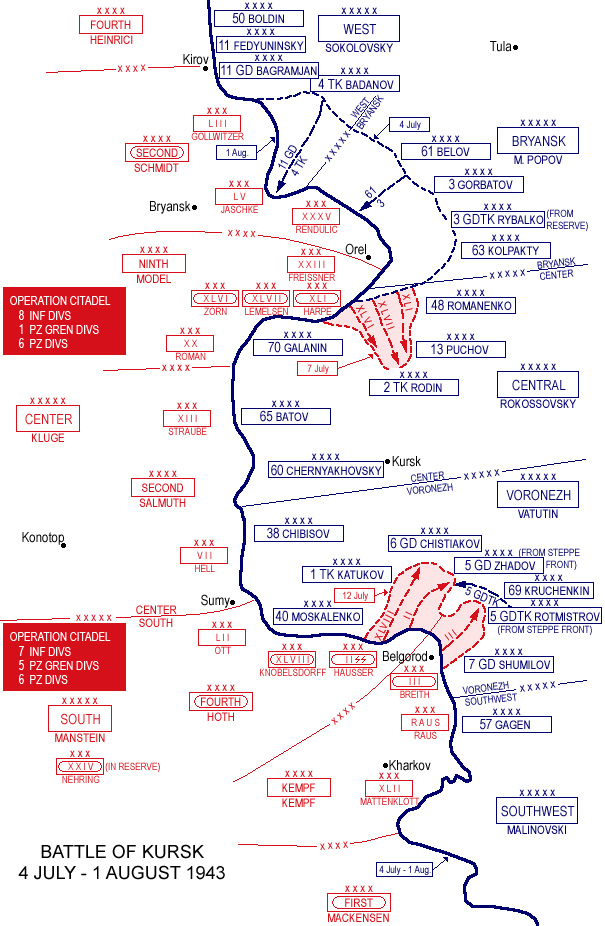
The 1943 German Citadel offensive against the Kursk bulge -- the last strategic German attack in the east -- and the Soviet counteroffensives that followed.
Educational history. Casualty figures are documented ranges. This is not operational advice, a ranking of nations, or a how-to for weapons or coups.
Operation Citadel opened on 5 July 1943 against the Soviet-held Kursk salient, after months of delay that the Red Army used to pack the bulge with mines, guns, and reserves. Model attacked from the north, Manstein's wing from the south. The German strategic aim -- to pinch off the salient and regain initiative after Stalingrad -- failed within two weeks.
Prokhorovka (12 July) became the named armour clash of the south, later inflated in Soviet and popular accounts into the "greatest tank battle" with tidy integers the archives do not support. Casualties on both sides run into the hundreds of thousands across July-August when the Soviet counteroffensives (Orel, Belgorod-Kharkov) are included -- a campaign, not a single afternoon.
Kursk ended German hopes of a 1943 summer decision in the east. English memory is thinner than Stalingrad or Normandy; wargamers and tank books over-weight Prokhorovka. For this atlas it is the high-intensity sequel to the Volga pocket -- and a reminder that "largest tank battle" is a caption to handle with ranges.
Citadel5 Jul 1943
SalientKursk bulge
Prokhorovka12 Jul 1943
Soviet repliesKutuzov / Rumyantsev
Orel / KharkovTaken in the counteroffensives
RoleLast German strategic attack in the east
Profile
Scale
40
Intensity
88
Duration
16
Tech shift
50
Political impact
60
Cultural memory
55
Pin a cost beat to a legacy beat
On this topic, pick one published cost band and one legacy lesson already on the page. Educational pairing — not a nation league.
Documented ranges and memory notes only. No ranking of countries, peoples, or armed forces as teams. Not operational advice.
Cost beat already published
Legacy beat already published
Cost or lesson
Theme reading only. Not a nation league.
Deep introduction
A prepared bulge and a last German throw
Citadel was an offensive the defender had been allowed to watch being prepared -- and the counterstrokes were the larger war.
Why wait?
Hitler delayed for more new armour (Panther, Elefant). Zhukov and Vasilevsky used the time. A late offensive against a ready defence is the political-military fact.
Allied landings in Sicily (10 July) pulled Hitler's attention and some formations -- a second-front shadow on an eastern map.
North and south
The northern face stalled earlier. The southern face got farther and made Prokhorovka a name. Neither pinch closed.
Soviet deep reserves (Steppe Front) were the depth Citadel could not eat.
Counteroffensives
Operations Kutuzov and Rumyantsev took Orel and Kharkov. The campaign's meaning is this sequel, not only the defensive week.
The Wehrmacht in the east was thereafter on the strategic defensive.
The Prokhorovka problem
Later Soviet figures of wrecks were propaganda arithmetic. Recent work (Zamulin, Glantz, and others) cuts the "meeting of 1,200 tanks in a field" cartoon without making the day small.
English tank-magazine memory still prefers the cartoon. This page does not.
World War IIA 1943 eastern campaign of the world war.
TankThe popular "tank battle" caption -- handle with archives, not magazine integers.
Normandy landingsSicily and the later Western Front pulled German eyes while Citadel burned -- a coalition-war fact.
Key terms
Citadel
The German offensive name, 5 July 1943.
Salient / bulge
The Kursk projection in the front.
Prokhorovka
12 July southern clash -- famous and over-counted.
Pakfront / defence in depth
Soviet prepared system -- historically named, not taught as a layout to copy.
Kutuzov
Northern Soviet counteroffensive against Orel.
Rumyantsev
Southern Soviet counteroffensive toward Kharkov.
Delay as a decision
Waiting for Panthers was a political-technical choice that gave the Red Army a minefield.
New kit on a debut (Panther) is a reliability story as well as a legend.
Caption vs archive
The "greatest tank battle" headline needs a range and a campaign map.
Glantz-era operational history is the English corrective to 1970s paperbacks.
After Citadel
The rest of the war in the east is Soviet initiative. Kursk is why that sentence becomes safe to teach.
Keep After Citadel pinned to 1943-07-16 (Citadel called off): Hitler ends the offensive. Battle of Kursk remains a 5 July-23 August 1943 file in Kursk salient, southern and central Russia, not a playbook.
40scaleEditorial 0-100 browsing score
88intensityEditorial 0-100 browsing score
16durationEditorial 0-100 browsing score
50techShiftEditorial 0-100 browsing score
Battle of Kursk: concrete atlas depth on Tool-Lifes.
Frequently asked questions
Are the scores a ranking of nations or armies?
No. Scores are browsing aids inside an era-bounded atlas — not live league tables of countries.
How many casualties?
Hundreds of thousands on both sides across the campaign is the honest band. Single-day Prokhorovka integers in old popular books are often too neat.
Was it the largest tank battle?
It was among the largest armour concentrations of the war. "Largest" depends on what you count (day vs campaign, runners vs hulls). Use the question, not a fake record plaque.
Why did Citadel fail?
A prepared, deep Soviet defence, German delay, limited reserves, and a strategic context (Sicily, the long 1943) that forbade a long slugfest.
What was Prokhorovka?
A 12 July clash on the southern face, important and later mythologised. It did not by itself "destroy the Panzerwaffe" in a single afternoon.
What followed?
Soviet offensives took Orel and Kharkov. Germany did not launch another strategic summer offensive in the east.
Who commanded?
Model (north), Manstein / Hoth (south), Zhukov and Vasilevsky at Stavka, Rokossovsky and Vatutin on the fronts, Konev's Steppe Front in reserve.