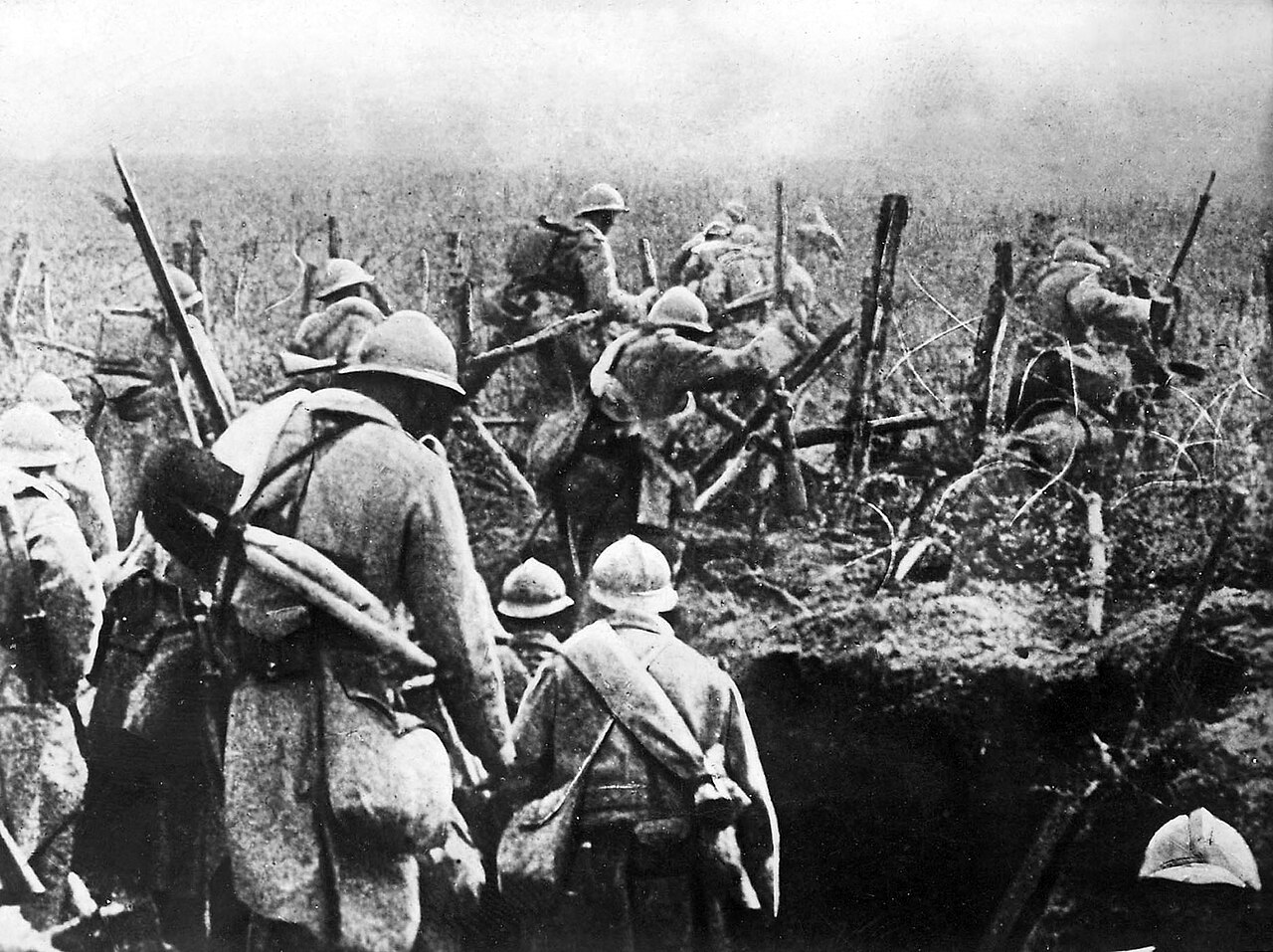
The First World War began with Austria-Hungary's declaration of war on Serbia on 28 July 1914, after the assassination of Archduke Franz Ferdinand in Sarajevo on 28 June. Within a week the alliance system had pulled in Germany, Russia, France and Britain; the Ottoman Empire and later Italy, Bulgaria and the United States widened the map.
About 15-22 million people died, scholarly range, including roughly 9-11 million military dead and a large civilian toll from blockade, massacre and the 1918 influenza that overlapped the last campaigns. The Western Front's trenches dominate English memory; the Eastern Front, the Alps, Mesopotamia, East Africa and the sea war were equally part of the same industrial conflict.
Four empires -- German, Austro-Hungarian, Ottoman and Russian -- collapsed. The 1919-23 peace settlements created new states and mandates, and also the grievances that Hitler and others later exploited. Poppies, cenotaphs and the two-minute silence remain the Anglophone template for remembering war itself.
Span28 Jul 1914-11 Nov 1918
Deathsabout 15-22 million
FrontsWest, East, Alps, Near East
US entry6 Apr 1917
Armistice11 Nov 1918
SettlementVersailles system
Profile
Scale
88
Intensity
90
Duration
48
Tech shift
85
Political impact
92
Cultural memory
88
Pin a cost beat to a legacy beat
On this topic, pick one published cost band and one legacy lesson already on the page. Educational pairing — not a nation league.
Documented ranges and memory notes only. No ranking of countries, peoples, or armed forces as teams. Not operational advice.
Cost beat already published
Legacy beat already published
Cost or lesson
Theme reading only. Not a nation league.
Deep introduction
Alliances, attrition and a broken peace
1914-1918 was the first fully industrial general war in Europe, fought with railways, artillery and mass conscription, and ended with a diplomatic system that cracked within a generation.
July Crisis to general war
The Sarajevo assassination was a regional shock; German backing of Austria (the "blank cheque") and Russian mobilisation made it continental. Britain's entry on 4 August followed the German invasion of Belgium.
War plans -- Schlieffen-Moltke, Plan XVII, the Austrian Balkan war -- assumed short campaigns. By Christmas 1914 the Western Front had frozen into field fortifications from the Channel to Switzerland.
Attrition as a system
Verdun, the Somme and Passchendaele were not accidents of stupidity alone; they were attempts to break a front that artillery and machine-guns favoured in defence. Commanders learned slowly, then all at once in 1918 with combined arms.
The blockade of the Central Powers and Germany's U-boat campaigns made food and shipping into weapons. The 1917 US entry added credit, men and a political end-state: Wilson's Fourteen Points.
Other fronts
Russia's 1917 revolutions took it out of the war at Brest-Litovsk (March 1918). Italy bled on the Isonzo; Allenby took Jerusalem and Damascus; the Arab Revolt and Sykes-Picot drew a postwar Middle East.
East Africa under von Lettow-Vorbeck and the massacre of Armenians in the Ottoman Empire belong in the same war, even when Western Front museums omit them.
Armistice and after
The 11 November 1918 armistice stopped the shooting in France before Allied armies entered Germany in force -- a fact later twisted by the "stab in the back" myth. Versailles (1919), Saint-Germain, Neuilly, Trianon and Sevres/Lausanne dismantled empires.
League of Nations mandates in the Middle East and the Pacific, and the US Senate's rejection of the League, left an incomplete security system. The Second World War is not a sequel by fate, but it is unintelligible without this peace.
The Great War invented the modern memorial state and left the map on which 1939 and later staff colleges still argued.
See also
World War IIThe Second World War reused this war's graves, grievances and staff colleges.
TankThe tank appeared in 1916 as an answer to trench deadlock and then matured as a system.
Royal NavyBlockade and the Grand Fleet were Britain's decisive strategic tools in 1914-18.
Thirty Years' WarLike 1618-1648, this war mixed state collapse, famine and a peace that redrew religion and borders -- a comparison historians use carefully.
Key terms
Schlieffen concept
German prewar idea of a rapid western victory before turning east -- modified and failed in 1914.
No man's land
The stripped ground between trench lines, dominated by artillery and machine-guns.
Unrestricted submarine warfare
German U-boat campaign against merchant shipping that helped bring the US into the war in 1917.
Fourteen Points
Wilson's January 1918 programme: open diplomacy, self-determination language, a league of nations.
Mandate
League of Nations device that transferred Ottoman and German colonies to Allied administrators.
Stab in the back
Postwar German myth that civilians and socialists, not the army, lost the war -- later a Nazi talking point.
Mass armies and the home front
Conscription, female munitions labour, and rationing made the home front a second army. Strikes in 1917-18 (France, Germany, Russia) were strategic events.
Colonial troops from India, Africa and the dominions fought in France and elsewhere, then returned to political systems that had not promised them equality.
Technology without decision
Poison gas, aircraft, tanks and radio appeared; none alone unlocked the front until 1918 combined-arms methods and German exhaustion coincided.
This page records that history. It does not teach employment of chemical or any other weapon.
A peace of maps
New states (Poland, Czechoslovakia, Yugoslavia) and the Turkish War of Independence showed that 1918 was a pause in violence, not an end. The 1923 Lausanne treaty, not Sevres, settled Anatolia.
Reparations and the Ruhr occupation (1923) poisoned German politics without rebuilding a stable Europe.
88scaleEditorial 0-100 browsing score
90intensityEditorial 0-100 browsing score
48durationEditorial 0-100 browsing score
85techShiftEditorial 0-100 browsing score
World War I: concrete atlas depth on Tool-Lifes.
Frequently asked questions
Are the scores a ranking of nations or armies?
No. Scores are browsing aids inside an era-bounded atlas — not live league tables of countries.
How many died?
About 15-22 million dead is the usual scholarly band, plus the 1918-19 influenza that killed tens of millions more worldwide, including many already weakened by the war. Military dead are better counted than civilians.
Why did it start?
No single cause. Alliance commitments, militarism, imperial rivalry, the Balkan crises, and a July 1914 diplomatic failure all appear in standard accounts. Historians still argue about German war aims and shared responsibility.
Why is the Western Front so famous in English?
That is where British, dominion and (from 1917) US armies fought longest. Poetry, photography and the density of cemeteries in France and Flanders created a portable memory. Other fronts were as deadly for those who fought there.
What was the Treaty of Versailles?
The 1919 treaty with Germany: territorial losses, disarmament clauses, Article 231 ("war guilt"), and reparations. It was one of several treaties. The US never ratified it.
Did tanks and aircraft decide the war?
They mattered increasingly in 1918, together with artillery-infantry methods and German economic collapse. They did not make 1916 "modern" in the later Second World War sense.
How did the war change the Middle East?
The Ottoman defeat, Sykes-Picot, the Balfour Declaration (1917), and League mandates in Syria, Palestine and Iraq created the state system still argued over today.
Why do people compare it to 1939-1945?
Same families, overlapping maps, and a peace that failed. The comparison is useful for memory and dangerous if it makes 1914 look like a mere rehearsal.