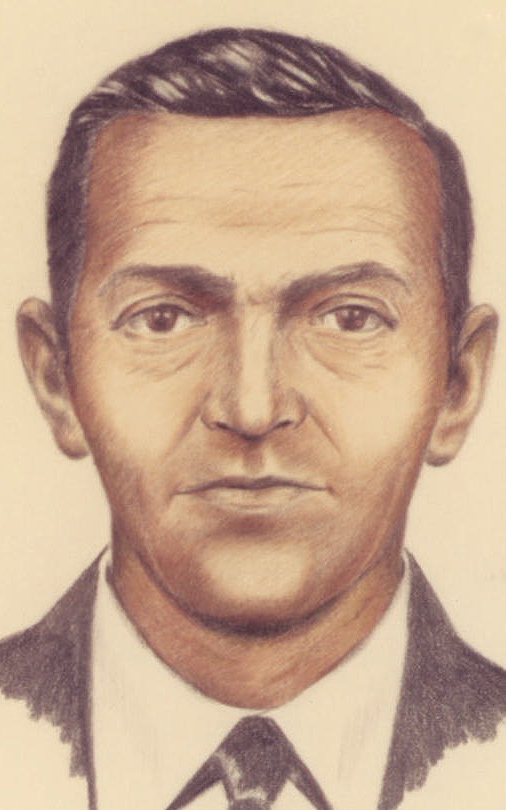
On 24 November 1971 a man calling himself Dan Cooper hijacked Northwest Orient Flight 305, took $200,000 in Seattle and jumped from a Boeing 727; he was never found.
Also called: Dan Cooper · Northwest Orient hijacking
At a glance
Score intensity
Darker cells mean a higher score for this topic on that metric.
Notoriety90
Mystery96
Scale42
Evidence38
Legal impact74
Culture88
LessMore
Score profile
Each bar is a 0-100 atlas score for this topic, not a timeline.
Notoriety90
Mystery96
Scale42
Evidence38
Legal impact74
Culture88
Evidence
Evidence
38%
Score profile
Mystery
96%
Timeline
Milestones in order. This is history, not a weekly activity grid.
On the afternoon of 24 November 1971, the day before Thanksgiving, a man who bought a one-way ticket under the name Dan Cooper boarded Northwest Orient Airlines Flight 305, a Boeing 727-51 registered N467US, at Portland International Airport. After takeoff for Seattle he passed a note to flight attendant Florence Schaffner and later showed her what she took to be a bomb in his briefcase. He demanded $200,000 in cash and four parachutes. The aircraft circled Puget Sound while the airline and the Federal Bureau of Investigation assembled the money and chutes at Seattle-Tacoma International Airport.
Passengers were released at Seattle after the ransom and parachutes came aboard. Captain William Scott, First Officer William Rataczak, flight engineer Harold E. Anderson and flight attendant Tina Mucklow remained. Cooper ordered a course toward Mexico City, a refueling stop at Reno, flaps and landing gear down, and a low, slow flight. Somewhere after takeoff from Seattle, over southwestern Washington in darkness and rain, he lowered the aft airstairs and left the aircraft. When the 727 landed at Reno at 23:45 PST the stairs were still down and Cooper was gone.
The FBI opened case NORJAK — Northwest hijacking. Serial numbers of the $20 bills were recorded. In February 1980 a boy, Brian Ingram, found three deteriorating packets of those bills, about $5,800 face value, on a Columbia River sandbar later called Tena Bar, near Vancouver, Washington. No confirmed remains, parachute or unused ransom cache has been found. The Bureau suspended active investigation on 12 July 2016, leaving the file unsolved.
Date24 Nov 1971
FlightNW 305, PDX–SEA
Ransom$200,000 in $20s
JumpSW Washington (est.)
FBI fileNORJAK
StatusUnsolved (FBI 2016)
Dossier scores
Notoriety 90
Mystery 96
Scale 42
Evidence 38
Legal impact 74
Culture 88
Notoriety
90
Mystery
96
Scale
42
Evidence
38
Legal impact
74
Culture
88
A hijacking without a body
D.B. Cooper is the name the press invented. The ticket said Dan Cooper. The public record is a short flight, a recorded ransom, a river find and a file the FBI chose to close without a defendant.
What happened on Flight 305
Cooper was described as a quiet man in a dark suit, white shirt, black tie and loafers, perhaps in his mid-forties, who ordered bourbon and smoked. He sat in the last row on the starboard side. After the note, he bargained through Mucklow. Northwest’s president, Donald Nyrop, authorised payment. Seattle police and FBI agents delivered a bag of $20 bills from several banks and four parachutes, two of them sport canopies from a local skydiving school.
After the passenger release, Cooper sent the remaining crew forward and used the aft stairs — a feature of the 727 that could be opened in flight. Crew instruments later showed a change consistent with a person leaving the aircraft. The jump zone was reconstructed from flight-path data as a corridor over Ariel, Washington, and the Lewis River country, later expanded as wind and timing models changed.
The name, the sketch and the file
A Portland reporter mixed the ticket name with a local man named D.B. Cooper; wire services kept the error. The FBI composites — especially the 1972 and 1973 sketches — became the American face of an unidentified hijacker. Agents interviewed thousands of people. Richard Floyd McCoy Jr., who hijacked a different airliner in 1972, was a much-cited lookalike; the Bureau did not treat him as Cooper.
Special Agent Ralph Himmelsbach, who stayed with NORJAK for years, later wrote that the jumper faced night, rain, timber and a thin chance of walking out with the money. That is an investigator’s memoir, not a finding that Cooper died. The 2016 suspension cited the age of the case and the death or fading of witnesses, not a recovered body.
The Columbia River bills
Ingram’s 10 February 1980 find on Tena Bar is the only physical recovery of ransom money that the FBI authenticated by serial number. The packets lay a few inches down in sand, upstream of the reconstructed jump zone if one assumes a simple downstream wash. Hydrologists and amateur theorists have argued over whether the bills floated, were buried, or were placed.
The find did not produce a campsite, a chute or a name. It did keep the case in American newspapers for another generation and supplied the one exhibit that later DNA and soil work could still touch. The remaining $194,200 has never been recovered in a form the Bureau accepted.
What the case changed in the air
Federal hijacking law and airport screening were already tightening after a wave of 1960s and early-1970s skyjackings. Cooper’s jump added a specific airworthiness answer: a mechanical lock, later nicknamed the Cooper vane, that keeps a 727’s aft stairs from being lowered in flight. Carriers also changed how they handled ransom and crew positioning on threatened flights.
The cultural afterlife outran the file. Songs, novels, a 1981 film and annual gatherings at Ariel, Washington, treated an unidentified jumper as folk hero. An encyclopedia’s job is to keep the ticket name, the flight number, the Tena Bar serials and the 2016 closure above that folklore.
Beat weight marks
Mark each timeline beat already on this dossier as supported, contested or unknown, using the public-record claims already filed here. Not a verdict.
Editorial marks on this device only. Public-record encyclopedia — not legal advice, not a how-to, not a private file.
Timeline beat
Supported / Contested / Unknown
24 Nov 1971 — Flight 305 hijacked
Claim already on file: The FBI secretly knows who Cooper was.
24 Nov 1971 — Seattle ransom and release
Claim already on file: Richard McCoy was D.B. Cooper.
24 Nov 1971 — Reno landing
Claim already on file: Cooper’s real given name was D.B.
1972–73 — Composites issued
Claim already on file: The ransom has all been found.
1972 — McCoy comparison
Claim already on file: The ransom has all been found.
10 Feb 1980 — Tena Bar find
Claim already on file: The ransom has all been found.
1981 — Cooper vane era
Claim already on file: The ransom has all been found.
2000s — Citizen suspects
Claim already on file: The ransom has all been found.
12 Jul 2016 — FBI suspends NORJAK
Claim already on file: The ransom has all been found.
2016– — Private paper
Claim already on file: The ransom has all been found.
An unidentified man who used the ticket name Dan Cooper on Northwest Orient Flight 305 on 24 November 1971. D.B. Cooper is a press error that stuck. No one was convicted. The FBI suspended the case in 2016.
What did he demand and receive?
He demanded $200,000 and four parachutes. Northwest Orient delivered that sum in $20 bills whose serial numbers were recorded, plus the chutes, at Seattle-Tacoma before the passengers were released.
Where did he leave the aircraft?
After the Seattle departure, over southwestern Washington, using the Boeing 727’s aft airstairs. The FBI’s first search box centred near Ariel; later wind models widened the corridor. No confirmed landing site was found.
Was any of the ransom found?
Yes. On 10 February 1980 Brian Ingram found about $5,800 in deteriorating $20 bills on Tena Bar, a Columbia River beach near Vancouver, Washington. The FBI matched serial numbers to the ransom list. The rest of the money remains unaccounted for.
Did the FBI identify a suspect?
The Bureau investigated thousands of names and publicly discussed several persons of interest. None was charged as Cooper. Richard McCoy, a 1972 hijacker, was a recurring comparison and was not adopted as the Flight 305 jumper.
Why is the case still unsolved?
No body, unused chute or unused ransom cache was authenticated. Witnesses aged. The 1980 river find did not lead to a person. In 2016 the FBI said active investigation was no longer justified.
What is NORJAK?
The FBI’s case name: Northwest hijacking. It is the filing label for the Flight 305 investigation, the serial-number work and the later Tena Bar exhibit.
What aviation rule is tied to the case?
A mechanical device on Boeing 727 aft stairs, widely called the Cooper vane, prevents those stairs from being lowered in flight. Airport screening and hijack-response practice were already changing; Cooper became the named example for the stair lock.