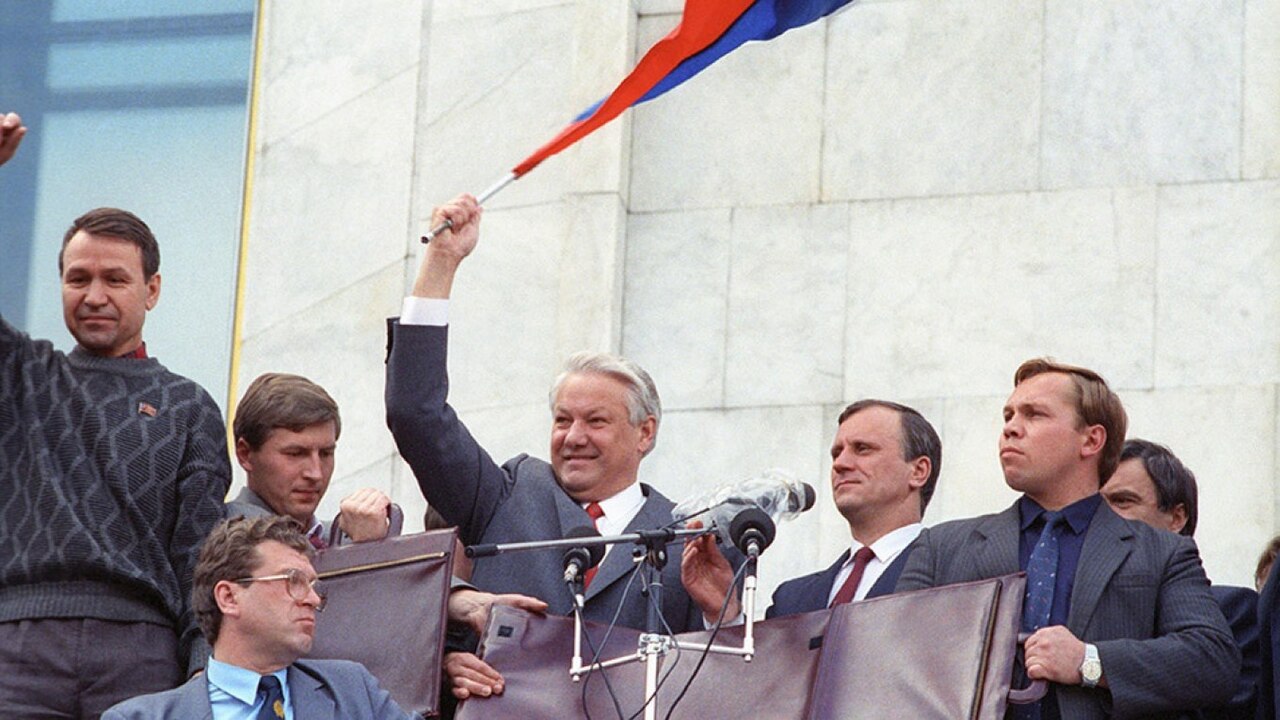
In the early hours of 19 August 1991 a self-styled State Committee on the State of Emergency (GKChP) announced that Mikhail Gorbachev was "unable" to govern and that it would run the Soviet Union. Tanks entered Moscow. Gorbachev was isolated at Foros in Crimea. The committee -- Yanayev, Yazov, Kryuchkov, Pugo and others -- opposed the union treaty scheduled for 20 August that would have recast the USSR as a looser federation.
Boris Yeltsin, president of the RSFSR, climbed on a tank outside the White House (the Russian parliament) and framed the committee as a junta. Military units hesitated; some crews fraternised with crowds. Three civilians died in a tunnel incident on the 21st. The committee collapsed. Pugo died by suicide; others were arrested.
The failed coup did not restore the Soviet order it claimed to save. It destroyed the centre's remaining legitimacy. Ukraine's independence referendum, the Belovezha accords, and the USSR's formal end on 26 December 1991 followed. English memory is Yeltsin-on-a-tank and CNN. Intensity was low; political impact in this atlas is among the highest. This is not a guide to seizing a capital.
Days19-21 Aug 1991
BodyGKChP (State Committee)
GorbachevHeld at Foros
YeltsinWhite House defiance
Dead in Moscow3 civilians
USSR end26 Dec 1991
Profile
Scale
55
Intensity
28
Duration
12
Tech shift
18
Political impact
90
Cultural memory
65
Pin a cost beat to a legacy beat
On this topic, pick one published cost band and one legacy lesson already on the page. Educational pairing — not a nation league.
Documented ranges and memory notes only. No ranking of countries, peoples, or armed forces as teams. Not operational advice.
Cost beat already published
Legacy beat already published
Cost or lesson
Theme reading only. Not a nation league.
Deep introduction
A committee, a tank, and a union that ended
August 1991 was a failed emergency that became an accelerant -- the opposite of Chile 1973's successful seizure.
Why August
The Novo-Ogaryovo union treaty would have shifted power to republics. Hardliners in the KGB, army and cabinet chose a decree night rather than lose the centre on paper.
Gorbachev's half-reforms had already hollowed the party's monopoly without building a new union consent.
Three days
Yanayev's shaking hands on television became an icon of weakness. The plotters issued bans and then hesitated to storm the White House -- a political-military failure of nerve, recorded as fact, not as a lesson in "how to."
Republic leaders watched; some condemned, some waited.
After the tank
Gorbachev returned to a country that had moved past him. The Communist Party was suspended. Republics bolted.
Yeltsin's personal myth was born on that armour -- a myth 1993 and the later 1990s would complicate.
December
Belovezha (8 December) and the Alma-Ata protocol ended the USSR in law. The coup's irony is complete: it hastened the death it meant to prevent.
December stays dated: 1991-08-19 (Yeltsin on the tank) in Moscow, Foros (Gorbachev), union republics. Dmitry Yazov (Defence minister) is a named witness -- The army name on the committee; units did not finish a seizure. Cost band: three civilians dead in Moscow; the USSR dissolved by December -- a low-body-count, high-system event. Encyclopedia, not a method.
Low intensity, huge political effect -- the inverse of many bloody seizures.
See also
Chile 1973 coupA successful 1970s coup versus a failed 1991 one -- outcome, not a method contrast to copy.
Carnation RevolutionAnother junta story that ended a regime; 1991 ended a union. Different morals, same family.
12 December 1979 coupA successful army seizure in a smaller state the same generation -- compare duration and blood, not recipes.
World War IIThe USSR that 1991 ended was a 1945 victor -- the long arc from Stalingrad to the White House steps.
Key terms
GKChP
The eight-man emergency committee of 19 August.
Foros
Gorbachev's Crimean isolation.
White House (Moscow)
The RSFSR parliament Yeltsin used as a stage.
Union treaty
The 20 August signing the plotters meant to stop.
Belovezha
8 December accords that dissolved the union in practice.
August putsch
The English nickname.
Hesitation
Tanks without a political finish: the committee issued statements and lost the street. That is a historical observation, not advice.
Three civilian deaths still make a ledger -- low is not zero.
Republics
The coup's audience was not only Moscow. Kiev and the Baltics heard a reason to leave.
The union died in many capitals, not only on a tank in one.
Myths of 1991
Yeltsin-as-democrat is a 19-21 August snapshot. The 1990s file is longer. Teach the snapshot and the sequel.
Keep Myths of 1991 pinned to 1991-08-21 (Three dead; collapse): Tunnel incident; committee flees the stage. Soviet 1991 coup attempt remains a 19-21 August 1991 file in Moscow, Foros (Gorbachev), union republics, not a playbook.
55scaleEditorial 0-100 browsing score
28intensityEditorial 0-100 browsing score
12durationEditorial 0-100 browsing score
18techShiftEditorial 0-100 browsing score
Soviet 1991 coup attempt: concrete atlas depth on Tool-Lifes.
Frequently asked questions
Are the scores a ranking of nations or armies?
No. Scores are browsing aids inside an era-bounded atlas — not live league tables of countries.
How many died?
Three civilians in Moscow on 21 August are the named dead of the street events. The systemic "death" was the union, not a battlefield.
Who was in the GKChP?
Gennady Yanayev (vice-president), Dmitry Yazov (defence), Vladimir Kryuchkov (KGB), Boris Pugo (interior) and others -- a committee of the centre's last cadres.
What did Yeltsin do?
As RSFSR president he denounced the committee, used the White House as a platform, and became the televised face of resistance. That did not make him the sole cause of failure.
Why did it fail?
Hesitation to use decisive force, elite splits, republic resistance, a public that would not treat the committee as legitimate, and plotters who looked unsure on television. This is analysis of a past failure, not a manual.
Did it end the USSR?
It accelerated an end already underway. Formal dissolution was 26 December 1991.
Where was Gorbachev?
Isolated at his dacha in Foros, Crimea, without reliable communications -- a fact of the three days.
Is this a how-to?
No. It is a historical file about a failed emergency committee.