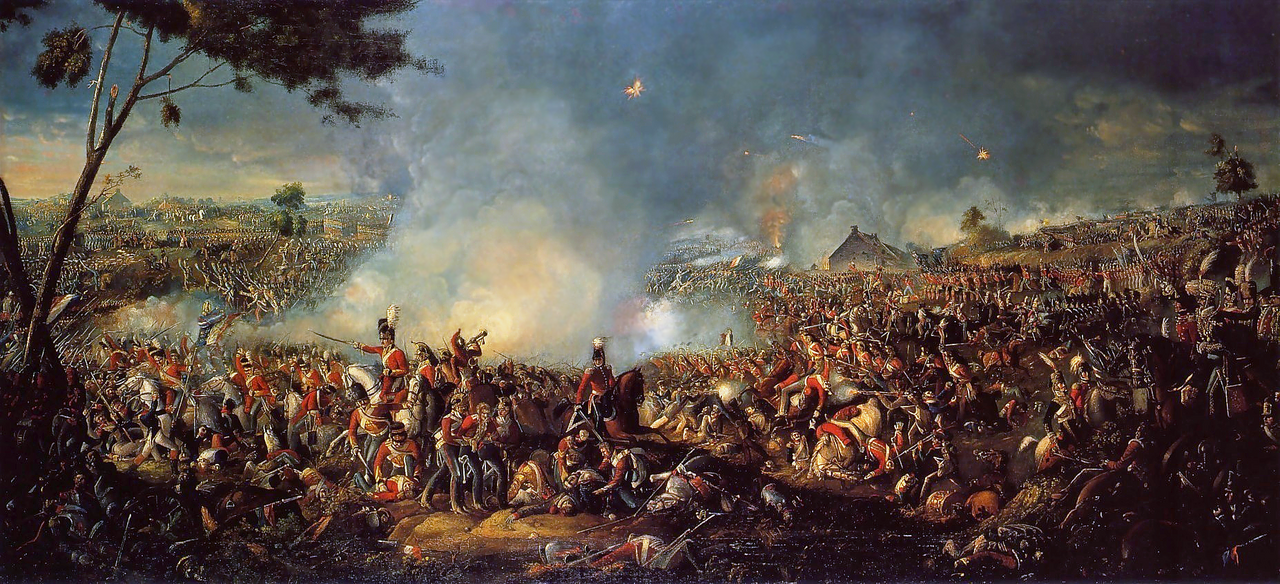
Waterloo was fought on 18 June 1815 on a shallow ridge south of Brussels, after Napoleon's escape from Elba and the 16 June battles at Ligny and Quatre Bras. Wellington's Anglo-Allied army held the ridge; Blucher's Prussians arrived in the afternoon on the French right. Napoleon's last throw ended in a general rout toward Paris.
About 40,000-50,000 men were killed or wounded in a day of artillery, cavalry, and infantry -- a Napoleonic butcher's bill, not a twentieth-century one. Hougoumont, La Haye Sainte, and the misjudged midday start (mud, or waiting for the ground to dry) structure every English account.
The battle closed the Napoleonic Wars in the English schoolroom more than Leipzig had. Belgian tourism, British "nearest-run thing" prose, and Prussian insistence on being in the picture are the memory war that never ended. For this atlas it is the low-scale, high-memory end of an era -- and a rhyme with later "one-day" myths (Midway, Tsushima) that should not be equated.
Date18 Jun 1815
Allied commandersWellington and Blucher
FrenchNapoleon
Casualtiesabout 40-50 thousand
EveQuatre Bras / Ligny 16 Jun
AfterSt Helena
Profile
Scale
22
Intensity
65
Duration
6
Tech shift
25
Political impact
82
Cultural memory
80
Pin a cost beat to a legacy beat
On this topic, pick one published cost band and one legacy lesson already on the page. Educational pairing — not a nation league.
Documented ranges and memory notes only. No ranking of countries, peoples, or armed forces as teams. Not operational advice.
Cost beat already published
Legacy beat already published
Cost or lesson
Theme reading only. Not a nation league.
Deep introduction
A ridge, a delay, and an ally who arrived
Waterloo is a British national day that was an allied day -- and a French catastrophe that Vienna then locked in.
Hundred Days preface
Elba, the 7th Coalition, and Napoleon's strike into Belgium to smash Wellington and Blucher apart. Ligny hurt the Prussians; it did not destroy them.
Grouchy's chase of Blucher is the French what-if that never dies.
The afternoon
Hougoumont soaked men. D'Erlon's attack failed. Ney's cavalry charged squares without enough horse artillery. The Imperial Guard's late attack broke.
Prussian pressure at Plancenoit decided the French right while the ridge still held.
Night and exile
The rout unhooked the army. Paris could not be a second 1814. St Helena followed. Vienna's final act had its battlefield seal.
Casualties on the ridge became a tourist industry within a generation.
Three stories
British: Wellington and the squares. Prussian: Blucher's march. French: mud, Grouchy, and betrayal. All three are in the sources; none is the whole ridge.
Three stories stays dated: 1815-06-18-am (Late start) in Ridge south of Brussels, present-day Belgium. Michel Ney (French marshal) is a named witness -- The cavalry charges and a later execution (1815) made him a romantic ruin. Cost band: about 40,000-50,000 dead and wounded in one day, usual band. Encyclopedia, not a method.
The last Napoleonic set-piece, a Royal Navy-era land decision, and a memory giant.
See also
Napoleonic WarsWaterloo ends the 1803-15 series in English dating.
Royal NavyBritish sea power made the coalition possible; the ridge finished the returned emperor.
World War ILater British memory stacked Waterloo under the same "national military Sunday" habit that 11 November then dominated.
Battle of TsushimaAnother one-day naval-or-field decision in this atlas -- comparison of decisiveness, not of weapons.
Key terms
Hundred Days
Napoleon's 1815 return.
Hougoumont
The chateau fight on Wellington's right.
La Haye Sainte
The farm in the centre that fell late.
Imperial Guard
The last French infantry throw.
Plancenoit
Prussian fight on the French right-rear.
Nearest-run thing
Wellington's caption -- a proverb.
Allies, not a solo
Without Blucher the ridge is a different sentence. English popular memory still under-writes the Prussian march.
Dutch-Belgian troops on the ridge are a third under-shown colour.
Mud and time
The late start is a weather-and-artillery story. It is not a complete explanation of defeat.
Grouchy remains a scapegoat industry.
Tourism as afterlife
The lion mound altered the ground it commemorates -- a warning about memory changing the map.
Keep Tourism as afterlife pinned to 1815-06-18 (D'Erlon / cavalry): Failed centre; Ney's charges. Battle of Waterloo remains a 18 June 1815 file in Ridge south of Brussels, present-day Belgium, not a playbook.
22scaleEditorial 0-100 browsing score
65intensityEditorial 0-100 browsing score
6durationEditorial 0-100 browsing score
25techShiftEditorial 0-100 browsing score
Battle of Waterloo: concrete atlas depth on Tool-Lifes.
Frequently asked questions
Are the scores a ranking of nations or armies?
No. Scores are browsing aids inside an era-bounded atlas — not live league tables of countries.
How many casualties?
About 40,000-50,000 killed and wounded is the usual combined band for the day.
Did Wellington win alone?
No. Blucher's Prussians were decisive in the afternoon. Wellington said as much.
Why did Napoleon lose?
Coalition numbers, a delayed start, failed combined-arms in the centre, and Prussian arrival -- not a single farmhouse.
What happened next?
Second abdication, Allied occupation, St Helena, and Vienna's settlement confirmed.
Why is it so famous in English?
It was the last battle, near a newspaper city, with a British-led army. Leipzig was larger and less English.
Is the site intact?
Mostly farmland with a later lion mound that changed the ridge profile -- memory architecture on a battlefield.