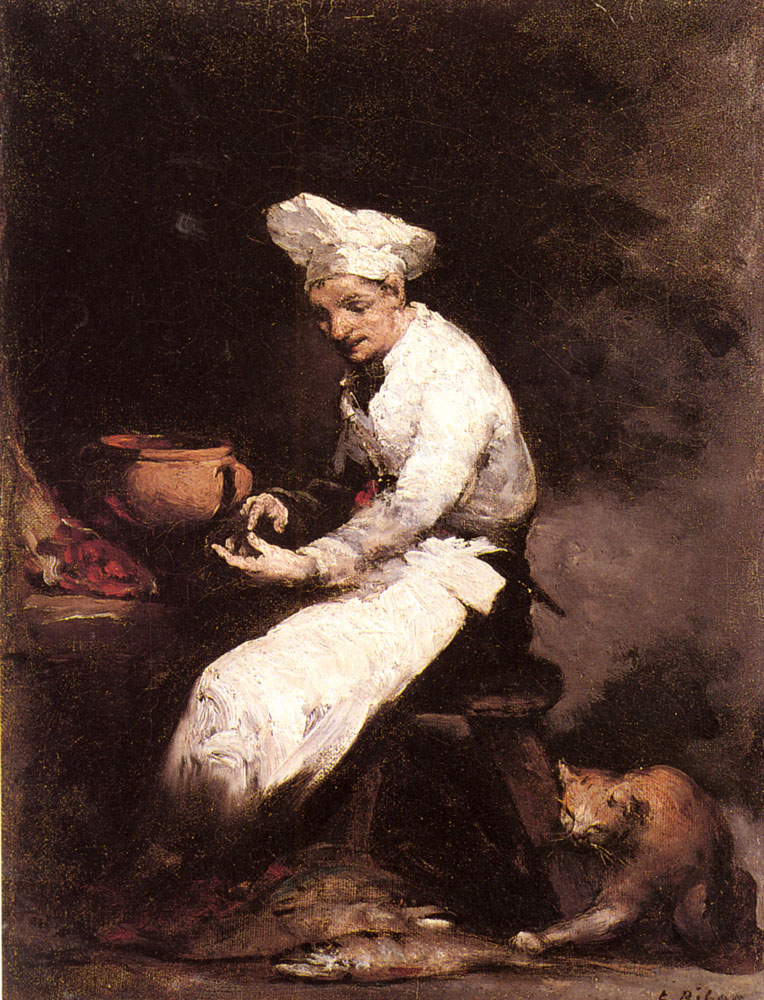
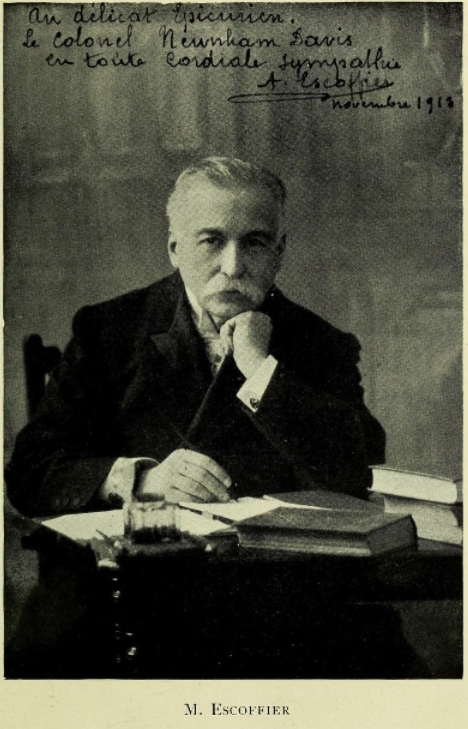
Chef: The professional who commands a kitchen brigade under nightly pressure, from Escoffier's Paris to Osaka's sushi counters and Lima's ceviche bars.
"Chef" comes from the French chef de cuisine, literally "head of the kitchen" — a title that only makes sense once a kitchen has more than one pair of hands in it. Wherever cooking became a paid, specialized trade rather than a household chore, it developed its own hierarchy: apprentice to journeyman in Europe's guilds, commis to chef de partie in the French brigade, "three years for rice, eight for sushi" at a Japanese sushi counter, wok one, two and three in a Cantonese kitchen.
There are two honest ways into the job, and both still work: a culinary school diploma, or simply getting hired as the person who washes lettuce and slowly being trusted with more. Either way, the trade is learned the same way — thousands of repetitions until knife work, seasoning and timing stop being decisions and become reflexes, executed at speed, standing up, for hours, while a room of strangers waits to be fed.
This page follows the job from Carême's sugar-sculpture centerpieces and Escoffier's brigade to Topkapi's sultan's kitchens, Chinese wok hierarchies, Nordic foraging and Lima's ceviche counters. It covers how people actually enter the trade, what a single service demands of the body and the palate, who reached the top of it and why, and how much of the work a machine can realistically do today.
Inside the profession
A chef's work is organised urgency: turning perishable ingredients, limited labour and a room full of expectations into dinner at exactly the same time every night.
The service behind the spectacle
The visible moment is the pass, but the day begins with deliveries, prep lists, stock, sauces, cleaning and a plan for what will run out first. During service, a chef reads tickets, heat, timing and people simultaneously. Good cooking matters; repeatable systems, clear calls and recovery after a mistake matter just as much.
A craft with many economies
A hotel banquet kitchen, neighbourhood bistro, hospital kitchen and tasting-menu restaurant share techniques but not incentives. Some chefs build a personal name; many build a dependable shift. Margin, rent and staffing can determine a menu more forcefully than inspiration, and ownership is a different job from cooking.
Learning by repetition
Culinary school can provide foundations and contacts, but stations teach speed, palate and judgement. Cooks progress by owning a prep task, then a station, then a service. The useful mentor explains why a sauce broke or a team slowed down rather than merely demanding another plate.
What technology cannot plate
Ordering software, combi ovens and recipe systems reduce waste and paperwork. They do not taste a tomato, calm a failing station, negotiate with a fish supplier or sense when a dining room needs the pace to change. The job is becoming more measured, but remains stubbornly physical and social.
How the work branches
Five common shapes of the same title — specialty, setting or career path.
Independent and fine-dining kitchens
Restaurant chef
Builds menus and directs service where consistency is judged plate by plate.
Restaurants, hotels and bakeries
Pastry chef
Works through precision, temperature and advance production rather than the dinner rush alone.
Homes, yachts and travel
Private chef
Plans around one household's tastes, privacy and changing schedules.
Hospitals, schools and workplaces
Institutional chef
Feeds volume within nutrition, safety and budget rules.
Small restaurants and food businesses
Chef-owner
Balances cooking with payroll, purchasing, marketing and survival.
How it reads by country
Same craft, different gatekeeping, status and daily texture — rewritten for readers in each language.
United States — tips, chains and chef brands
Independent kitchens coexist with large restaurant groups, while tip-credit rules and health regulations vary by state. Major cities can turn chefs into public brands, but housing costs make kitchen careers hard to sustain early on.
South Korea — Korean cuisine and fast service
Restaurant work spans barbecue, soup houses, hotel kitchens and a competitive cafe and bakery scene. Delivery platforms and late dining intensify service rhythms; formal culinary careers sit alongside powerful family-business traditions.
Japan — apprenticeship and specialised counters
Long apprenticeships remain influential in sushi, kaiseki and ramen, although hotels and international groups recruit more conventionally. Seasonal ingredients and exact repetition carry prestige, while small counters make the chef's presence part of the meal.
Germany — training routes and regulated kitchens
The Ausbildung route gives many cooks a formal entry, and collective agreements shape some hotel and institutional jobs. Regional cooking, bakery craft and migrant-owned restaurants create distinct career lanes.
United Kingdom — London pressure and pub kitchens
London's restaurant scene offers visibility and demanding rents; elsewhere, pubs, hotels and contract catering employ large numbers of chefs. Apprenticeships compete with informal kitchen progression, and recruitment shortages have reshaped wages.
Singapore — hawker heritage and global hotels
Hawker stalls, hotel brigades and international restaurant groups operate side by side. Ingredients and labour are highly import-dependent, while diners expect both local mastery and rapid access to global food trends.
From the archive
Commons CC/PD images self-hosted for this profession.
Why attitude matters here
A chef's knife skills get someone hired; what keeps them on the line is whether they can hold quality steady on the two-hundredth ticket of a Friday night, not just the first.
Consistency is the actual product
A guest who orders the same dish twice expects the same dish twice, whether it's the first plate of service or the four-hundredth. Talent produces one great plate; attitude produces the same plate at 6pm and at midnight, seasoned the same, cooked the same, sent at the same pace. Kitchens fail on the average plate, and the average is set by whether the cook still cares once the recipe's novelty is gone.
Mistakes get owned in real time, not covered
A dropped ticket, an undercooked piece of fish, a wrong allergy note happen in every kitchen. What separates a safe kitchen from a dangerous one is whether the person who erred says so immediately, at volume, so the pass can react, instead of hoping no one notices and quietly re-firing it. Calling out one's own mistake before it reaches a guest is trained attitude, not technique, and it is the difference between a bad night and a hospitalization.
Apprentices are trusted before they've proven anything
A commis on day one is handed knives, heat, and other people's food and told to keep up. The kitchen runs on the assumption that a new cook will ask before guessing, admit confusion instead of freezing, and take correction without sulking through the next hour. A technically gifted apprentice who can't take a sharp correction mid-service is a liability at every station; one with modest hands but a level head becomes trustworthy within weeks.
Stances that hold up under pressure
Five concrete postures the work rewards, not slogans.
Tastes every component before it leaves the pass
Not glancing at the plate — actually tasting the sauce, the seasoning, the doneness, every single time, even on the fortieth identical order of the night. The cooks who stop tasting because they 'know' the dish is where consistency quietly erodes and no one notices until a regular complains.
Calls 'behind,' 'hot,' and 'corner' every time, not just when convenient
Kitchen safety calls are boring to repeat for the thousandth time, which is exactly why skipping them under pressure is a tell. A cook who stops calling out movement or hot pans as service gets frantic is prioritizing speed over the people working three inches away from them.
Preps for the volume that's actually coming, not the volume that's convenient
Under-prepping to leave earlier, then blaming the rush when the station runs out mid-service, is a pattern that shows up fast to anyone paying attention. The cooks worth keeping prep to Friday's forecast even on a slow Tuesday, because running out at 9pm on a Saturday is not bad luck, it's a choice made three hours earlier.
Keeps station discipline as the ticket count climbs
Mise en place either stays clean and re-set between fires or it degrades into a pile that slows every subsequent plate. Watching whether a cook re-organizes their station during the ninety-second gaps between tickets, rather than only when a chef is looking, reveals whether the discipline is real or performed.
Treats the newest apprentice's questions as worth answering
How a line cook responds to a nervous commis asking the same question twice under pressure — with a real answer or with contempt — predicts how they'll behave once they have their own station and their own apprentices. Kitchens that tolerate contempt toward beginners are training the next generation of people who normalize it.
Moments that reveal it
Situations that separate résumé language from how someone actually practices.
A ticket comes back from the pass because a dish was under-seasoned, and the mistake traces to a mis-en-place error made an hour earlier by someone else on the line.
Does the cook who plated it own the send-out and fix it without first explaining whose fault the prep was, or do they spend the thirty seconds a fix requires instead arguing about blame while the ticket clock runs?
A health inspector arrives unannounced during a slammed Saturday dinner service, and the walk-in has fallen a few degrees out of range since the delivery that morning.
Does the chef flag the temperature issue and pull the affected product before it's asked about, or quietly hope the inspector doesn't check that specific unit while a full dining room keeps ordering off the same menu around them?
Two cooks call out sick on the same Friday night and the pass has no realistic way to run at full speed with the staff remaining.
Does the chef simplify the menu, cut a section, or slow ticket times openly with the front of house, or push the remaining cooks to match full-staff pace and let quality quietly slip on tickets that go out anyway?
A cook is moved to an unfamiliar station — say, from grill to garde manger — for one night because someone is out.
Do they ask the station's regular cook for the actual specs and taste every plate against a reference, or wing it from memory and let a night of substandard salads go out because admitting unfamiliarity felt like a demotion?
Where "calling" turns harmful
"Passion" is the excuse kitchens use to not pay for labor
Unpaid "stages" — trial shifts stretched into weeks of free labor under the promise of a job that may never come — get justified as an aspiring cook proving their passion. The same rhetoric excuses screaming and eighty-hour weeks as the price of a serious calling rather than what they are: labor violations a functioning kitchen does not need in order to run well. The best kitchens hit their standards on paid hours worked by rested people.
The profile
Resists AI78
Pay38
Barrier to entry34
Autonomy72
Demand83
Impact61
How exposed is it to AI?
Low
Roughly a fifth of the work is realistically automatable in the near term — mostly repetitive prep, frying and high-volume assembly at the chain end of the industry. Menu creation, seasoning judgment, sourcing relationships and leading a brigade through live service remain far outside what current robotics or AI can do.
No. Culinary school helps, but the trade's oldest and still most common route is the kitchen apprenticeship: starting as a dishwasher or commis and being promoted on demonstrated skill. Auguste Escoffier, Marie-Antoine Carême and Jiro Ono all learned this way. Employers generally care far more about stage experience and a trusted reference than about a diploma.
How long does it take to become a head chef?
Most cooks reach head chef roughly eight to twelve years after their first kitchen job — a few years learning stations as commis and chef de partie, several more running the pass as sous chef. There is no fixed timetable or exam; promotion depends entirely on a head chef judging you ready to run a kitchen.
What is the difference between a chef and a cook?
In a professional kitchen, a cook executes a dish; a chef — from the French for "head" — is responsible for the menu, the standards and everyone else's work. Every chef has been a cook, but the title formally means leadership, not just skill at the stove, which is why a brigade has only one chef de cuisine.
Is being a chef a well-paid career?
It varies enormously by stage and country. Commis and line cooks are among the lowest-paid skilled trades; in the US the median for chefs and head cooks was about $61,000 in 2024. The real money sits with the small minority who become chef-owners or build a restaurant group, where income comes from the business, not a wage.
What is "staging" in a professional kitchen?
A stage (pronounced the French way, "stahj") is an unpaid or low-paid trial shift, sometimes lasting days and sometimes months, worked at a kitchen the cook wants to learn from or be hired by. It is how cooks build a network and a resume of respected names, and how a head chef sees someone work before offering a job.
Will robots and AI replace chefs?
Not the chef role itself: menu invention, seasoning judgment, sourcing relationships and running a room under live pressure resist automation. But most cooking jobs are not chef jobs — robotic fryers and assembly lines already handle repetitive fast-food stations, which is where the real, measurable job losses to automation are concentrated.
What is the hardest part of becoming a chef?
The years of low pay, long standing shifts and physical strain before wages catch up, combined with an industry-wide turnover rate near 80 percent a year in the US. Burns, cuts and bad knees are routine. Most people who leave the trade cite the hours and the pay long before they cite the cooking itself.
Do you have to train in France to become a top chef?
No — that idea reflects only one tradition among many. Japan's shokunin sushi apprenticeships, Chinese wok-station hierarchies, Ottoman palace kitchens and today's Nordic and Latin American movements each built their own path to mastery, and chefs from Lima to Modena to Tokyo now sit alongside French-trained names on any serious list of the field's best.
Embed this ranking
Paste this code into your blog or site — the ranking stays up to date.