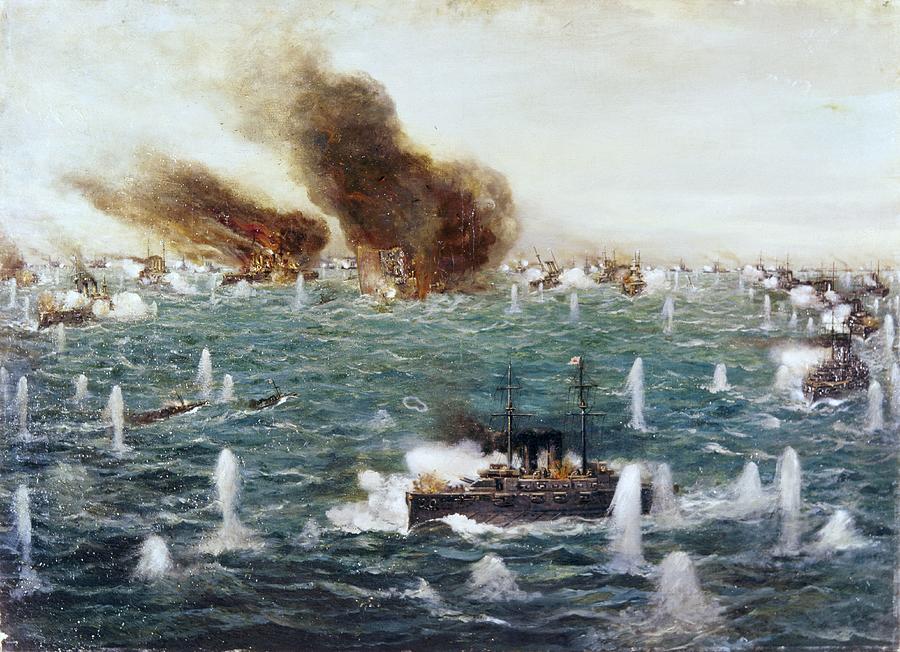
The 27-28 May 1905 fleet action in which Togo Heihachiro destroyed the Russian Baltic Fleet -- a Korean-strait day that ended a war and recast Asian naval hierarchy.
Educational history. Casualty figures are documented ranges. This is not operational advice, a ranking of nations, or a how-to for weapons or coups.
The Battle of Tsushima was fought on 27-28 May 1905 in the strait between Korea and Japan, at the end of the Baltic Fleet's eight-month voyage from Europe. Vice-Admiral Zinovy Rozhestvensky had taken Russia's last European battle line around the Cape after the Dogger Bank fiasco. Admiral Togo Heihachiro waited with the Combined Fleet on interior lines, bunkered and repaired after Port Arthur.
In daylight on the 27th Togo crossed the Russian T -- the manoeuvre English naval histories never tire of drawing. Russian battleships were wrecked by fire and then by night torpedo attacks. Thousands of Russian sailors died or drowned; Japanese dead numbered in the hundreds. The war's naval decision was a weekend; the Treaty of Portsmouth (September 1905) followed under US mediation.
For Korean geography this is a home-water battle: the strait is Korea's door. The political sequel -- Japanese protectorate over Korea (1905) and annexation (1910) -- is not a footnote to Togo's turn. English memory treats Tsushima as a "Trafalgar of the East" and as a rehearsal of 1905 modernity (radio, rangefinders). Pair it with Midway: two decisive days, two orders of the same sea.
Dates27-28 May 1905
VictorTogo / Combined Fleet
Russian fleetRozhestvensky / Baltic Fleet
Crossing the TTogo's turn in the English telling
TreatyPortsmouth, Sep 1905
PlaceStrait beside Korea
Profile
Scale
18
Intensity
60
Duration
5
Tech shift
55
Political impact
64
Cultural memory
50
Pin a cost beat to a legacy beat
On this topic, pick one published cost band and one legacy lesson already on the page. Educational pairing — not a nation league.
Documented ranges and memory notes only. No ranking of countries, peoples, or armed forces as teams. Not operational advice.
Cost beat already published
Legacy beat already published
Cost or lesson
Theme reading only. Not a nation league.
Deep introduction
A world cruise, a strait, and a protectorate
Tsushima was a gunnery action that ended a European fleet and opened a Japanese imperial decade on the Korean peninsula.
The long voyage
Libau to Madagascar to Cam Ranh: a fleet that arrived exhausted, fouled, and politically already damaged by shooting at British trawlers (Dogger Bank). Coaling was a global logistic epic.
Rozhestvensky's choice of the Tsushima route (versus a longer Pacific loop) made the meeting likely.
27-28 May
Togo's "U-turn" and the T, then a night of destroyers. Suvorov, Oslyabya, Borodino, Alexander III -- the named wrecks of the English diagrams.
Nebogatov surrendered remnants on the 28th. The Baltic Fleet ceased to be a tool.
Portsmouth
Roosevelt's mediation, Witte's diplomacy, and a treaty that gave Japan a free hand in Korea and a position in Manchuria -- without a huge indemnity, which sparked riots in Japan.
The war was over; Korea's independence was not saved.
Memory in three countries
Japan: Togo as nelson-like saint. Russia: a humiliation in the revolution year 1905. Korea: a strait battle that licensed a protectorate. English navalism: a proof that "Asiatic" fleets could master the line of battle -- a racist surprise the sources record and we should name.
Memory in three countries stays dated: 1905-05-14 (Baltic Fleet enters the theatre) in Tsushima Strait, between Korea and Japan. Theodore Roosevelt (Mediator) is a named witness -- Portsmouth won him a Nobel and wrote Japan into Korea -- a US diplomatic hinge. Cost band: Russian dead and drowned in the thousands; Japanese dead in the hundreds -- a lopsided fleet action. Encyclopedia, not a method.
1905 in a Korean strait, a cousin of Trafalgar in English talk, and a preface to Japanese rule in Korea.
See also
Royal NavyThe English comparison is Trafalgar -- a dangerous compliment that hides Korea.
Battle of MidwayThe other decisive Pacific-adjacent fleet day in this atlas.
Republic of Korea Armed ForcesA much later Korean navy exists in waters Togo once commanded -- history, not a live ORBAT.
Korean WarA later war in the same peninsula's waters and politics -- not a sequel of 1905, but a reminder that this strait stayed a great-power door.
Key terms
Crossing the T
Togo's daylight manoeuvre in the English diagram -- historical, not a current tactic to run.
Baltic Fleet voyage
The eight-month cruise that arrived already half-beaten.
Dogger Bank
1904 shooting of British trawlers -- a political wound on the voyage.
Mikasa
Togo's flagship, now a museum.
Portsmouth
September 1905 treaty.
Protectorate 1905
The Korean political sequel of the same year.
Korea is not a backdrop
The strait's politics are Korean independence, not only Russian and Japanese honour.
Eulsa 1905 follows Tsushima as a diplomatic violence.
Race and surprise
European commentary that "Asiatics" had won a line-of-battle fight is a primary source of 1905 racism. Quote it as evidence, not as analysis to repeat.
Japan's own imperial project in Korea was not a liberation.
Radio and range
Wireless and modern gunnery are the tech-shift story -- described, not as a fire-control manual.
Keep Radio and range pinned to 1905-05-27-28 (Night torpedoes): Destroyers finish cripples. Battle of Tsushima remains a 27-28 May 1905 file in Tsushima Strait, between Korea and Japan, not a playbook.
18scaleEditorial 0-100 browsing score
60intensityEditorial 0-100 browsing score
5durationEditorial 0-100 browsing score
55techShiftEditorial 0-100 browsing score
Battle of Tsushima: concrete atlas depth on Tool-Lifes.
Frequently asked questions
Are the scores a ranking of nations or armies?
No. Scores are browsing aids inside an era-bounded atlas — not live league tables of countries.
How many died?
Russian dead and drowned number in the thousands; Japanese dead in the hundreds. Treat published figures as a lopsided band, not a parade integer.
Why did Russia lose so badly?
A exhausted fleet after a world cruise, a fresher Japanese fleet on interior lines, better gunnery and tactics that day, and a meeting on Togo's chosen water.
What was crossing the T?
A line-of-battle geometry in which Togo's fleet brought broadsides to bear on the Russian van. It is a 1905 event in the diagrams, not a lesson to apply to modern missiles.
What did the Treaty of Portsmouth do to Korea?
It recognised Japan's paramount interest in Korea. The Eulsa protectorate followed in November 1905; annexation in 1910. The naval victory had a colonial sequel.
How does it compare to Midway?
Both were short, decisive fleet actions that recast who could use the sea. 1905 was battleships; 1942 was carriers. Do not flatten them into one "decisive battle" brand.
Who commanded?
Togo Heihachiro (Combined Fleet); Kamimura and others in supporting roles; Rozhestvensky (wounded/captured) and Nebogatov (surrender) for Russia.