At a glance
Battle of Tsushima · taglineThe 27-28 May 1905 fleet action in which Togo Heihachiro destroyed the…
Battle of Tsushima · In daylight on the 27th Togo crossed the Russian T -- the manoeuIn daylight on the 27th Togo crossed the Russian T -- the manoeuvre English…
Battle of Tsushima · For Korean geography this is a home-water battle: the strait is For Korean geography this is a home-water battle: the strait is Korea's door.…
Battle of Tsushima · paras 1Libau to Madagascar to Cam Ranh: a fleet that arrived exhausted, fouled, and…
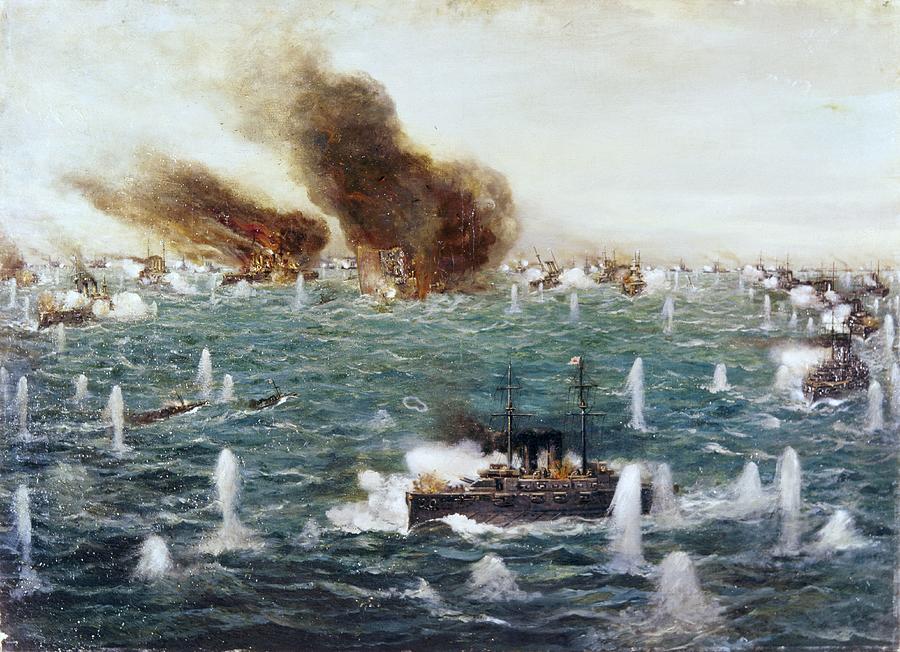
In daylight on the 27th Togo crossed the Russian T -- the manoeuvre English naval histories never tire of drawing. Russian battleships were wrecked by fire and then by night torpedo attacks. Thousands of Russian sailors died or drowned; Japanese dead numbered in the hundreds. The war's naval decision was a weekend; the Treaty of Portsmouth (September 1905) followed under US mediation.
Battle of Tsushima · tagline
The 27-28 May 1905 fleet action in which Togo Heihachiro destroyed the Russian Baltic Fleet -- a Korean-strait day that ended a war and recast Asian naval hierarchy. The Battle of Tsushima was fought on 27-28 May 1905 in the strait between Korea and Japan, at the end of the Baltic Fleet's eight-month voyage from Europe.
Battle of Tsushima · In daylight on the 27th Togo crossed the Russian T -- the manoeu
In daylight on the 27th Togo crossed the Russian T -- the manoeuvre English naval histories never tire of drawing. Russian battleships were wrecked by fire and then by night torpedo attacks. Thousands of Russian sailors died or drowned; Japanese dead numbered in the hundreds. The war's naval decision was a weekend; the Treaty of Portsmouth (September 1905) followed under US mediation.
Battle of Tsushima · For Korean geography this is a home-water battle: the strait is
For Korean geography this is a home-water battle: the strait is Korea's door. The political sequel -- Japanese protectorate over Korea (1905) and annexation (1910) -- is not a footnote to Togo's turn. English memory treats Tsushima as a "Trafalgar of the East" and as a rehearsal of 1905 modernity (radio, rangefinders). Pair it with Midway: two decisive days, two orders of the same sea.
Battle of Tsushima · paras 1
Libau to Madagascar to Cam Ranh: a fleet that arrived exhausted, fouled, and politically already damaged by shooting at British trawlers (Dogger Bank). Coaling was a global logistic epic. Togo's "U-turn" and the T, then a night of destroyers. Suvorov, Oslyabya, Borodino, Alexander III -- the named wrecks of the English diagrams.
This explains a campaign, battle, or weapon in context. It is not a league of nations. It does not replace the full topic page.
Questions
- What is the next question after this?
- For Korean geography this is a home-water battle: the strait is Korea's door. The political sequel -- Japanese protectorate over Korea (1905) and annexation (1910) -- is not a footnote to Togo's turn. English memory treats Tsushima as a "Trafalgar of the East" and as a rehearsal of 1905 modernity (radio, rangefinders). Pair it with Midway: two decisive days, two orders of the same sea.
- Does this page rank people or nations?
- This explains a campaign, battle, or weapon in context. It is not a league of nations. It does not replace the full topic page.
- Where is the longer entry?
- Libau to Madagascar to Cam Ranh: a fleet that arrived exhausted, fouled, and politically already damaged by shooting at British trawlers (Dogger Bank). Coaling was a global logistic epic. Togo's "U-turn" and the T, then a night of destroyers. Suvorov, Oslyabya, Borodino, Alexander III -- the named wrecks of the English diagrams.
Next question: United States military · Open the topic: Battle of Tsushima
Why is "a single assassination headline" the wrong stop when reading the August mobilization in 1914? · Why is "a paper count of tanks" the wrong stop when reading the campaign in France in 1940? · Why is "the landing nickname alone" the wrong stop when reading the Inchon landing in 1950? · Why is "a body-count column" the wrong stop when reading the Tet offensive in 1968? · Why is "the battle nickname alone" the wrong stop when reading Austerlitz in 1805? · Why is "one casualty total" the wrong stop when reading Gettysburg in 1863? · 50 campaign reading notes