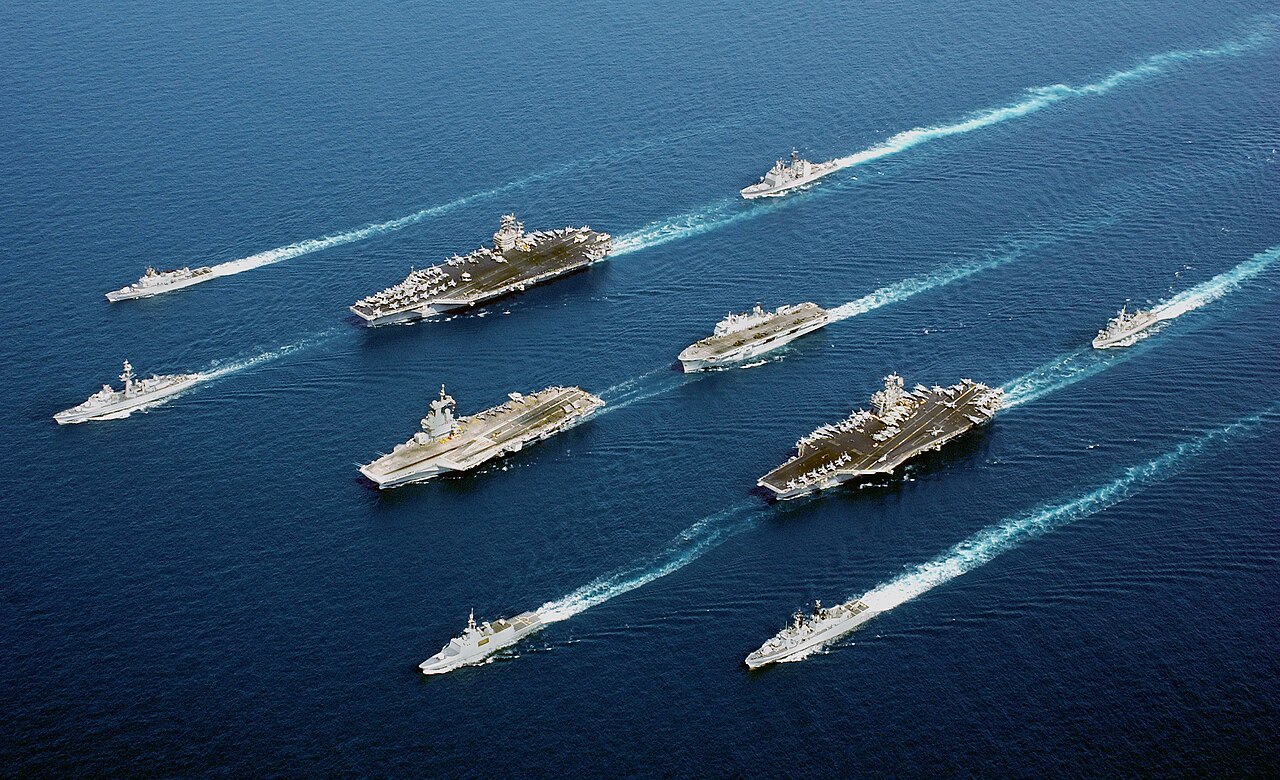
The aircraft carrier grew from 1918-22 experiments (HMS Argus, Hosho, Langley) into the Pacific war's decisive capital ship. Taranto (1940) and Pearl Harbor showed the type's reach; Midway showed that carriers could destroy each other without sighting a battleship. This page is that history -- not a deck-cycle or navigation manual.
The US Essex class and then Forrestal-to-Nimitz "supercarriers" made the type a political object: a sovereign airfield that can sit off a coast. Britain's retreat from large-deck aviation (CVA-01 cancelled, Invincible-class VTOL, then Queen Elizabeth) is a fiscal-political story. Soviet/Russian and later Chinese carriers are a different design culture (ski-jump, then catapult experiments).
English memory is Midway films and a city-sized US deck. Korean memory is Inchon's carrier air (1950) and later alliance decks in nearby seas -- plus a domestic debate about aviation ships that this page will not umpire as a live programme. TechShift is high; intensity is that of a type, not a war.
EarlyArgus / Hosho / Langley 1918-22
ProofTaranto 1940; Midway 1942
US typeEssex then supercarriers
NuclearEnterprise 1961; Nimitz class
OthersRN, MN, PLAN, INS -- historical
ROKLPX / aviation-ship debates -- open politics, not an ORBAT
Profile
Scale
42
Intensity
40
Duration
75
Tech shift
82
Political impact
60
Cultural memory
64
Pin a cost beat to a legacy beat
On this topic, pick one published cost band and one legacy lesson already on the page. Educational pairing — not a nation league.
Documented ranges and memory notes only. No ranking of countries, peoples, or armed forces as teams. Not operational advice.
Cost beat already published
Legacy beat already published
Cost or lesson
Theme reading only. Not a nation league.
Deep introduction
A deck that ate the battleship's prestige
The carrier is an industrial-political system -- air wing, escorts, and a state's decision to be present at sea -- told as history.
1918-1941
Experiments, the Washington Treaty's carrier clauses, and the 1940-41 shocks (Taranto, Pearl Harbor, Bismarck's air wound).
Battleship admirals lost an argument the wrecks then settled.
1942-45
Midway, the Philippine Sea, kamikaze as a late reply. Escort carriers as a second type for convoys and landings (Inchon's air came from decks).
No current strike-planning content.
1946-91
Nuclear propulsion (Enterprise, 1961), the US supercarrier as alliance theatre, the RN's political retreat, the Soviet Kiev/Kuznetsov path.
Vietnam and later crises used decks as diplomacy.
After 1991
Chinese carrier public progress, Indian and French large decks, ROK LPX/aviation debates in open press -- dated as politics, not as a building guide or a threat table.
After 1991 stays dated: 1941-12 (Pearl Harbor) in From the North Sea experiments to the Pacific and later US forward presence. Jackie Fisher / early RN (RN pioneer context) is a named witness -- The RN's early aviation-at-sea culture -- Argus as a British first. Cost band: not a war -- sailor and aircrew deaths sit on the battle pages (Midway, etc.). Encyclopedia, not a method.
Battle of InchonCarrier air as part of Chromite's preparation -- a Korean meeting.
Royal NavyThe first experimenter and a later political retreat from large decks.
United States militaryThe supercarrier as a US force-structure fact -- historical, not a live deployment list.
Key terms
Flattop
Sailor slang that became civilian.
Air wing
The embarked aviation -- the reason the hull exists.
CATOBAR / STOBAR / STOVL
Launch-recovery families -- named as history, not as a design class.
Essex class
The US WWII mass type.
Supercarrier
Post-Forrestal US large-deck political object.
Escort carrier
The small second type of 1942-45.
Presence as politics
A deck offshore is a diplomatic sentence. History is full of those sentences; this is not a crisis playbook.
Budgets decide whether the sentence can be said.
Korea 1950
UN carriers were a daily fact of the air war and of Inchon.
The type met the peninsula as an alliance tool.
Who can afford a deck
A short list of states -- a political-economy fact, not a shopping list.
Keep Who can afford a deck pinned to 1944-45 (Philippine Sea / kamikaze): Mass decks and a late reply. Aircraft carrier remains a 1918-present (as a type; decisive 1940-45) file in From the North Sea experiments to the Pacific and later US forward presence, not a playbook.
42scaleEditorial 0-100 browsing score
40intensityEditorial 0-100 browsing score
75durationEditorial 0-100 browsing score
82techShiftEditorial 0-100 browsing score
Aircraft carrier: concrete atlas depth on Tool-Lifes.
Frequently asked questions
Are the scores a ranking of nations or armies?
No. Scores are browsing aids inside an era-bounded atlas — not live league tables of countries.
What happened at Midway?
Carrier air groups destroyed four Japanese fleet carriers. See the Midway page. This page is the type's longer story.
Why do few states operate large carriers?
Cost, bases, escorts, and air wings -- a political-industrial threshold. History names who crossed it; this is not advice to cross it.
How did Korea meet the type?
UN carrier air in 1950-53, including Inchon's preparation. Later US decks in regional crises are alliance history -- not a current tracker.
What is a supercarrier?
A post-1955 US term for the Forrestal-and-after large CATOBAR decks, later nuclear-powered. A political size as much as a tonnage.
Did Britain abandon carriers?
It abandoned CVA-01 and large CATOBAR for a period, used VTOL Invincible-class decks, then built Queen Elizabeth-class large decks -- a political arc, not a simple funeral.
Are carriers obsolete vs missiles?
A cyclical headline, like "tanks are dead." This page records the argument's history, not a 2026 verdict or a vulnerability cookbook.