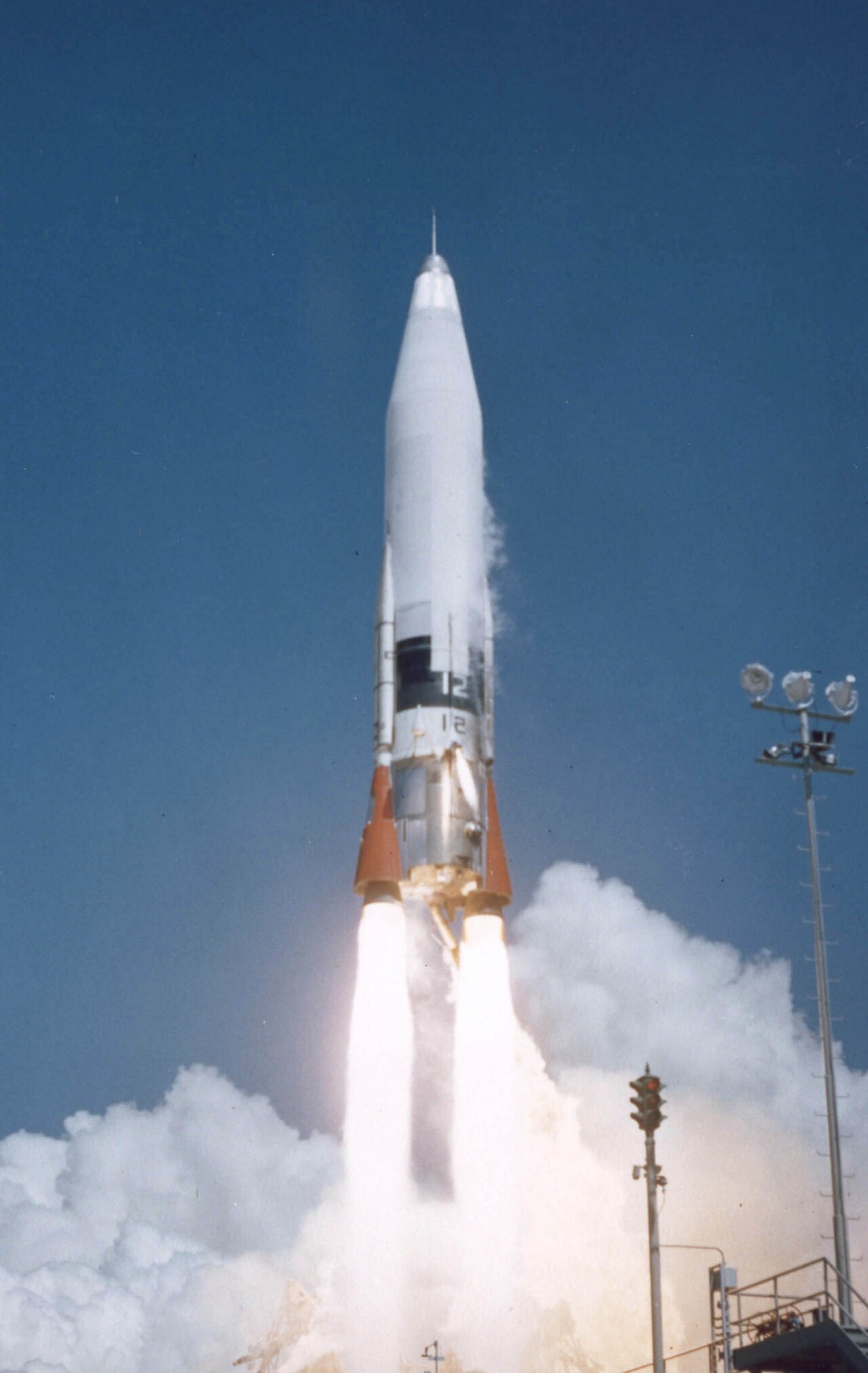
The intercontinental ballistic missile is a Cold War political object with a Second World War grandfather. Germany's V-2 (first combat use 8 September 1944 against Paris; London from 8 September as well in the British memory) proved a liquid-fuel rocket could carry a warhead across a country. It did not decide 1945. It decided who would hire Wernher von Braun and who would hire the Soviet teams that became Sergei Korolev's bureau.
On 21 August 1957 the Soviet R-7 flew as the first intercontinental ballistic missile. Sputnik followed on 4 October. The United States answered with Atlas (operational 1959), Titan, and then the solid-fuel Minuteman (1962) that made silo fields a civic landscape in the Great Plains. Submarine-launched ballistic missiles (Polaris, 1960) hid the same idea at sea. This page is that history -- ranges, treaties, crises -- not a guide to building, aiming, or launching anything.
TechShift in this atlas is near the ceiling: the ICBM recast deterrence, civil defence, and the meaning of "surprise." Intensity is moderate because the type's main career was non-use. Cultural memory is Dr. Strangelove, the 1983 Able Archer scare, and school-desk "duck and cover." Korean memory is the peninsula as a nuclear-adjacent theatre after 1953, not a silo field of its own in the 1960s -- a distinction this file will keep.
AncestryV-2, 1944-45
First ICBM flightR-7, 21 Aug 1957
US pairAtlas (1959) then Minuteman
Crisis hingeCuba, Oct 1962
Arms controlSALT, INF, START, New START
Sea cousinSSBN / SLBM
Profile
Scale
75
Intensity
35
Duration
62
Tech shift
96
Political impact
85
Cultural memory
72
Pin a cost beat to a legacy beat
On this topic, pick one published cost band and one legacy lesson already on the page. Educational pairing — not a nation league.
Documented ranges and memory notes only. No ranking of countries, peoples, or armed forces as teams. Not operational advice.
Cost beat already published
Legacy beat already published
Cost or lesson
Theme reading only. Not a nation league.
Deep introduction
A rocket that became a treaty subject
The ICBM is less a battlefield weapon than a diplomatic fact: flight tests, false alarms, and numbered limits on paper.
V-2 to R-7
Peenemunde, Mittelbau-Dora slave labour, and the 1945 scramble for teams and drawings are the unethical start. Korolev's R-7 was a missile that could also throw a satellite -- politics in a first stage.
No propulsion or re-entry cookbook belongs here. The sentence is: a 1944 city-attack rocket became a 1957 intercontinental type.
Two forces, one crisis
SAC under LeMay and later Schriever's missileers built a US land leg. The Strategic Rocket Forces became a Soviet service. October 1962 put medium-range missiles in Cuba and ICBM alert in the background of thirteen days.
McNamara's "assured destruction" language is a dated staff dialect, not a present targeting brief.
Treaties as the real campaign
SALT I (1972), the ABM Treaty, SALT II (signed 1979, unratified), INF (1987), START I (1991), and New START (2010, extended 2021) are the ICBM's political battles. Cheating scandals and verification trains are part of that file.
A treaty is a limit on a type -- described as history, not as a bargaining manual.
After the Cold War
Ukraine's inherited missiles were transferred in the 1990s Budapest story. New states tested long-range rockets. The type did not retire. This page still will not teach a test or a silo procedure.
Korea enters as a later regional missile-politics reader, not as a 1957 operator.
Fighter jetThe air-breathing cousin in the triad story -- bombers, not a how-to.
Key terms
V-2
German 1944-45 ballistic rocket -- the type's grandfather.
R-7
First ICBM flight, 21 August 1957; also Sputnik's launcher.
Minuteman
US solid-fuel silo ICBM from 1962 -- a civic landscape in the Plains.
Triad
Land ICBM, bomber, and SLBM as three legs -- a dated US doctrine word.
SALT / START
The numbered treaty families that made the type a diplomatic object.
Fail deadly / fail safe
Popular English for command arrangements -- named as debate, not as a switch primer.
Non-use as the career
The ICBM's main historical fact is that the large Cold War types were not fired in anger.
That fact is why intensity is scored below world wars and why this page is a political file.
Verification
Satellites, on-site inspectors, and telemetry limits were the unglamorous campaign.
A treaty without counting rules is a press release -- a historical lesson, not a present brief.
False alarms
The 1979 NORAD tape incident and the 1983 Petrov story sit in the public file as close calls.
They are arguments for human judgment in a dated system -- not a current watch-floor guide.
75scaleEditorial 0-100 browsing score
35intensityEditorial 0-100 browsing score
62durationEditorial 0-100 browsing score
96techShiftEditorial 0-100 browsing score
Intercontinental ballistic missile: concrete atlas depth on Tool-Lifes.
Frequently asked questions
Are the scores a ranking of nations or armies?
No. Scores are browsing aids inside an era-bounded atlas — not live league tables of countries.
Did ICBMs come from the V-2?
Teams, drawings, and the idea of a ballistic rocket did. Range, warhead, and guidance of the 1957-62 types were a different industrial generation. Mittelbau-Dora slave labour is part of the V-2 ledger.
What was the Cuban Missile Crisis to this type?
October 1962 was about medium-range missiles in Cuba and a US blockade, with ICBM and bomber forces on high alert in the background. It is a political crisis file, not a firing drill.
What did SALT and START do?
They capped and later reduced declared launchers and warheads, with verification. SALT I is 1972; START I is 1991; New START is 2010. Details belong to the treaty texts, not to a targeting lesson.
How does the submarine page relate?
SSBNs carry SLBMs -- the sea leg of the same deterrent idea. See that page for boats; this page for land missiles and the shared treaty story.
How does Korea fit?
The ROK was not a 1950s ICBM operator. The peninsula sits in later extended-deterrence and regional missile politics -- described as history, not as a live threat map.
Why is techShift so high here?
Because the type changed what "surprise attack" and "alliance guarantee" meant after 1957, more than it changed any single battlefield.
Is this a how-to?
No. No design, fuel, guidance, or launch content. Encyclopedia of a political-technical type only.