At a glance
Thirty Years' War · The Thirty Years' War opened with the Defenestration of Prague oThe Thirty Years' War opened with the Defenestration of Prague on 23 May…
Thirty Years' War · About 4-8 million people died in the Empire, scholarly range -- About 4-8 million people died in the Empire, scholarly range -- a demographic…
Thirty Years' War · The Peace of Westphalia (Munster and Osnabruck, 24 October 1648)The Peace of Westphalia (Munster and Osnabruck, 24 October 1648) resettled…
Thirty Years' War · paras 1The 1618 revolt and Frederick V's brief winter kingship ended at White…
About 4-8 million people died in the Empire, scholarly range -- a demographic disaster in parts of Germany from battle, typhus, famine and marauding armies that lived off the land. Magdeburg's 1631 sack became the emblem of civilian horror. Gustavus Adolphus of Sweden won at Breitenfeld (1631) and died at Lutzen (1632).
Thirty Years' War · The Thirty Years' War opened with the Defenestration of Prague o
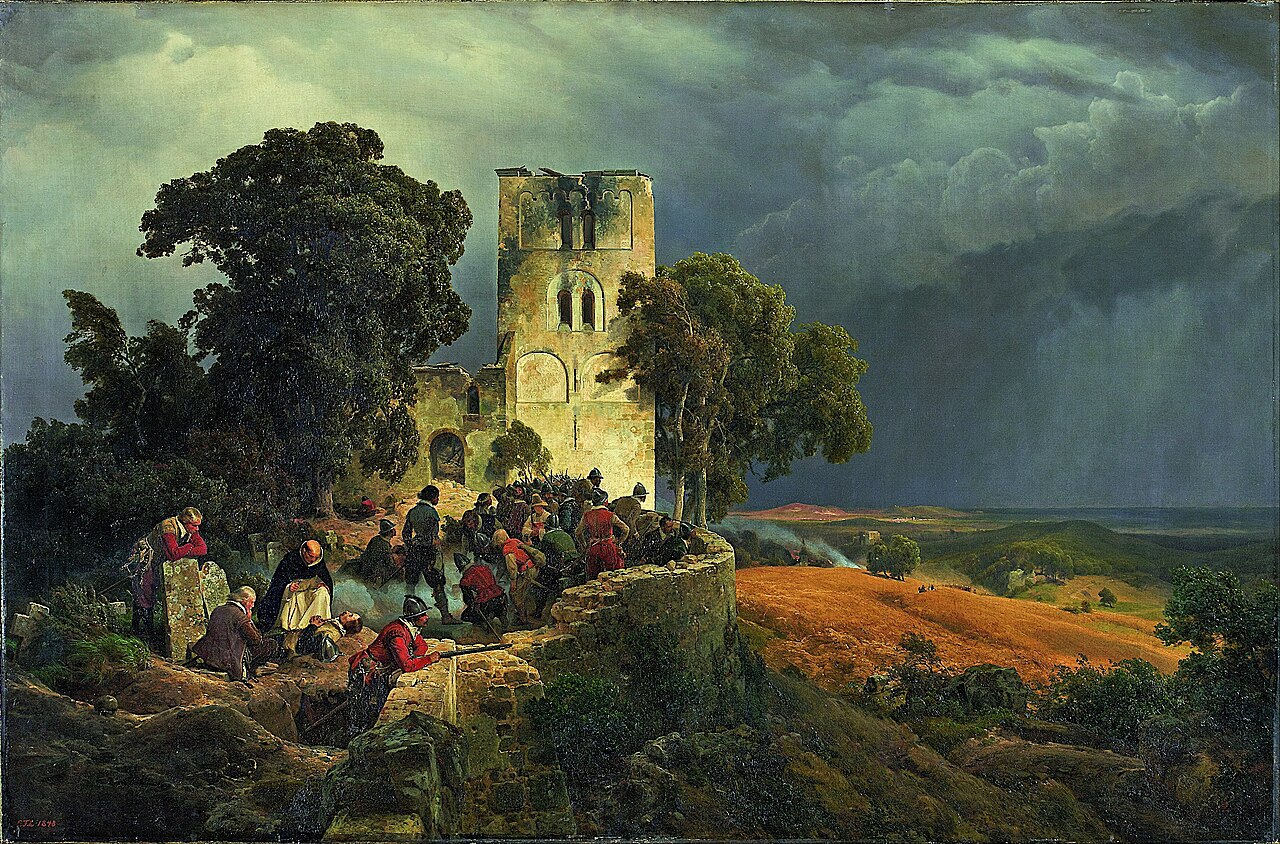
The Thirty Years' War opened with the Defenestration of Prague on 23 May 1618, when Bohemian Protestant estates threw Habsburg officials from a window. What began as a Bohemian revolt inside the Holy Roman Empire became a European war as the Palatinate, Denmark, Sweden and France entered against the Habsburgs and the Catholic League.
Thirty Years' War · About 4-8 million people died in the Empire, scholarly range --
About 4-8 million people died in the Empire, scholarly range -- a demographic disaster in parts of Germany from battle, typhus, famine and marauding armies that lived off the land. Magdeburg's 1631 sack became the emblem of civilian horror. Gustavus Adolphus of Sweden won at Breitenfeld (1631) and died at Lutzen (1632).
Thirty Years' War · The Peace of Westphalia (Munster and Osnabruck, 24 October 1648)
The Peace of Westphalia (Munster and Osnabruck, 24 October 1648) resettled religion in the Empire, recognised Dutch and Swiss facts, and became a later textbook label for "sovereignty." English memory is thinner than for Waterloo or 1914; German local memory of emptied villages is thicker.
Thirty Years' War · paras 1
The 1618 revolt and Frederick V's brief winter kingship ended at White Mountain (8 November 1620). Habsburg reconquest brought forced re-Catholicisation and exile -- a Bohemian tragedy that later Czech memory never treated as a German footnote.
This explains a campaign, battle, or weapon in context. It is not a league of nations. It does not replace the full topic page.
Questions
- What is the next question after this?
- The Peace of Westphalia (Munster and Osnabruck, 24 October 1648) resettled religion in the Empire, recognised Dutch and Swiss facts, and became a later textbook label for "sovereignty." English memory is thinner than for Waterloo or 1914; German local memory of emptied villages is thicker.
- Does this page rank people or nations?
- This explains a campaign, battle, or weapon in context. It is not a league of nations. It does not replace the full topic page.
- Where is the longer entry?
- The 1618 revolt and Frederick V's brief winter kingship ended at White Mountain (8 November 1620). Habsburg reconquest brought forced re-Catholicisation and exile -- a Bohemian tragedy that later Czech memory never treated as a German footnote.
Next question: Battle of Tsushima · Open the topic: Thirty Years' War
Why is "a single assassination headline" the wrong stop when reading the August mobilization in 1914? · Why is "a paper count of tanks" the wrong stop when reading the campaign in France in 1940? · Why is "the landing nickname alone" the wrong stop when reading the Inchon landing in 1950? · Why is "a body-count column" the wrong stop when reading the Tet offensive in 1968? · Why is "the battle nickname alone" the wrong stop when reading Austerlitz in 1805? · Why is "one casualty total" the wrong stop when reading Gettysburg in 1863? · 50 campaign reading notes