🧮The Greats

Mathematician · From Babylonian scribes to Fields medalists and AI-assisted proof: the profession that turns hard questions into permanent certainty, one theorem at a time.

Choosing eight names from twenty-five centuries is an argument, not a census, and it necessarily wrongs whole civilizations of unrecorded talent — the Kerala school alone anticipated European calculus by two hundred years and barely enters Western histories. The eight below are chosen because each permanently changed what mathematics is or who is allowed to do it, and because their stories are documented and checkable.

They span Syracuse, Baghdad, the Swiss-Russian academies, Göttingen, Madras, Moscow-era Stockholm and Tehran. Three are women who had to break the profession open before they could work in it. None of them fits the lone-genius myth cleanly: every one depended on a patron, a teacher, a letter answered or a door someone else forced.

The all-time podium

Al-Khwarizmi
Al-Khwarizmi
Khwarazm / Abbasid Baghdad
2
Archimedes
Archimedes
Syracuse (Greek Sicily)
1
Leonhard Euler
Leonhard Euler
Switzerland / Russia / Prussia
3

The eight who reached the top

1
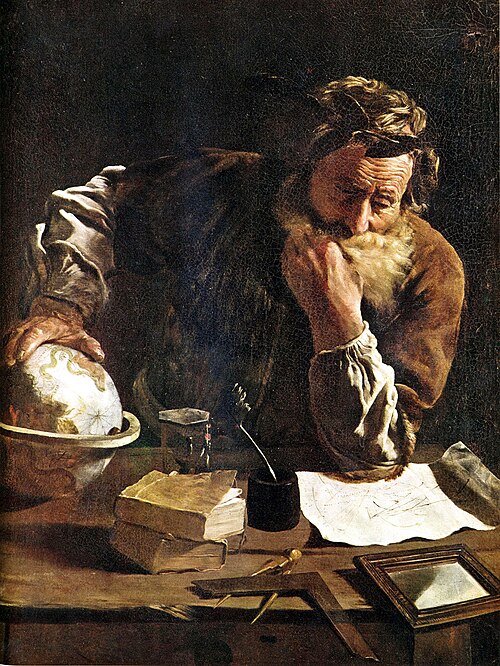
Classical depiction of Archimedes of Syracuse. Domenico Fetti · Public domain

Archimedes

Syracuse (Greek Sicily) · c. 287–212 BCE

Archimedes computed pi more tightly than anyone before him, found areas and volumes by summing infinitely many slices, and anticipated the integral calculus by nearly two millennia. He treated rigorous proof and physical intuition as one instrument — and his war machines held Rome's fleet off Syracuse for over two years.

The story

Archimedes asked that his tomb carry no inscription of his victories, only a diagram: a sphere inside a cylinder, marking his proof that the sphere fills exactly two-thirds of the cylinder enclosing it. In 75 BCE, 137 years after a Roman soldier killed him during the sack of Syracuse, the Roman quaestor Cicero went looking for the grave, found it near the Agrigentine gate overgrown with thorns and forgotten by the Syracusans themselves, and identified it by that small carved figure — the result its owner had judged his finest.

“Judge your work by the theorem you would put on your tomb, not by the applause it earned.”
Bounds on pi
223/71 < π < 22/7
Years ahead of calculus
~1,900
Treatises surviving
About a dozen
2
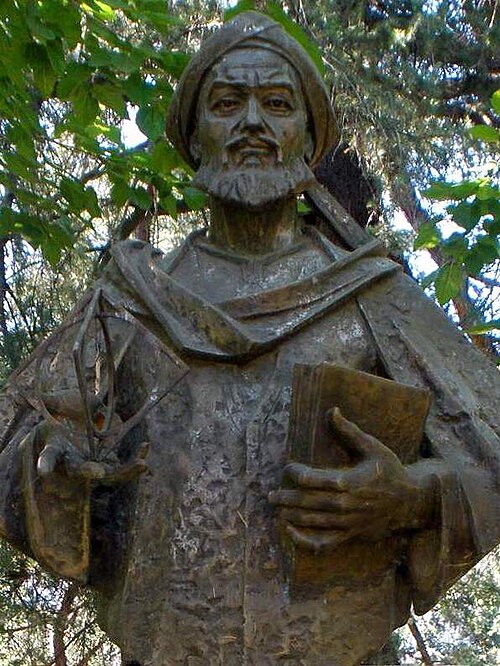
Statue commemorating the Persian mathematician al-Khwarizmi. Zarateman · CC0

Al-Khwarizmi

Khwarazm / Abbasid Baghdad · c. 780–850

Working at Caliph al-Ma'mun's House of Wisdom in ninth-century Baghdad, al-Khwarizmi wrote the treatise that named algebra — al-jabr, "restoring" — and the arithmetic that carried Indian decimal numerals westward. The Latin rendering of his name, Algoritmi, became the word "algorithm": one career, two fields named.

The story

His algebra was written as a manual for practical life: its longest sections work out Islamic inheritance law, dividing estates among widows, sons and daughters in the prescribed shares, alongside problems of trade and canal-digging. When Robert of Chester translated the book into Latin in 1145, European scholars encountered equation-solving as a systematic discipline for the first time, and the Arabic al-jabr of his title hardened, through Spanish and Latin mouths, into the permanent name of the subject.

“Organize a method clearly enough and it can outlive your language, your empire and the spelling of your name.”

Everyday words from his work
algebra & algorithm
Written under caliph
al-Ma'mun, c. 820
Centuries as a European text
400+
3
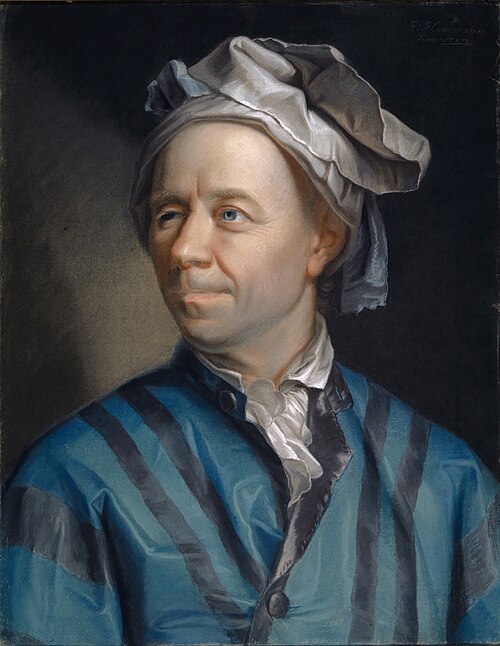
Portrait of Leonhard Euler, the most prolific mathematician in history. Jakob Emanuel Handmann · Public domain

Leonhard Euler

Switzerland / Russia / Prussia · 1707–1783

Euler is the most prolific mathematician who ever lived — his collected works exceed eighty volumes — and he gave the field its modern voice: e, i, the function notation f(x) and the summation sign are all his. Salaried by the academies of St Petersburg and Berlin, he solved whatever the eighteenth century asked.

The story

Euler lost his right eye in 1738 and nearly all remaining sight after a failed cataract operation in 1771, and simply reorganized: dictating to assistants around a table, he produced roughly half his life's output after going blind, remarking that he now had fewer distractions. On 18 September 1783 he spent the afternoon calculating the flight of the newly invented Montgolfier balloons and the orbit of the recently discovered planet Uranus, then collapsed mid-conversation with his family. Condorcet's eulogy ends: "he ceased to calculate and to live."

“Build methods and habits strong enough to carry the work through catastrophes that would end most careers.”

Collected works
80+ volumes
Output produced while blind
~half
Notation still standard
e, i, f(x), Σ
4
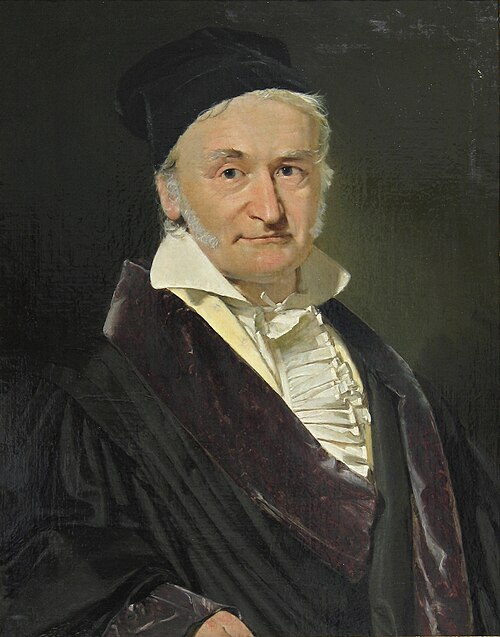
Portrait of Carl Friedrich Gauss, the 'prince of mathematicians'. Christian Albrecht Jensen · Public domain

Carl Friedrich Gauss

Germany · 1777–1855

From Göttingen, Gauss dominated half a century of mathematics — number theory, geometry, astronomy, magnetism, statistics — publishing under the motto "few, but ripe." His Disquisitiones Arithmeticae, published at 24, turned number theory into a systematic discipline, and contemporaries simply called him the prince of mathematicians.

The story

On 30 March 1796, the eighteen-year-old Gauss proved that a regular seventeen-sided polygon can be constructed with compass and straightedge — the first advance on that classical problem in two thousand years — and by his own account the discovery decided him for mathematics over philology. He began his famous scientific diary the same week. He wanted a heptadecagon carved on his gravestone; the stonemason reportedly refused, saying it would be indistinguishable from a circle, so the memorial in his native Braunschweig bears a seventeen-pointed star instead.

“One decisive early result can settle what a life is for.”

Age at the 17-gon proof
18 (1796)
Disquisitiones published at
24 (1801)
Years the problem had waited
~2,000
5
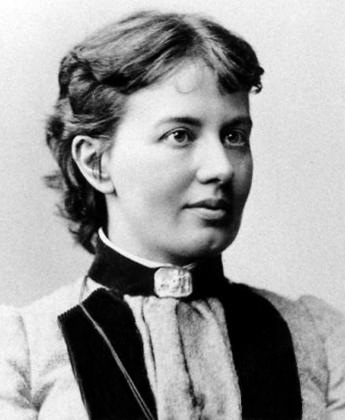
Photograph of Sofya Kovalevskaya, the first woman to hold a full professorship in mathematics in modern Europe. Unknown author Unknown author · Public domain

Sofya Kovalevskaya

Russia / Sweden · 1850–1891

Barred from Russian universities by her sex, Kovalevskaya became the first woman in modern Europe to hold a full professorship in mathematics, at Stockholm in 1889, and won the French Academy's Prix Bordin in 1888 for the rotating rigid body — the "Kovalevskaya top" — a solution judged so remarkable the prize money was increased.

The story

At eighteen she contracted a fictitious marriage with the young paleontologist Vladimir Kovalevsky, because an unmarried Russian woman could not travel abroad to study. Berlin's university refused to enroll her, so Karl Weierstrass — after testing her with problems set for his best students — taught her privately for four years. In 1874 Göttingen granted her a doctorate in absentia, summa cum laude, on three papers, one containing the Cauchy–Kovalevskaya theorem still taught today. No university in Europe would then hire her; Stockholm finally called in 1883.

“When every front door is locked, work of undeniable quality can eventually force a side door open.”

First woman full professor
Stockholm, 1889
Prix Bordin
1888, prize raised
Doctorate, in absentia
Göttingen, 1874
6
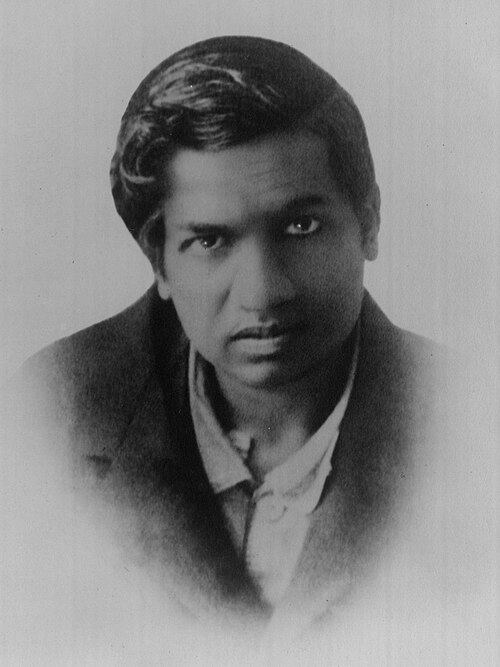
Photograph of Srinivasa Ramanujan, the self-taught genius of number theory. Unknown author Unknown author · CC BY 4.0

Srinivasa Ramanujan

India · 1887–1920

A self-taught clerk from Madras Presidency, Ramanujan filled notebooks with thousands of formulas derived by methods no one has fully reconstructed. Brought to Cambridge by G. H. Hardy in 1914, he produced partition asymptotics and mock theta functions that still feed active research — including in string theory — a century after his death at 32.

The story

In January 1913 Hardy received a nine-page letter from an unknown 25-year-old accounts clerk at the Madras Port Trust, containing roughly 120 theorems stated without proof. He and Littlewood sat down that evening to sort genius from delusion, and Hardy later wrote that the strangest formulas had to be true, "because, if they were not true, no one would have had the imagination to invent them." Within fifteen months Ramanujan was at Trinity College; in 1918, at thirty, he became one of the youngest Fellows of the Royal Society in its history.

“Send the letter. The gatekeeper who takes an outsider seriously changes history as much as the outsider does.”

Theorems in the first letter
~120
Age elected FRS
30 (1918)
Notebook entries still mined
3,900+
7

Emmy Noether

Germany / United States · 1882–1935

Noether rebuilt algebra around structures — rings, ideals, chain conditions — rather than calculations, founding the abstract approach that defines the modern subject, and her 1918 theorem tying symmetries to conservation laws underpins theoretical physics. Einstein's published tribute after her death called her the most significant creative mathematical genius yet produced since women entered higher education.

The story

When Göttingen's mathematicians moved to habilitate her in 1915, professors in other faculties objected to a woman lecturing; Hilbert answered a faculty meeting: "I do not see that the sex of the candidate is an argument against her admission. We are a university, not a bathhouse." He lost. For four years her courses were advertised under Hilbert's name with Noether as "assistant," until the postwar republic allowed her habilitation in 1919. Dismissed again in 1933 for being Jewish, she moved to Bryn Mawr College in the United States and died there after surgery eighteen months later.

“The institutions were wrong twice; the theorems were right permanently. Do work the gatekeepers cannot erase.”

Years lecturing under Hilbert's name
4 (1915–19)
Noether's theorem
1918
Einstein's tribute
NY Times, 1935
8

Maryam Mirzakhani

Iran / United States · 1977–2017

Mirzakhani, who grew up in Tehran during the Iran–Iraq war, became in 2014 the first woman and first Iranian to win the Fields Medal, for work connecting the geometry of surfaces, billiards and moduli spaces. She described research as being lost in a jungle, using everything learned to invent new tricks — and, with luck, finding a way out.

The story

As a schoolgirl she won gold at the 1994 International Mathematical Olympiad in Hong Kong and returned in 1995 in Toronto to score a perfect 42 out of 42, the first Iranian student ever to do so. As a Stanford professor she worked slowly — she called herself a "slow" mathematician — sketching for hours on enormous sheets of paper spread across the floor, doodling figures around the edges of her calculations, so that her young daughter Anahita described her mother's work as "painting." She died of breast cancer in 2017, at forty, three years after the Seoul medal ceremony.

“Depth beats speed. She called herself slow, and out-thought a generation.”

Fields Medal
First woman, 2014
IMO 1995 score
42/42, perfect
Age at death
40 (2017)

Bars are scaled to the leader in this list.

Comparison Lab

Toggle names on and off — every bar rescales to the leader of your selection.

5 / 8

The argument

Newton, Euclid, Riemann, Hilbert and Erdős all have obvious claims on this list, and Grothendieck — who rebuilt algebraic geometry, then renounced the profession and vanished into the Pyrenees — is perhaps the most argued-over omission. Any eight-name list of mathematicians is a fight the moment it is published; this one weights those who changed both the mathematics and who could be a mathematician.

Grigori Perelman is the sharpest test case: he proved the Poincaré conjecture, the only Millennium Prize Problem yet solved, then declined the Fields Medal in 2006 and the $1 million prize in 2010, saying he was not interested in money or fame and objecting that the credit was shared unfairly relative to Richard Hamilton's groundwork. Whether a list of professional legends should be led by a man who rejected the profession's every honor is genuinely contested.

The deeper bias is documentary. Madhava of Sangamagrama derived the infinite series for pi around 1400, two centuries before Gregory and Leibniz, and remains nearly invisible because the Kerala school's transmission left the European record late and thin; Chinese masters like Liu Hui and Zu Chongzhi are similarly undercounted. The history of mathematics is still mostly written from the archives that survived, in the languages historians read.

Keep exploring

More in Science & Research