🌾Origins & Evolution

Farmer · The profession that made every other one possible — feeding the world for eleven millennia, from the first Fertile Crescent wheat to autonomous tractors.

Farming did not begin as a profession; it began as a survival strategy that slowly abolished every alternative. Once Fertile Crescent villages committed to sown wheat and barley around 11,500 years ago, populations grew past what foraging could ever feed again, and the growing of food became the permanent occupation of most of humanity — a condition that lasted until well into the twentieth century in most of the world.

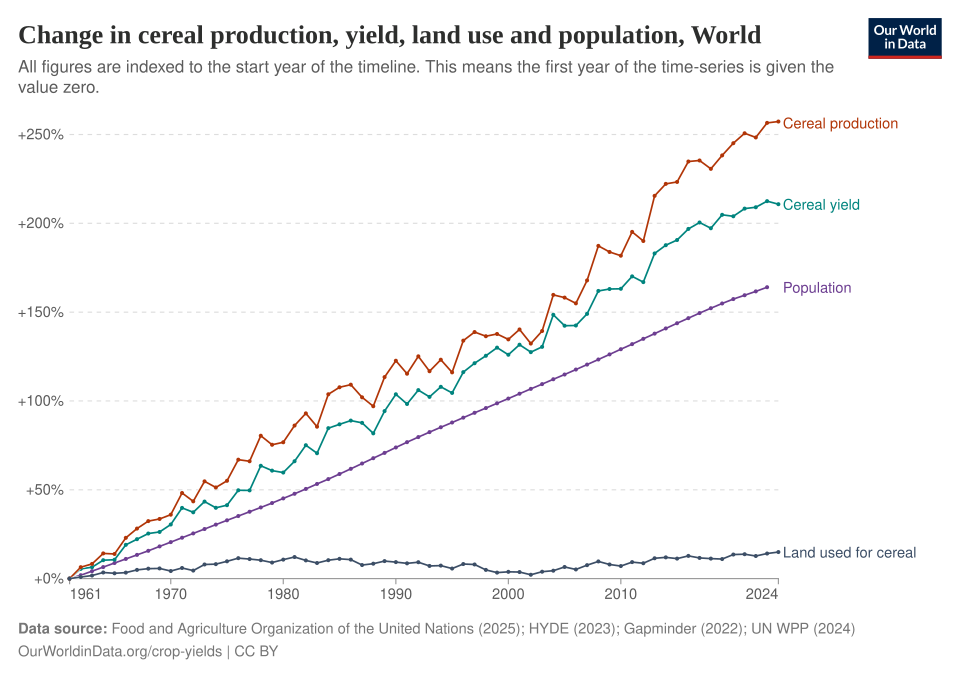
The profession's history is a story of three long substitutions: animal muscle for human muscle, machines for animals, and information for guesswork. Each substitution multiplied how many people one farmer could feed — from perhaps three or four in the Middle Ages to well over a hundred on a mechanized farm today — and each emptied the countryside of the workers the previous era had needed.

Where it began

c. 9500 BCEThe Fertile Crescent

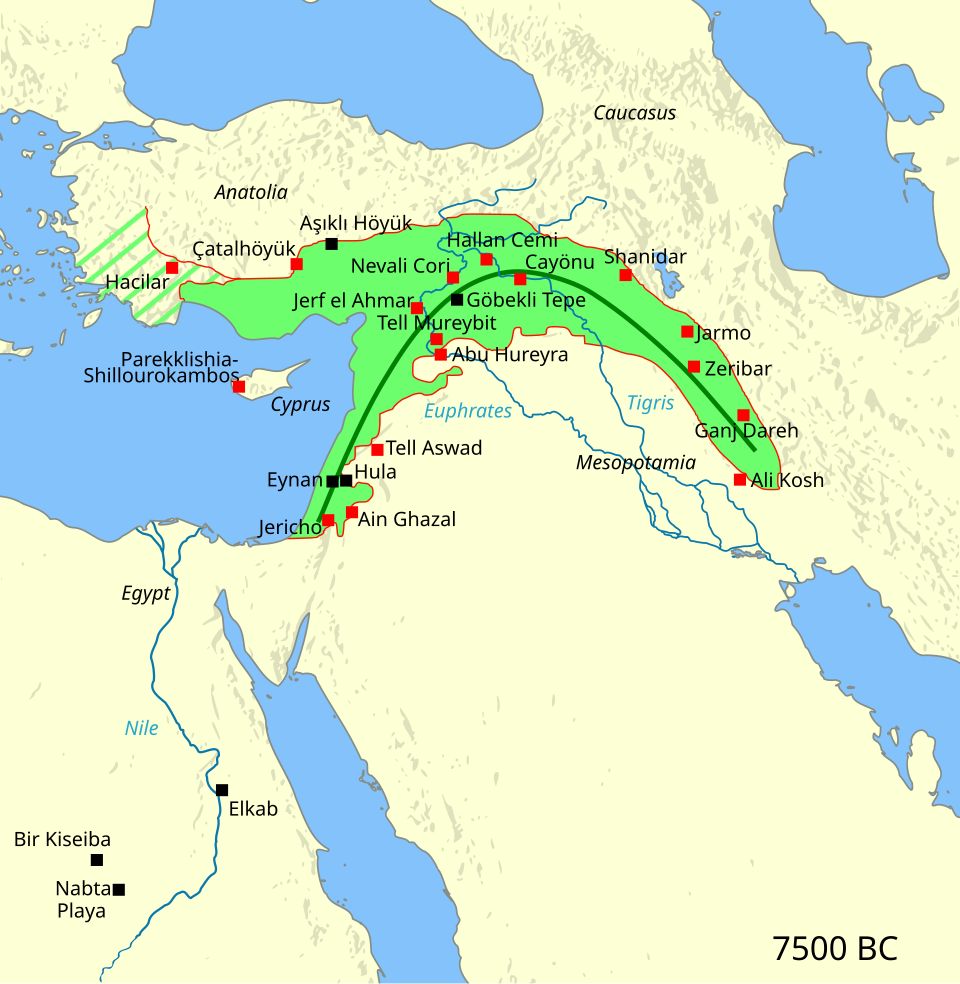
In the hill country arcing from the Levant through southeast Anatolia to the Zagros mountains, Neolithic communities crossed from harvesting wild stands to deliberately sowing saved seed. The archaeological founder crops — einkorn and emmer wheat, barley, lentils, peas, chickpeas, bitter vetch and flax — appear together at sites like Jericho and Abu Hureyra, and genetic studies trace domesticated einkorn to the Karacadağ hills of southeast Turkey. Sheep, goats, cattle and pigs were domesticated in the same region within roughly the same two millennia, completing the mixed-farming package that later spread into Europe, North Africa and Asia.

Timeline

c. 9500 BCEThe founder crops are domesticated

Villages in the Fertile Crescent begin sowing saved seed of wheat, barley and pulses rather than only harvesting wild stands. Within centuries the plants themselves change — grains grow larger and seed heads stop shattering — the permanent genetic signature of the first farmers' selection.

c. 7000 BCERice farming takes hold in China

Communities along the Yangtze river valley cultivate rice in wet fields, one of several fully independent inventions of agriculture — millet in northern China, maize and squash in Mesoamerica, potatoes in the Andes and sorghum in Africa followed their own separate paths. Farming was not spread from one cradle; humanity invented it at least seven times.

c. 3000 BCEThe plough and irrigation remake the river valleys

Ox-drawn ard ploughs and organized canal irrigation in Mesopotamia and Egypt let farmers work heavier soils and second crops, producing the taxable grain surpluses that fed the first cities, scribes and standing armies. Farming became the economic base of the state — and farmers its most heavily taxed class.

c. 160 BCECato writes the first surviving farm manual

Cato the Elder's De Agri Cultura, the oldest complete surviving work of Latin prose, is a practical handbook on running an estate — vine yields, olive presses, slave rations and the flat advice that the forehead of the owner does more good than the back of his head. Roman agronomy treated farming as a science worth writing down.

1701Jethro Tull builds the seed drill

On his Berkshire farm, Jethro Tull builds a horse-drawn drill that sows seed in neat rows at a set depth instead of broadcasting it by hand, cutting seed waste and making hoeing between rows possible. It becomes the emblem of the British Agricultural Revolution, alongside the Norfolk four-course rotation that abolished the fallow year.

1834McCormick patents the mechanical reaper

Cyrus McCormick patents a horse-drawn reaper that cuts grain many times faster than a laborer with a scythe, first demonstrated in Virginia in 1831. Harvest — the great labor bottleneck that had set the size of every farm since the Neolithic — begins its long surrender to machinery.

1892Froelich runs the first gasoline tractor

In Clayton County, Iowa, John Froelich builds the first gasoline-powered tractor that can drive both forward and backward, and uses it to power a threshing run that season. His Waterloo company's engine business is bought by John Deere in 1918, founding the tractor line that helps retire tens of millions of draft horses.

1909–1913Haber–Bosch synthesizes nitrogen fertilizer

Fritz Haber demonstrates ammonia synthesis from air in 1909, and Carl Bosch industrializes it at BASF's Oppau plant by 1913. Synthetic nitrogen removes the oldest ceiling on crop yields; by common estimates, roughly half of the people alive today are fed by crops grown with it.

1944–1970The Green Revolution

Norman Borlaug's semi-dwarf, disease-resistant wheat, bred in Mexico from 1944, and IRRI's IR8 rice transform yields across Mexico, India, Pakistan and the Philippines; India's wheat harvest nearly doubles between 1965 and 1970. Borlaug receives the 1970 Nobel Peace Prize — the only one ever awarded chiefly for plant breeding.

2022The driverless tractor goes on sale

John Deere unveils a fully autonomous 8R tractor at the CES electronics show in January 2022, steering by GPS and cameras with no one in the cab, while robotic milkers — sold by Lely since 1992 — already handle a large share of new dairy installations in northwest Europe. A century after replacing the horse, the tractor begins replacing its own driver.

The eras

Depiction of early Neolithic agriculture, the beginning of farming.
Bjoertvedt , Lars A · CC BY-SA 4.0 · Wikimedia Commons
c. 9500 BCE – 500 CE

The Neolithic bargain and the ancient farmer

Farming spread from its several independent cradles until most of humanity lived by it, but the bargain was harsh: early farmers were shorter, more disease-ridden and harder-worked than the foragers they replaced, bound to their fields and to the states that taxed them. Egypt's flood-fed Nile plots, Rome's slave-run latifundia estates and China's intensively manured smallholdings show how differently the same occupation could be organized — and how consistently those who grew the food ranked below those who taxed it.
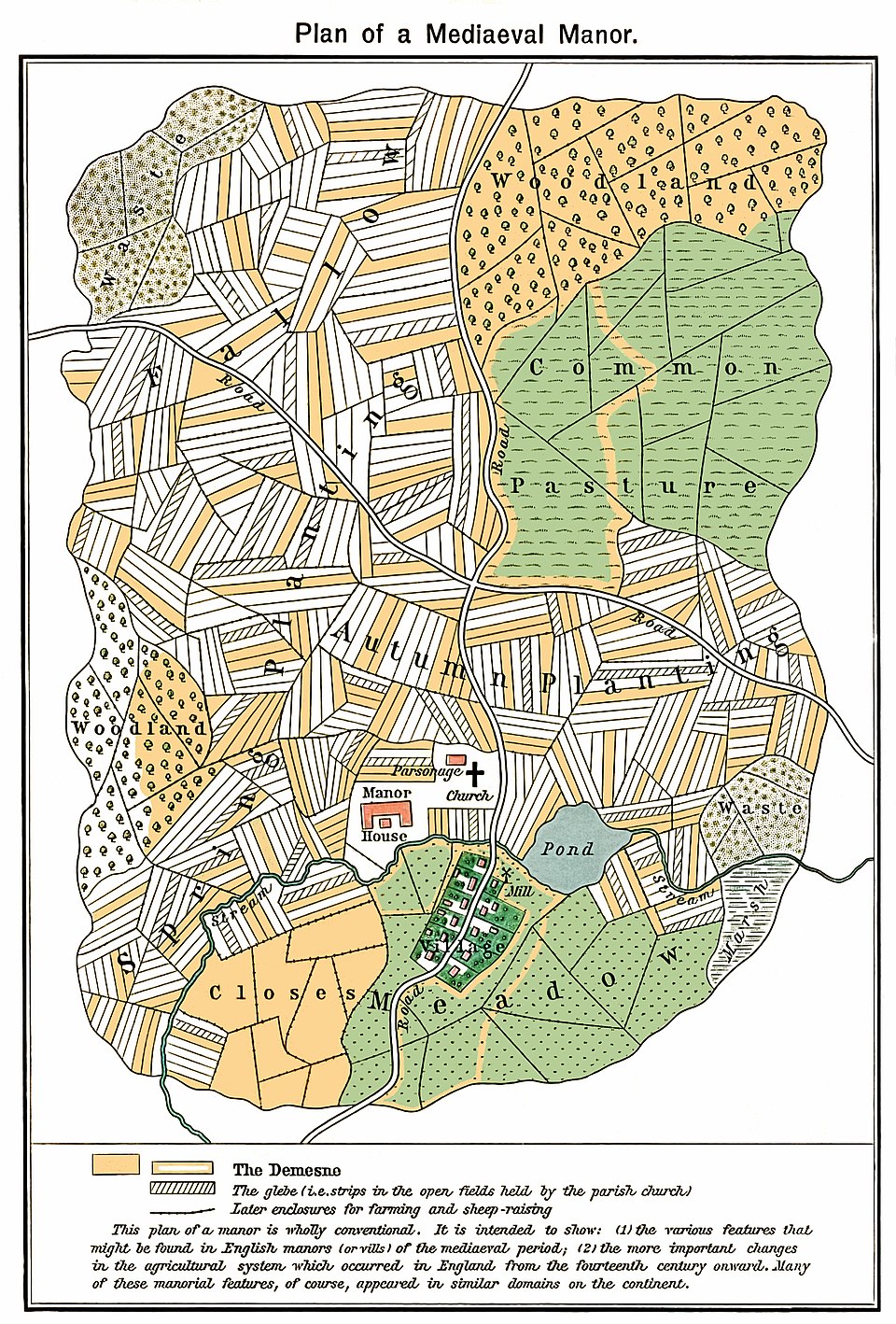
A medieval open-field system with peasants working long strips of land.
William R. Shepherd, Historical Atlas , New York, Henry Holt and Company, 1923 · Public domain · Wikimedia Commons
500 – 1700

Peasants, serfs and the open fields

Across medieval Europe, most farmers were peasants working scattered strips in vast communal open fields, owing their lord labor, produce and fees, and in the case of serfs legally bound to the manor itself. The three-field rotation, the heavy mouldboard plough and the horse collar slowly raised output, while farming villages in Song China, the Islamic world and the Americas ran sophisticated systems — terraced rice paddies, qanat-irrigated oases, chinampa raised beds — that matched or exceeded anything in Europe.

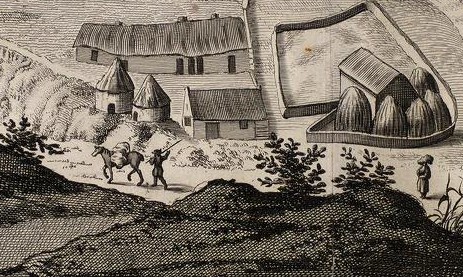
Farming during the British Agricultural Revolution, with new implements and enclosed fields.
John Slezer · Public domain · Wikimedia Commons
1700 – 1900

The Agricultural Revolution and the world grain trade

Britain's agricultural revolution — Tull's seed drill, the Norfolk four-course rotation, Bakewell's selective livestock breeding and the enclosure of the open fields — roughly doubled yields and freed the labor that fed the Industrial Revolution's factories. Railways, steamships and the McCormick reaper then opened the American prairies, the Argentine pampas and the Russian steppe to export grain, ruining and remaking farmers across whole continents as world prices reached every village.

High-yield wheat of the Green Revolution era growing in a test field.
Hannah Ritchie · CC BY 4.0 · Wikimedia Commons
1900 – 1980

Tractors, chemicals and the Green Revolution

The tractor replaced the horse, Haber–Bosch nitrogen replaced manure, and hybrid seed, pesticides and semi-dwarf Green Revolution varieties multiplied yields — while farm populations collapsed in every industrialized country, from over a third of US workers in 1900 to under three percent by 1980. The era also showed the new system's fragility: the 1930s Dust Bowl blew away the topsoil of over-ploughed plains, and Stalin's collectivization killed millions of the peasants it was supposed to modernize.

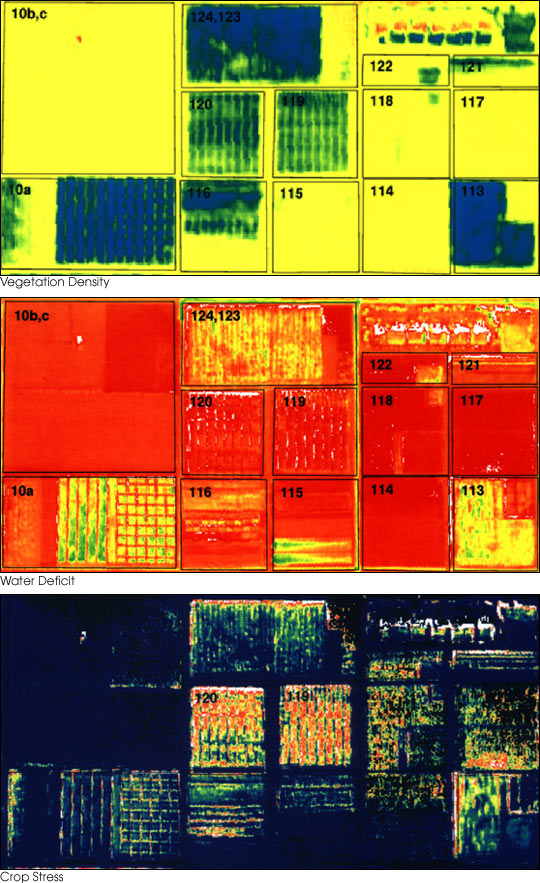
A modern tractor guided by GPS as part of precision agriculture.
Susan Moran, Landsat 7 Science Team and USDA Agricultural Research Service (U.S. Government work) · Public domain · Wikimedia Commons
1980 – present

Precision, consolidation and climate

Satellite positioning reached the tractor cab in the 1990s, and with it precision agriculture: yield maps, variable-rate fertilizer, section-controlled sprayers and, since 2022, fully autonomous machines. Farms grew fewer and larger across the rich world while remaining tiny across much of Africa and Asia, and the profession's central problem began shifting from producing enough to producing sustainably — under water limits, biodiversity rules, carbon markets and a visibly less predictable climate.

What this job replaced

Neighbouring trades that no longer exist — absorbed, automated or regulated away.

Horse-team ploughman

antiquity – 1950s

For most of farming's history, the most skilled worker on any farm was the one who could drive and care for its draft animals — oxen first, then horses, whose numbers in the United States peaked around 26 million in the late 1910s. The tractor erased the trade in a single generation: by 1960 working horse teams had all but vanished from American and western European fields, and the ploughman's craft survives mainly in ploughing matches, heritage farms and Amish communities.

Itinerant threshing crew

c. 1850 – 1950

Steam traction engines and threshing machines were too expensive for one farm, so crews traveled farm to farm each autumn, threshing the neighborhood's grain in a communal ritual of shared labor and enormous meals that rural memoirs across North America and Europe recall vividly. The combine harvester, which reaps and threshes in a single pass, dissolved the trade — and with it one of the countryside's great social institutions — by the 1950s.

Gleaner

antiquity – c. 1900

For millennia the rural poor held a customary right to gather grain left behind after harvest — the Hebrew Bible's Book of Ruth turns on it, and Jean-François Millet's 1857 painting The Gleaners made it an icon of rural France. England's courts ruled in Steel v Houghton (1788) that no common-law right to glean existed, enclosure fenced the fields, and mechanical harvesters eventually left too little behind to gather; the living survives only in charity gleaning projects that harvest surplus for food banks.

Trades that vanished →

Farming's history compresses badly because it moved so slowly for so long: a Roman farmer transported to the year 1700 could have worked most European farms with little retraining, while a farmer of 1900 would recognize almost nothing in a modern grain operation's cab.

What has not changed is the shape of the bet. A farmer still commits capital and labor months before knowing what the weather, the pests and the market will do — the oldest form of risk-taking in the economy, still running on an annual cycle that no technology has shortened.

Keep exploring

More in Frontier & Field