🧬The Greats

Biologist · The scientist who studies life itself, from Linnaeus naming species by hand to editing genomes with CRISPR, still testing every idea against a living organism.

Choosing eight names from a science practiced on every continent for over two thousand years is unfair to countless researchers whose work never got translated, credited, or recorded at all — especially women and scientists working outside a handful of well-documented countries and languages.

The eight below are chosen because their specific, checkable discoveries are still directly visible in how biology is done today. They span twenty-five centuries and reached their insights through very different routes: a monastery garden, a burning ship in the Atlantic, an X-ray photograph taken by someone else, and a conference hallway conversation in Puerto Rico.

The all-time podium

Charles Darwin
Charles Darwin
England
2
Carl Linnaeus
Carl Linnaeus
Sweden
1
Alfred Russel Wallace
Wales / England
3

The eight who reached the top

1
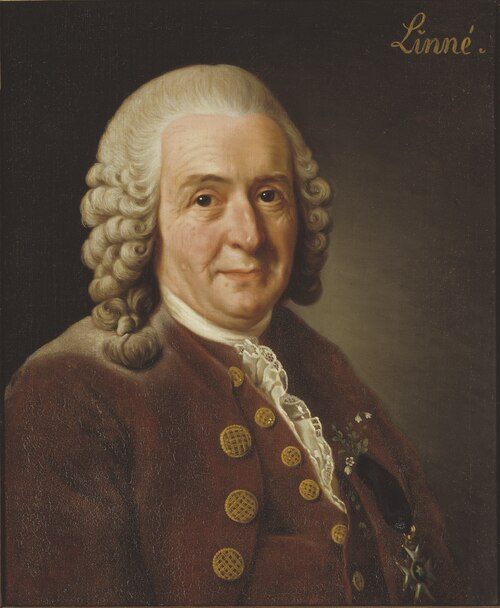
An 18th-century oil portrait of the Swedish botanist Carl Linnaeus wearing a Linnaea flower. Alexander Roslin · Public domain

Carl Linnaeus

Sweden · 1707–1778

Linnaeus created the two-part Latin naming system and the nested hierarchy of ranks that still organizes every living thing scientists classify today, publishing the framework in Systema Naturae in 1735 and refining it across twelve further editions during his lifetime.

The story

In 1746, Linnaeus sent his first student "apostle," Christopher Tärnström, to collect specimens in Southeast Asia; Tärnström died of fever on the Vietnamese island of Côn Sơn within months, leaving a widow who reportedly blamed Linnaeus for his death. Undeterred, Linnaeus sent roughly sixteen more students on similar collecting expeditions over his career; several never returned. The specimens and field notes that did make it home fed directly into later editions of Systema Naturae.

“Building a shared system for naming all of nature required specimens from everywhere, at a real human cost.”
Species named across his major works
~12,000
Student "apostles" sent abroad
~17
Editions of Systema Naturae in his life
12
2
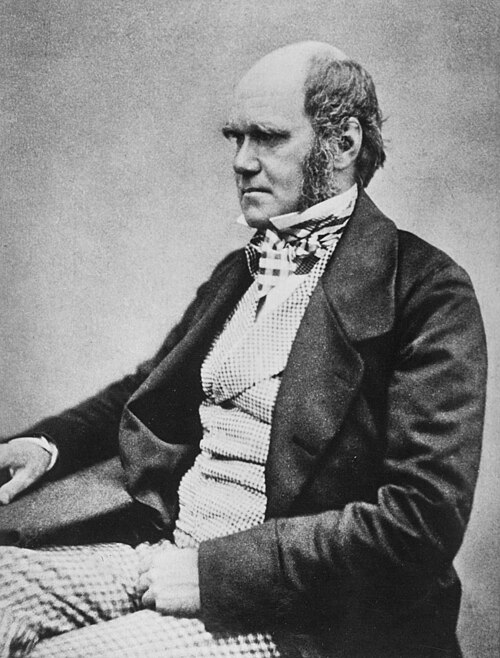
A photographic portrait of Charles Darwin with his characteristic long white beard. Charles_Darwin_seated.jpg : Henry Maull (1829–1914) and John Fox (1832–1907) (Maull & Fox) [ 3 ] derivative work: Bea o · Public domain

Charles Darwin

England · 1809–1882

Two decades of observation, breeding experiments and correspondence after his five-year voyage on HMS Beagle led Darwin to natural selection, the mechanism explaining how species change over time — published in On the Origin of Species in 1859 after Alfred Russel Wallace forced his hand.

The story

In June 1858, while mourning his infant son's death from scarlet fever, Darwin received a letter from Alfred Russel Wallace, then collecting specimens in the Malay Archipelago, outlining a theory of natural selection nearly identical to Darwin's own unpublished work of two decades. Friends arranged for extracts of both men's writings to be read jointly at the Linnean Society on 1 July 1858, with neither author present, before Darwin rushed Origin of Species into print the next year.

“Sitting on a correct idea for twenty years does not make it yours alone forever.”

Years between the idea and publishing
~20 years
Beagle voyage length
5 years (1831–36)
Copies of Origin sold on release day
1,250 copies
3
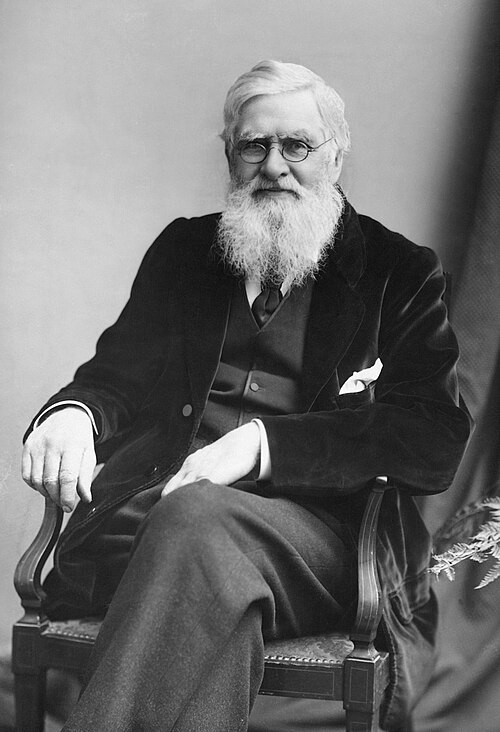
A photographic portrait of the naturalist and explorer Alfred Russel Wallace. London Stereoscopic and Photographic Company (active 1855-1922) · Public domain

Alfred Russel Wallace

Wales / England · 1823–1913

A self-taught naturalist who funded his fieldwork entirely by selling specimens to museums and collectors, Wallace independently arrived at natural selection while collecting in the Malay Archipelago, and his 1858 letter to Darwin forced the theory's joint public announcement.

The story

In August 1852, returning from four years collecting in the Amazon, Wallace's ship Helen caught fire in the mid-Atlantic; he watched almost his entire collection of specimens, drawings and notes burn and sink. He and the crew spent ten days adrift in an open lifeboat before a passing ship rescued them. Rather than quit, Wallace set out again within two years for the Malay Archipelago, where eight more years of collecting eventually led him to natural selection.

“Losing everything collected does not have to end the work — only delay the discovery.”

Specimens collected in the Malay Archipelago
~125,000
Years spent collecting there
8 years
Days adrift after the 1852 shipwreck
10 days
4
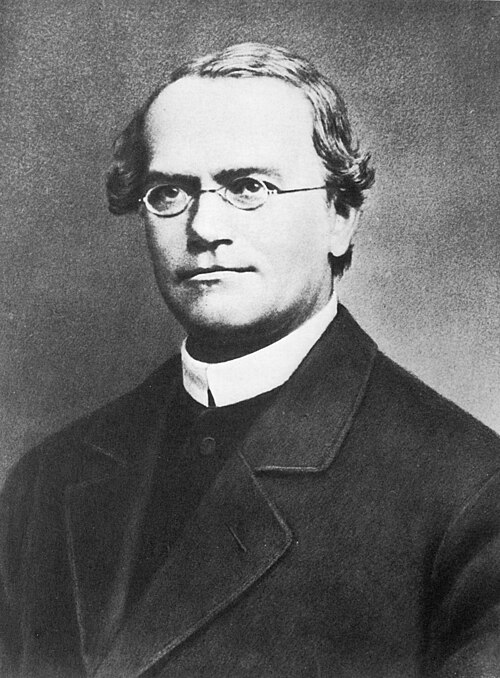
A formal portrait photograph of the Augustinian friar and geneticist Gregor Mendel. Unknown author Unknown author · Public domain

Gregor Mendel

Austrian Empire (Moravia, now Czechia) · 1822–1884

An Augustinian friar who spent eight years cross-breeding pea plants in his monastery garden, Mendel worked out the basic statistical laws of inheritance decades before genes or DNA were known — though his 1866 paper went almost unread until three botanists rediscovered the same laws in 1900.

The story

Between 1856 and 1863, Mendel grew and hand-pollinated roughly 28,000 pea plants in the garden of St. Thomas's Abbey in Brno, tracking seven distinct traits across generations. He presented the results to Brno's Natural History Society in 1865 and published them the next year in the society's own proceedings, a journal so obscure it was barely cited for 35 years. Only in 1900, after three botanists independently found the same ratios, was his paper recognized as having solved the problem decades earlier.

“A correct answer published in the wrong journal can sit ignored for a generation.”

Pea plants grown and tracked
~28,000
Years of experiments
8 years (1856–63)
Years until rediscovery
34 years (to 1900)
5
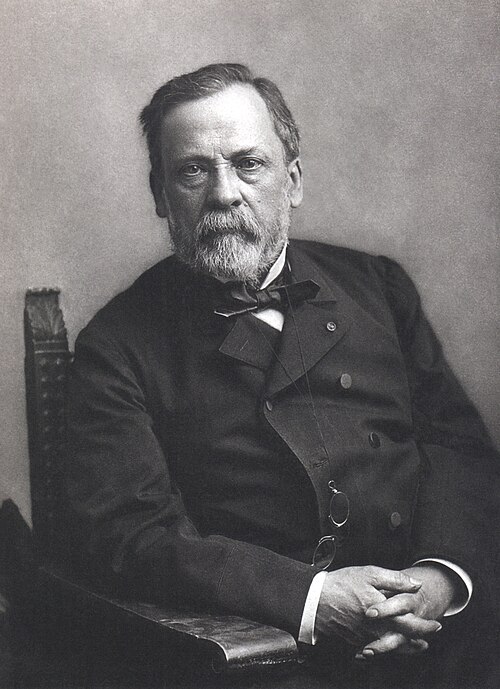
A photographic portrait of the French chemist and biologist Louis Pasteur in his laboratory. Paul Nadar · Public domain

Louis Pasteur

France · 1822–1895

Pasteur disproved spontaneous generation with his sealed swan-neck flask experiments, helped establish germ theory of disease, invented pasteurization, and developed life-saving vaccines against anthrax and rabies, founding the Paris research institute that still carries his name and now spans a global network.

The story

In July 1885, a mother brought her nine-year-old son Joseph Meister to Pasteur's Paris laboratory after a rabid dog had bitten the boy fourteen times. Rabies was then a certain, agonizing death, and Pasteur's vaccine had only ever been tested on dogs. With two licensed physicians actually administering the injections, since Pasteur held no medical degree himself, the boy received thirteen doses of increasingly potent vaccine over ten days — and survived, becoming the first person ever saved from rabies.

“An unproven treatment can be the right call when the alternative is certain death, if the evidence behind it is real.”

Doses given to Joseph Meister
13 doses
Years researching germ theory
~20 years
Countries with a Pasteur Institute today
~25 countries
6
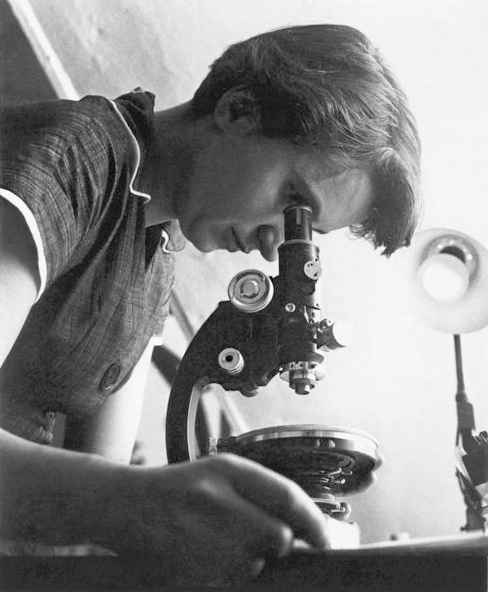
A photographic portrait of X-ray crystallographer Rosalind Franklin. MRC Laboratory of Molecular Biology · CC BY-SA 4.0

Rosalind Franklin

England · 1920–1958

A meticulous X-ray crystallographer at King's College London, Franklin produced the clearest diffraction images yet of DNA fiber, evidence critical to solving its double-helix structure — though Watson and Crick used it without her knowledge, and she died of ovarian cancer before the 1962 Nobel Prize.

The story

In May 1952, Franklin's student Raymond Gosling, working under her direction at King's College London, produced Photograph 51, the sharpest X-ray image yet of DNA fiber, requiring roughly 100 hours of exposure. In January 1953, colleague Maurice Wilkins showed it to James Watson without asking Franklin first; Watson and Francis Crick used it, along with her unpublished data, to build their double-helix model within weeks. All three papers appeared together in Nature that April, but only Watson, Crick and Wilkins shared the 1962 Nobel Prize.

“The data that solves a problem and the credit for solving it do not always reach the same person.”

Photograph 51 exposure time
~100 hours
Months from photo to Nature papers
~11 months
Age at death
37
7

Barbara McClintock

United States · 1902–1992

A cytogeneticist who spent decades studying maize chromosomes at Cold Spring Harbor Laboratory, McClintock discovered "jumping genes" (transposons) in the 1940s — a finding so far ahead of its time it was widely dismissed until molecular biology caught up, and she won an unshared 1983 Nobel Prize.

The story

At the 1951 Cold Spring Harbor Symposium, McClintock presented years of evidence that genes could move between chromosome positions and switch other genes on or off, an idea so far outside contemporary genetics that her mostly baffled audience largely dismissed it. She stopped publishing the work in detail soon after and kept studying maize quietly for decades, confident in her data even as almost no one else worked on it. DNA sequencing eventually confirmed transposable elements across many species, and in 1983 she received the Nobel Prize, unshared.

“Being right thirty years before anyone else can check can look, for a long time, exactly like being wrong.”

Years from discovery to Nobel Prize
32 years (1951–83)
Years working at Cold Spring Harbor
~50 years
First woman with an unshared Medicine Nobel
1983, a first
8

Jennifer Doudna

United States · b. 1964

With French microbiologist Emmanuelle Charpentier, Doudna showed in 2012 that the CRISPR-Cas9 bacterial immune system could be reprogrammed to cut DNA at any chosen sequence, turning a curiosity of bacterial defense into the fastest, cheapest gene-editing tool ever built, and sharing the 2020 Nobel Prize in Chemistry.

The story

In 2011, at a scientific conference in Puerto Rico, Charpentier approached Doudna to propose a collaboration on a puzzling bacterial defense system called CRISPR. Working between Berkeley and Charpentier's lab in Sweden, the two labs showed by June 2012 that CRISPR's Cas9 enzyme could be reprogrammed with a single guide RNA to cut any chosen DNA sequence, turning a bacterial immune mechanism into a programmable editing tool almost overnight. In October 2020 they shared the Nobel Prize in Chemistry, the first Nobel science prize awarded to a team of only women.

“A defense system bacteria evolved against viruses became one of biology's most precise tools for editing any genome.”

Years from paper to Nobel Prize
8 years (2012–20)
Gene-editing cost drop vs. earlier methods
~100x cheaper (est.)
First all-women team to share a science Nobel
2020, a first

Bars are scaled to the leader in this list.

Comparison Lab

Toggle names on and off — every bar rescales to the leader of your selection.

5 / 8

The argument

Wallace's role is genuinely contested: he arrived at natural selection independently and forced the theory's public announcement, yet history overwhelmingly credits Darwin alone. Some historians call this a fair reflection of Darwin's two decades of supporting evidence; others call it a lasting injustice to Wallace.

Franklin's exclusion from the 1962 Nobel Prize is often framed simply as theft of credit, but the full picture is more complicated: Nobel rules bar posthumous awards and cap winners at three per prize, and Franklin had died four years earlier. The genuine ethical criticism is narrower — that Watson and Crick used her unpublished data without her knowledge or permission.

The popular "ignored genius" story around McClintock is pushed back on by some historians, who note she was already an elected National Academy of Sciences member and a respected cytogeneticist well before 1951, and that colleagues found her transposon papers hard to follow partly because of genuinely dense writing, not simply dismissal of a woman scientist.

Keep exploring