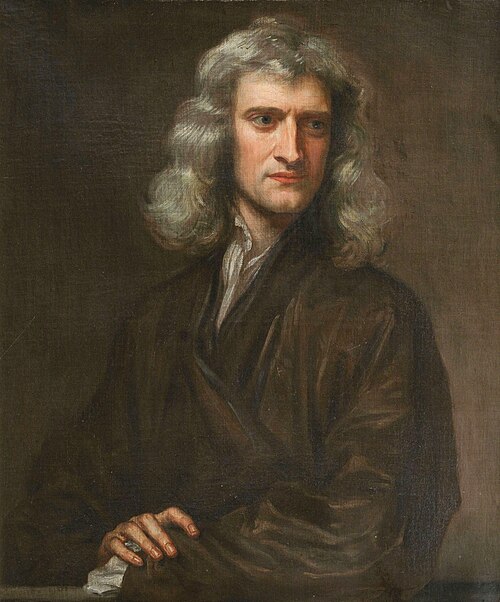
 Godfrey Kneller · Public domain
Isaac Newton
Formulated the laws of motion and universal gravitation in his 1687 Principia Mathematica, unifying terrestrial and celestial mechanics under a single mathematical framework and setting the template — precise laws, testable predictions — every physicist since has followed.
In 1665, isolated at Woolsthorpe during a plague outbreak, Newton pushed a bodkin, a blunt needle, between his eyeball and the bone of its socket to press on the back of his own eye, then recorded in his notebook the colored rings the pressure produced. The notebook survives at Cambridge University Library, an unsettling but characteristic example of his willingness to experiment on himself to understand light and vision.
“Real understanding sometimes demands testing an idea directly, however uncomfortable or strange the method looks to others.”