🏔️The Greats

Mountain Guide · The certified professional who leads strangers up — and above all back down — the world's great mountains, a trade Chamonix organized in 1821.

Any list of eight guides is unfair to a profession whose best work leaves no record except clients who came home. It is doubly unfair to the generations of Sherpa, Balti and Andean professionals whom Western expedition ledgers filed under 'porter' regardless of what they actually did on the mountain. The eight below are chosen because their influence is documented, checkable, and still visible in how the job is done.

They span three centuries and four countries — a crystal hunter who unlocked Mont Blanc, the two great rivals of the Golden Age, a guide who died on the profession's darkest day, the most famous mountain professional who ever lived, and three living figures who redrew who gets to wear the carnet. Together they trace the trade's whole arc, from valley guild to global profession.

The all-time podium

Christian Almer
Christian Almer
Switzerland
2
Jacques Balmat
Jacques Balmat
France
1
Melchior Anderegg
Melchior Anderegg
Switzerland
3

The eight who reached the top

1
Statue of Jacques Balmat in Chamonix, pointing toward the summit of Mont Blanc. Unknown author Unknown author · Public domain

Jacques Balmat

France · 1762–1834

A Chamonix crystal hunter who, with physician Michel-Gabriel Paccard, made the first ascent of Mont Blanc on 8 August 1786 — the climb conventionally taken as the birth of both alpinism and the guiding trade. He guided de Saussure's famous ascent a year later and was honored by the King of Sardinia with the style 'Balmat du Mont Blanc'.

The story

In June 1786, caught out by nightfall while prospecting the approaches, Balmat survived a night alone in the open above the snowline — something Chamonix folk wisdom held to be fatal. The involuntary experiment convinced him the summit was reachable with a high bivouac. Two months later, watched through telescopes from the valley, he and Paccard stood on top of Western Europe in the evening light. Balmat died as he had lived: at 72 he fell to his death hunting gold in the cliffs above the Sixt valley, and his body was never found.

“An accident survived is data: Balmat turned a forced bivouac into the key that unlocked Mont Blanc.”
Mont Blanc first ascent
8 Aug 1786
Summit altitude
~4,806 m
Age at his last prospecting climb
72 years
2
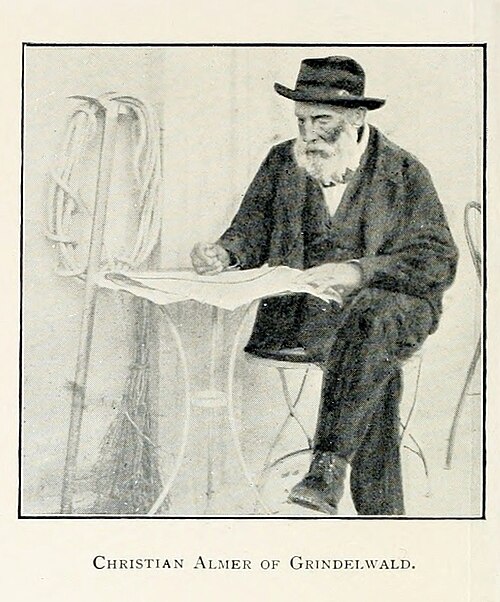
Portrait of Grindelwald guide Christian Almer. Unknown author · Public domain

Christian Almer

Switzerland · 1826–1898

The great Grindelwald guide of the Golden Age: on the 1854 Wetterhorn climb that opened it, on the Eiger's first ascent in 1858, on the Barre des Écrins with Whymper in 1864, and on major new routes for four decades with clients from Wills to Coolidge. With Melchior Anderegg, one half of the era's standing argument about who was the greatest guide alive.

The story

Almer entered history as a gatecrasher: in 1854 he and Ulrich Kaufmann chased Alfred Wills' party up the Wetterhorn carrying a young fir tree to plant on the summit, were nearly taken for hostile rivals, and finished the climb alongside them. Forty-two years later, in June 1896, he returned to the same summit with his wife Margaritha to mark their golden wedding anniversary — he was 70, she 71, and the climb was celebrated across Europe as the couple's fifty-year love letter to the mountain that made his name.

“A guiding career is measured in decades of bringing people home — and Almer's lasted long enough to climb his first summit again at 70.”

Eiger first ascent
1858
Golden-wedding Wetterhorn climb
Age 70, 1896
Career span
~40 years
3
Portrait of Melchior Anderegg, called the King of Guides. Edward Whymper · Public domain

Melchior Anderegg

Switzerland · 1828–1914

Called 'the King of Guides' in Victorian Britain, the Meiringen woodcarver led first ascents of the Dent d'Hérens, Monte Disgrazia and Zinalrothorn, and in 1865 the Brenva Spur on Mont Blanc — for decades the boldest ice route in the Alps. Across roughly fifty years of guiding, no client death was ever recorded against his name.

The story

Anderegg guided Lucy Walker of Liverpool for over two decades, including her 1871 Matterhorn climb — the first by a woman. Walker never married, and late in life, asked why, she is said to have answered that she loved mountains and Melchior, and Melchior already had a wife. The Alpine Club brought him to London as a celebrity; his portrait hung in its rooms, and English climbers booked his seasons years ahead. He kept living in Meiringen, carving wood in winter, guiding in summer, to the end.

“Trust kept intact over decades is the guide's real asset; technique is only how you protect it.”

Client deaths in ~50 years
None recorded
Brenva Spur first ascent
1865
Years guiding Lucy Walker
20+
4
Portrait of Chamonix guide Michel Croz, who died on the Matterhorn in 1865. Edward Whymper · Public domain

Michel Croz

France · 1830–1865

The Chamonix guide from the hamlet of Le Tour whom Edward Whymper called the finest of his age. In just two seasons, 1864–65, he led first ascents including the Barre des Écrins, the Grandes Jorasses and finally the Matterhorn — the profession's greatest streak, ended on its darkest day.

The story

On 14 July 1865 Croz led Whymper's party up the Matterhorn, first to the summit of the last great unclimbed Alpine peak. On the descent, the novice Douglas Hadow slipped and knocked Croz from his stance; the rope snapped behind them, and Croz, Hadow, Hudson and Douglas fell some 1,200 m down the north face. The broken rope is still displayed in Zermatt's Matterhorn Museum, and a pointed summit of the Grandes Jorasses he had climbed a year earlier carries his name — Pointe Croz.

“The rope ties every life on it to the weakest member; choosing who ties in is the first safety decision.”

Matterhorn first ascent
14 July 1865
Major first ascents, 1864–65
A dozen peaks
Fall down the north face
~1,200 m
5
Tenzing Norgay in climbing gear, first to summit Everest with Edmund Hillary in 1953. SAS Scandinavian Airlines · Public domain

Tenzing Norgay

Nepal / India · 1914–1986

The most famous mountain professional in history. A Sherpa expedition veteran of six Everest attempts — reaching about 8,600 m with Swiss climber Raymond Lambert in 1952 — he summited with Edmund Hillary on 29 May 1953, then spent 22 years as director of field training at Darjeeling's Himalayan Mountaineering Institute, building Asia's pipeline into the profession.

The story

On the summit, Hillary photographed Tenzing holding his ice axe aloft with the flags of Nepal, the United Nations, Britain and India — but there is no summit photograph of Hillary, because Tenzing had never used a camera and, as Hillary later wrote, the top of Everest was no place to teach him. Tenzing buried sweets and a pencil his daughter Nima had given him in the snow as a Buddhist offering. Hounded afterward by the question of who stepped up first, he finally answered in his autobiography: Hillary — ending the speculation with characteristic grace.

“Six failures were the qualification for the seventh attempt; fame found the working professional, not the other way round.”

Everest expeditions to succeed
7th, in 1953
Height reached with Lambert, 1952
~8,600 m
Years training guides at HMI
22 (1954–76)
6
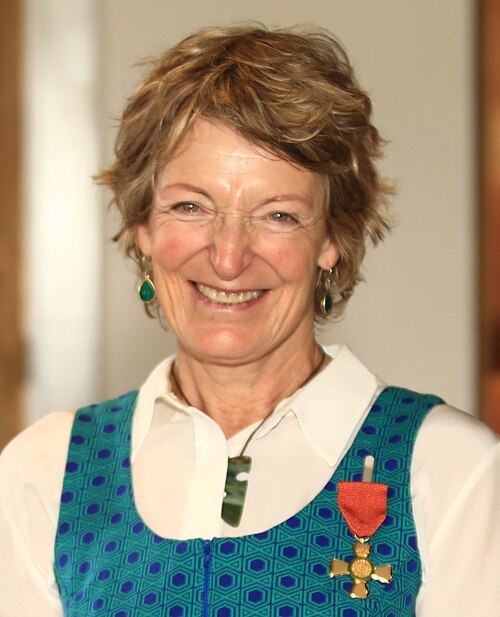
New Zealand mountaineer and guide Lydia Bradey. New Zealand Government, Office of the Governor-General · CC BY 4.0

Lydia Bradey

New Zealand · b. 1961

On 14 October 1988 the Christchurch-born climber became the first woman to summit Everest without supplemental oxygen, climbing alone above the South Col. She went on to full IFMGA certification — New Zealand's first woman to earn it — and a long guiding career that has taken her back to Everest's summit repeatedly with clients.

The story

Her greatest climb was doubted for years. Bradey's teammates — Rob Hall among them — had already left base camp, and her route was not covered by the expedition's permit, so the team publicly cast doubt on her claim, partly to protect itself from Nepali sanctions. She had climbed without a summit photograph that could settle it. The Himalayan Database and the climbing world eventually accepted the ascent, and she told the full story in her 2015 memoir Going Up Is Easy — by then a veteran guide whose word was her profession.

“Records mean little without witnesses; in guiding as in climbing, a career is built on being believed.”

First female no-O2 Everest ascent
14 Oct 1988
Everest summits
6 by 2019
IFMGA certification
NZ's first woman
7

Kami Rita

Nepal · b. 1970

From Thame — the Khumbu village that also produced Tenzing Norgay — Kami Rita Sherpa has climbed Everest more times than anyone: 31 ascents between 1994 and May 2025, nearly all of them while working, fixing ropes and leading clients as a senior guide for Kathmandu-based Seven Summit Treks.

The story

In May 2024 he summited Everest twice within ten days — his 29th and 30th ascents — not as a stunt but as a work schedule, guiding one rotation and then going back up with the next. Interviewers keep asking about the record; he keeps giving the same answer, that he climbs for a living and the number simply accumulated. His father was among the first generation of professional Sherpa guides after the 1950s expeditions; the son turned the family trade into the most repeated act of high-altitude work in history.

“At the top of the profession the record is a by-product: thirty seasons of showing up for work.”

Everest ascents
31 (by 2025)
First Everest summit
1994
Two summits in one season
10 days apart, 2024
8

Dawa Yangzum Sherpa

Nepal · b. 1990

Raised in the remote Rolwaling valley, she summited Everest at 21, K2 at 23, and in December 2017 became the first Nepali woman to earn the IFMGA carnet — full international certification in a national industry where women had been confined to teahouse and trekking work. She now guides 8,000 m peaks and teaches at the Khumbu Climbing Center.

The story

On 26 July 2014, Dawa Yangzum, Maya Sherpa and Pasang Lhamu Sherpa Akita became the first Nepali women's team to summit K2 — on the 60th anniversary of its first ascent, on the mountain where Nepali men had long worked and died as staff. She had left home in her mid-teens against her family's wishes to work on expeditions. The K2 climb silenced the argument that Sherpa women belonged below base camp; the IFMGA carnet she finished three years later made the point in paperwork no employer could dispute.

“Certification converts permission into paper: with the carnet, nobody can say a Sherpa woman cannot lead.”

First Nepali woman with IFMGA carnet
Certified 2017
K2, first Nepali women's team
26 July 2014
8,000 m peaks climbed
5+ by 2024

Bars are scaled to the leader in this list.

Comparison Lab

Toggle names on and off — every bar rescales to the leader of your selection.

5 / 8

The argument

Who really led the 1786 Mont Blanc climb was the profession's first great controversy. Nineteenth-century myth-making — much of it traceable to Alexandre Dumas' colorful 1832 interview with the elderly Balmat — cast Paccard as a dragged-up passenger. Modern historians have rehabilitated the doctor as a full partner and probable co-leader; Chamonix gave Balmat his statue in 1887, while Paccard waited for his until the ascent's bicentenary in 1986.

Victorian Alpine Club dinners argued Almer versus Anderegg for decades without settling it, and the argument was really about what a guide is: Almer the bolder route-finder, Anderegg the man who never lost a client. The profession still runs on the same axis — audacity versus stewardship — and still cannot rank one above the other.

The deepest injustice in any such list is structural: until late in the 20th century, Himalayan record-keeping credited Western climbers by name and filed the Nepalis who led, fixed and broke trail as 'porters'. Ang Tharkay, sirdar of the 1950 Annapurna expedition, and generations like him did guiding's work without guiding's title — the reason this list's living Nepali members insist so firmly on the carnet.

Keep exploring

More in Frontier & Field