👨‍🚀The Greats

Astronaut · The rarest job on Earth is practiced off it: roughly 700 people have ever held it, from Gagarin's 108 minutes to year-long tours on the space station.

Ranking astronauts is an exercise in comparing incomparable kinds of nerve: the first person to trust a rocket at all, the first to leave a vehicle in vacuum, the person who accumulated the most time living with the consequences. The eight below are chosen because each permanently changed what the job is — and each story is documented from flight records, memoirs and agency histories.

They span the Soviet Union and Russia, the United States, Canada and China, and sixty years of vehicles from Vostok to Crew Dragon. Missing are hundreds of equally competent people who drew later flights, backup seats or none at all — in a profession this small, the line between legend and footnote was often a crew assignment.

The all-time podium

Neil Armstrong
Neil Armstrong
United States
2
Yuri Gagarin
Yuri Gagarin
Soviet Union
1
Alexei Leonov
Alexei Leonov
Soviet Union
3

The eight who reached the top

1
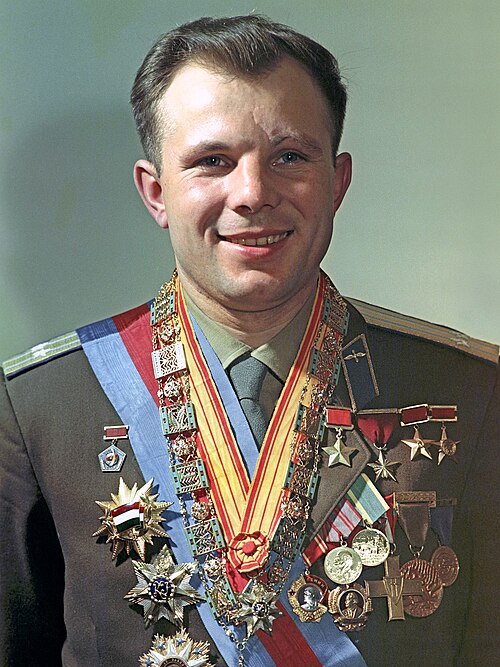
Yuri Gagarin in his cosmonaut helmet, 1961. Александр Моклецов / СовИнформБюро · CC BY 4.0

Yuri Gagarin

Soviet Union · 1934–1968

A foundry worker's son and 27-year-old air force lieutenant, Gagarin became the first human in space on 12 April 1961 — one 108-minute orbit aboard Vostok 1. His flight created the profession outright, and his grin became the Soviet Union's most effective diplomatic instrument until his death in a 1968 jet crash.

The story

Vostok's design required Gagarin to eject at seven kilometres and land separately by parachute — a detail the USSR concealed for years because record rules required a pilot to land with the craft. He came down in a field near the village of Smelovka, where a forester's wife, Anna Takhtarova, and her granddaughter backed away from the orange-suited figure. "Don't be afraid," he called, "I am a Soviet like you — and I need to find a telephone to call Moscow."

“Someone has to go first; being worth trusting with that is a profession in itself.”
Place in history
1st human in space
Flight length
108 minutes
Age at flight
27 years old
2
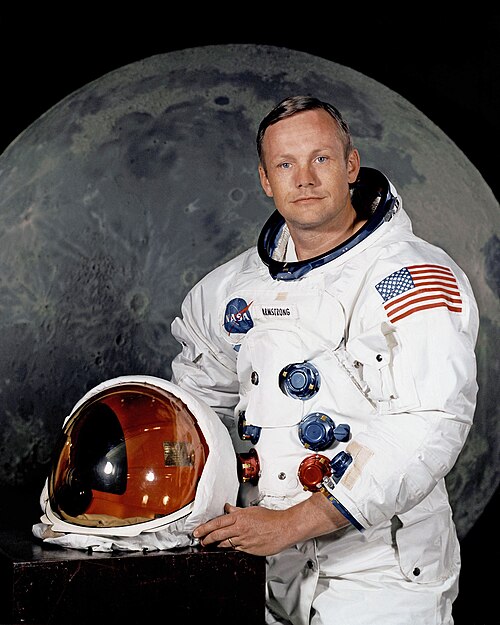
Neil Armstrong in his white Apollo 11 spacesuit. Unknown author Unknown author · Public domain

Neil Armstrong

United States · 1930–2012

A naval aviator, aeronautical engineer and X-15 test pilot before joining NASA, Armstrong commanded Apollo 11 and on 20 July 1969 became the first person to walk on the Moon — then spent the rest of his life deflecting the fame toward the 400,000 people whose work had put him there.

The story

The Moon was arguably not his best flying. On Gemini 8 in 1966, minutes after completing the world's first orbital docking, a stuck thruster spun his spacecraft toward one revolution per second — vision blurring, blackout approaching. Armstrong undocked, diagnosed the failure as his own craft's, and stopped the tumble with the re-entry thrusters, aborting the mission but saving the crew. NASA's official history credits that cold sequencing under spin as a reason he was later trusted with the first landing.

“Reputation is what you did when the machine failed, not what the plan said.”

Place in history
1st on the Moon
First moonwalk
2 h 31 min
Gemini 8 tumble
≈1 rev/second
3
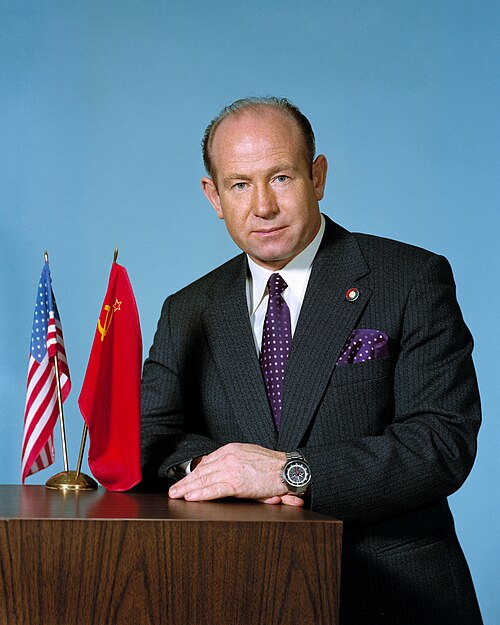
Cosmonaut Alexei Leonov, the first person to walk in space. This image or video was catalogued by Lyndon B. Johnson Space Center of the United States National Aeronautics and Space Administration (NASA) under Photo ID: S74-20824 . · Public domain

Alexei Leonov

Soviet Union · 1934–2019

The first human to float free of a spacecraft — twelve minutes outside Voskhod 2 on 18 March 1965 — Leonov was also a trained artist who sketched in orbit and, a decade later, commanded the Soviet half of the 1975 Apollo–Soyuz mission, the Cold War's first joint flight.

The story

Returning from the first spacewalk, Leonov found his suit had ballooned rigid in vacuum: his fingers had pulled out of the gloves and he could not fit through the airlock. Without telling ground control, he opened a valve and bled his own suit pressure down near the threshold of decompression sickness, then wrestled in head-first, against procedure, soaked in sweat with his heart racing. The crew then landed 386 kilometres off target and spent two freezing nights in the Ural taiga among wolves before rescuers skied in.

“The plan ends at the airlock; what you do next is why they sent a human.”

Place in history
1st spacewalk
Time outside
12 minutes
Suit pressure vented to
0.27 atm
4
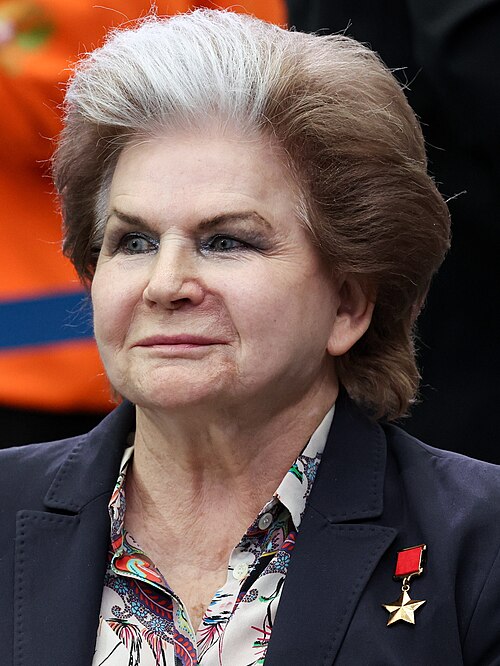
Valentina Tereshkova, the first woman in space, in 1963. This file comes from the website of the President of the Russian Federation and is licensed under the Creative Commons Attribution 4.0 License. In short: you are free to distribute and modify the file as long as you attribute www.kremlin.ru . Note: Works published on site before April 8, 2015 are also licensed under Creative Commons Attribution 3.0 License. The permission letter from the Press Secretary for the President of the Russian Federation is available here . · CC BY 4.0

Valentina Tereshkova

Soviet Union · b. 1937

A textile-factory worker and amateur parachutist with no pilot training, Tereshkova flew 48 orbits alone aboard Vostok 6 in June 1963 — more time in space than every American astronaut combined at that date. Sixty years on, she is still the only woman ever to have flown to space solo.

The story

During the flight Tereshkova noticed the automatic orientation program was set wrong: it would have raised her orbit during descent instead of bringing her home. She reported it; Sergei Korolev's team checked, confirmed the error and uploaded corrected settings — and asked her to keep it quiet. She did, for roughly forty years, until she spoke about it publicly in the 2000s, adding that she had been reprimanded in orbit for other deviations while quietly saving the program's own arithmetic.

“Check the numbers yourself, even when the numbers were written by the legends.”

Place in history
1st woman in space
Orbits flown
48 orbits, solo
Women flying solo since
None — still alone
5
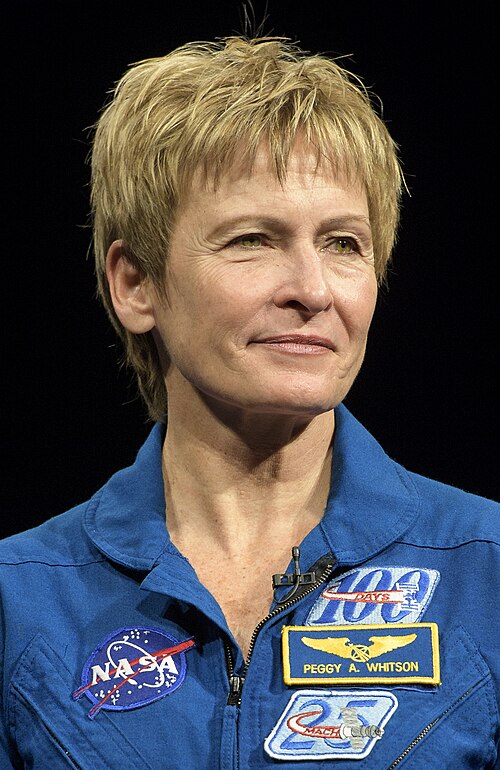
NASA astronaut Peggy Whitson aboard the International Space Station. NASA , Joel Kowsky · Public domain

Peggy Whitson

United States · b. 1960

An Iowa farm girl turned biochemist, Whitson became the first female ISS commander in 2008, NASA's first female chief astronaut, and the most experienced American astronaut ever — roughly 700 days in space across four missions by 2025, the last two commanding private Axiom flights after her NASA retirement.

The story

Her third return to Earth, in April 2008, went ballistic: Soyuz TMA-11's modules failed to separate cleanly and the capsule dropped into a steep, spinning descent that peaked above eight g and landed 470 kilometres short, setting the steppe grass burning around it. Whitson, coming home from six months of commanding the station, climbed out through the smoke, was checked over — and applied the experience to a career that later made her the standard-setter for private mission command.

“Longevity in this job is compounded competence: every uneventful day is a decision someone made correctly.”

Career time in space
≈700 days (2025)
Spacewalks
10 EVAs
ISS command
1st woman, 2008
6
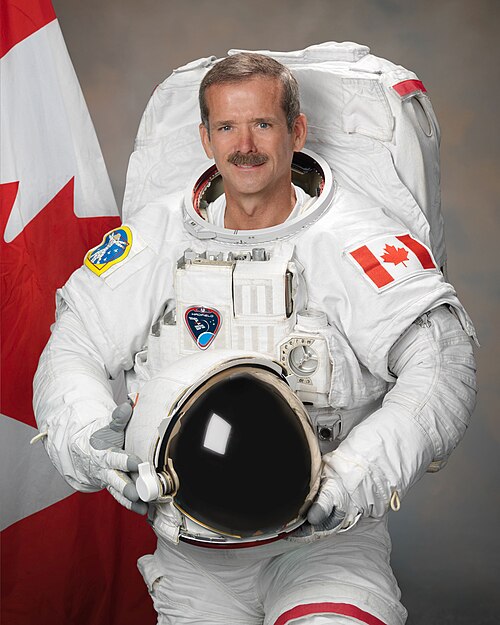
Canadian astronaut Chris Hadfield playing guitar aboard the ISS. Robert Markowitz · Public domain

Chris Hadfield

Canada · b. 1959

A Royal Canadian Air Force test pilot, Hadfield became the first Canadian to walk in space in 2001 and the first to command the ISS in 2013 — then redefined the astronaut's public role, explaining orbital life to millions and recording a weightless "Space Oddity" watched tens of millions of times.

The story

During his first spacewalk in April 2001, anti-fog solution contaminated Hadfield's left eye; in weightlessness the tears could not drain, so they pooled, crossed the bridge of his nose and blinded the right eye too. Outside the station, seeing nothing, he reported it, followed the ground's instruction to open his suit's purge valve — venting precious oxygen to flush the air — and kept working as his tears slowly diluted the contaminant. He finished the installation of Canadarm2 half-blind, then completed a second spacewalk days later.

“Panic is optional even when blindness isn't; verbalize, ventilate, and keep working the checklist.”

Firsts for Canada
1st EVA & command
Missions flown
3 flights
"Space Oddity" reach
50M+ views
7

Yang Liwei

China · b. 1965

A fighter pilot chosen from China's secret first astronaut batch, Yang flew Shenzhou 5 alone for 21 hours and 14 orbits on 15 October 2003, making China the third nation to launch a human on its own rocket — and instantly the most famous person in a country of 1.3 billion.

The story

Seconds into ascent, an unexpected low-frequency vibration set Yang's internal organs resonating; for about 26 seconds, he later wrote, he felt he was dying, unable even to speak, while cameras showed him motionless. He rode it out, reported the phenomenon precisely in debrief, and engineers traced and fixed the oscillation — later crews never felt it. His unglamorous, exact description of nearly being shaken apart is taught inside the program as model test-pilot reporting.

“Surviving the anomaly matters less than describing it well enough to delete it.”

Place in history
1st Chinese in space
Flight length
21 h, 14 orbits
Chinese astronauts since
20+ flown by 2025
8

Mae Jemison

United States · b. 1956

A physician, engineer and former Peace Corps medical officer in West Africa, Jemison became the first African American woman in space aboard Shuttle Endeavour's STS-47 in September 1992, running bone-cell and frog-embryo experiments — then left NASA to spend her career widening who imagines themselves in the seat.

The story

Jemison, who grew up watching Nichelle Nichols play Lieutenant Uhura, opened her shifts on Endeavour with Uhura's line: "Hailing frequencies open." The tribute completed a circle — Nichols had worked on NASA's 1970s astronaut recruitment drives — and closed another in 1993, when Jemison appeared in an episode of Star Trek: The Next Generation, the first real astronaut to appear on the series that had helped recruit her.

“Representation is an instrument: who is seen doing the job decides who applies for it.”

Place in history
1st Black woman in space
Mission duration
8 days, STS-47
Careers before NASA
MD, engineer, Peace Corps

Bars are scaled to the leader in this list.

Comparison Lab

Toggle names on and off — every bar rescales to the leader of your selection.

5 / 8

The argument

Where the profession begins is genuinely contested: the FAI's Kármán line sits at 100 kilometres, the US services award wings from 50 miles, and suborbital passengers on Blue Origin's minutes-long hops now claim the same title as station commanders. The FAA stopped issuing commercial astronaut wings entirely at the end of 2021, retreating to a simple list of names — a bureaucratic shrug at an unresolved question.

The corps' history also has a counterfactual roster. In 1960–61, thirteen American women — later called the Mercury 13 — privately passed the same Lovelace Clinic medical screening as the Mercury men, some scoring better; the effort was shut down, and Congress heard testimony in 1962 that going first was a male prerogative. Whether the profession's timeline should carry their names is still argued in every history of the era.

Even Gagarin's record carries an asterisk lovers of precision still probe: because he ejected and parachuted separately, his flight technically violated the FAI's own rule that a pilot land with the craft. The federation accepted the record anyway — a tacit admission, repeated ever since, that the profession's milestones are defined by what humans actually did, not by the paperwork drafted before anyone had done it.

Keep exploring

More in Frontier & Field