🎻Origins & Evolution

Musician · Spends years mastering an instrument or voice, then earns a living from performances, recordings and teaching in a market streaming has broadened but paid less for.

Music is old enough that its first instruments predate agriculture, writing and even most spoken languages we can reconstruct — bone flutes carved some forty thousand years ago survive in European caves. But 'musician' as a paid, specialized role is a much later invention, built first around temples and courts, then guilds, then a public willing to pay to listen, then a recording industry that could sell the same performance millions of times.

This page follows that arc through ten turning points, five longer eras, and three roles the profession lost along the way — from the court composer bound to one patron's household to the copyist whose entire trade was replaced by notation software.

Where it began

c. 40,000 BCESwabian Jura, present-day Germany

Archaeologists excavating the Hohle Fels cave in southwestern Germany found a flute carved from a griffon vulture's wing bone, radiocarbon-dated to roughly 40,000 years ago — among the oldest confirmed musical instruments yet discovered, predating cave painting found in the same region. Its five finger holes show it was built for controlled, repeatable pitches rather than random sound, meaning something recognizable as deliberate music-making is at least as old as the first evidence of Homo sapiens' symbolic culture in Europe.

Timeline

c. 40,000 BCEThe Hohle Fels flute is carved

A flute cut from a griffon vulture's wing bone is left in a cave in present-day Germany — among the oldest confirmed musical instruments, showing deliberate, pitched music-making already existed in the Upper Paleolithic.

c. 1400 BCEThe Hurrian Hymn is notated

A hymn to the goddess Nikkal, inscribed on a clay tablet at Ugarit in present-day Syria, becomes the oldest substantially complete piece of notated music yet found, with both lyrics and tuning instructions for a stringed instrument.

c. 1025Guido d'Arezzo invents the staff

The Italian monk Guido d'Arezzo develops a four-line musical staff and a syllable system (ut-re-mi-fa-sol-la) for sight-singing, letting melody be written down precisely for the first time instead of passed on entirely by ear.

1321Paris musicians form a guild

Instrumentalists in Paris organize the Confrérie de Saint-Julien-des-Ménétriers, one of Europe's earliest musicians' guilds, regulating who could legally perform for pay in the city and setting a model professional bodies would follow for centuries.

1723Bach becomes Leipzig's cantor

Johann Sebastian Bach is appointed Thomaskantor of Leipzig, answerable to the church and town council for composing a new cantata almost every week — the era's typical arrangement, in which a musician's livelihood depended entirely on one institutional employer.

1761Haydn enters Esterházy service

Joseph Haydn joins the Esterházy princely court as a salaried Vice-Kapellmeister, eventually serving the family for roughly thirty years — the high point of the court-patronage model, in which a composer wrote and performed almost entirely for one household.

1809Vienna's nobles fund Beethoven's independence

After Beethoven is offered a salaried post in Kassel, three Viennese aristocrats sign a contract guaranteeing him a lifetime annuity on the sole condition that he stay in Vienna and compose — letting him work as an independent artist rather than a court employee.

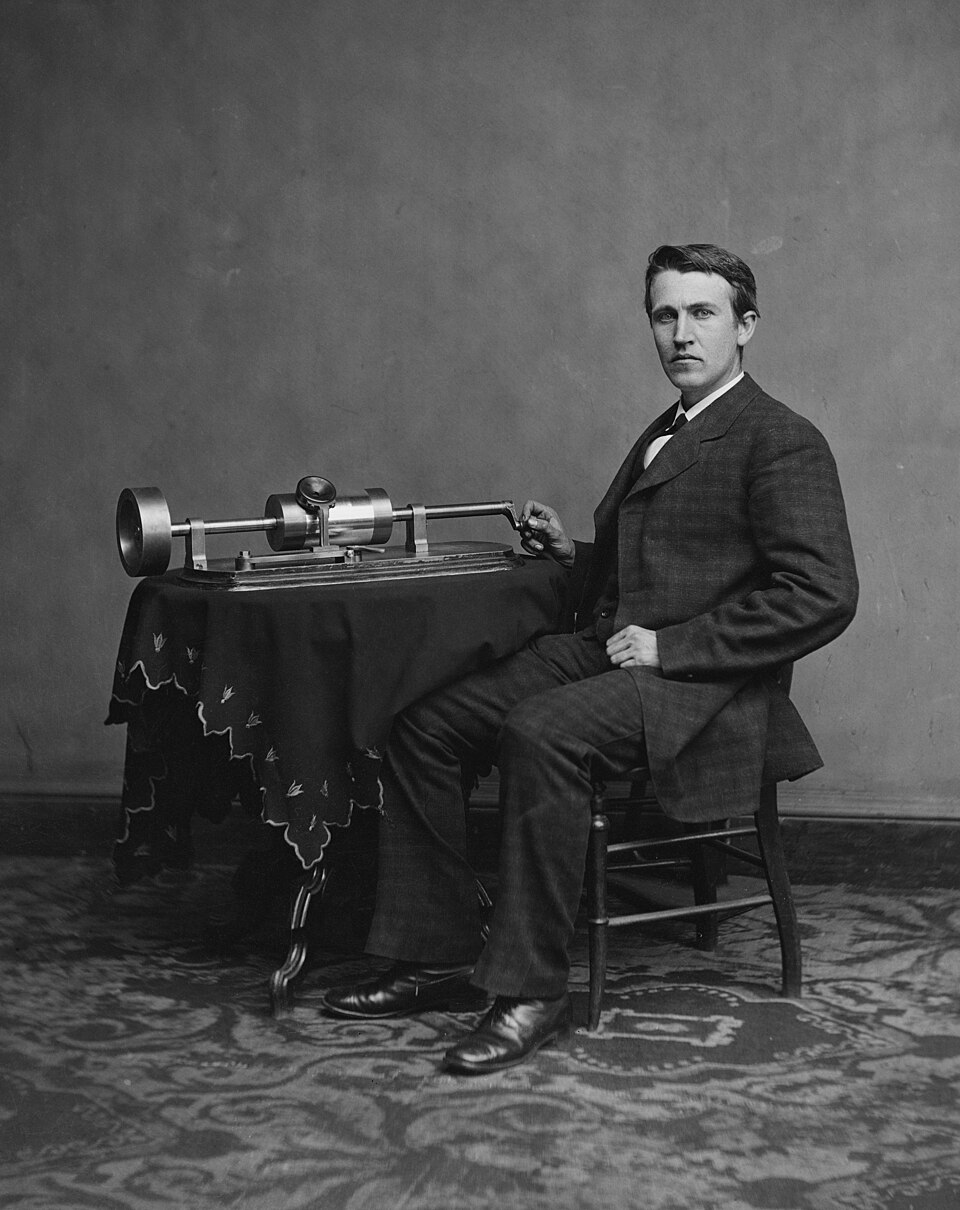
1877Edison invents the phonograph

Thomas Edison records 'Mary Had a Little Lamb' on a tinfoil cylinder, creating the first device that could capture and replay sound — the invention that would eventually let a single performance be sold to millions who never saw it live.

1942-1944The AFM recording ban

The American Federation of Musicians, led by James Petrillo, bans its members from making commercial recordings for two years, demanding royalties from record sales to fund musicians displaced by jukeboxes and recorded radio — a direct labor fight over recording's threat to live work.

2008Spotify launches

The Swedish streaming service Spotify launches publicly, beginning music's shift from a purchased copy to an on-demand subscription — reshaping how, and how little, a recorded performance now pays the musician who made it.

The eras

c. 40,000-800 BCE

Ritual sound, oral tradition

For most of this span music left no separate record from the rest of religious and communal life: instruments accompanied ritual, myth and mourning, and skill passed directly from player to player with nothing written down. Ancient Egyptian tomb paintings and Mesopotamian clay tablets show harpists, singers and temple musicians attached to specific gods or courts, but almost none are known by name — music was a function performed for a rite, not yet a personal, credited art.
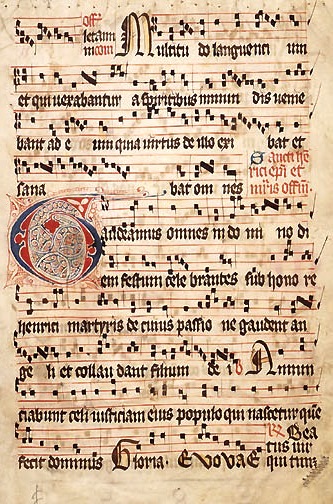
Illuminated medieval manuscript page showing Gregorian chant notation
Unknown author · Public domain · Wikimedia Commons
c. 800-1400

Church and monastery

European sacred music consolidated around Gregorian chant, standardized and named for Pope Gregory I though compiled well after his death, sung by monks and clerics who trained for years to memorize an enormous repertoire before Guido d'Arezzo's notation made it possible to write chant down directly. Hildegard von Bingen, a Benedictine abbess, became the first composer whose biography, letters and a large attributed body of music all survive together, writing chant and what may be the earliest surviving morality play with music, Ordo Virtutum.

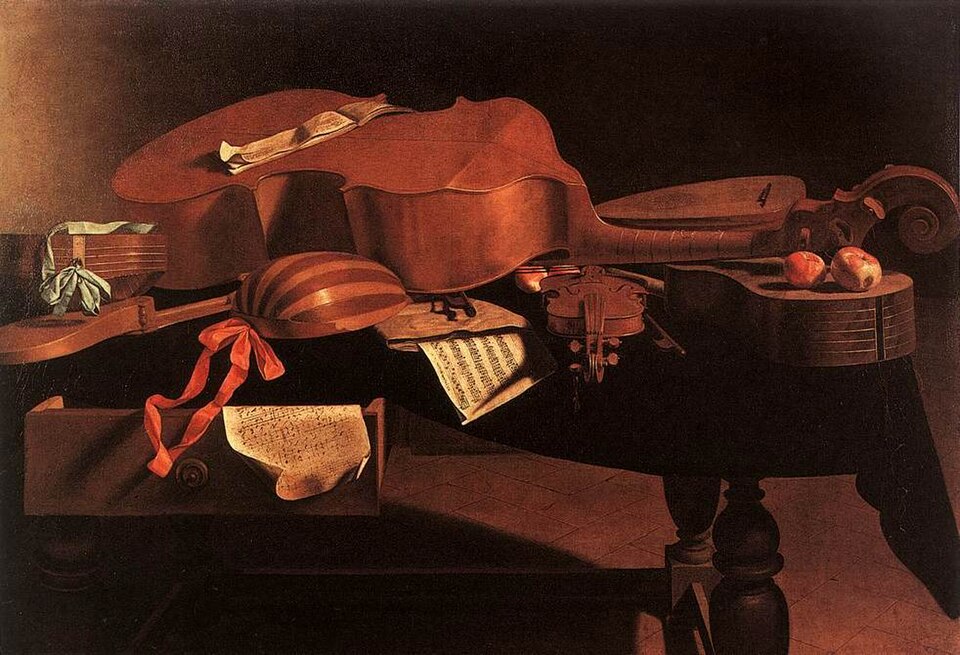
Baroque-era chamber ensemble performing with period string instruments
Evaristo Baschenis · Public domain · Wikimedia Commons
c. 1400-1750

Court and church patronage

Renaissance and Baroque musicians worked almost entirely for a single patron — a prince's court, a cathedral, a wealthy household — composing and performing on demand, often wearing livery like other household servants, and rarely owning the rights to their own music. Bach, Handel and Vivaldi all built careers this way, moving between church, court and civic posts, while urban guilds regulated who could be paid to perform in a given town at all.

A packed 19th-century concert hall during a Romantic-era recital
Josef Danhauser · Public domain · Wikimedia Commons
c. 1750-1900

The freelance composer emerges

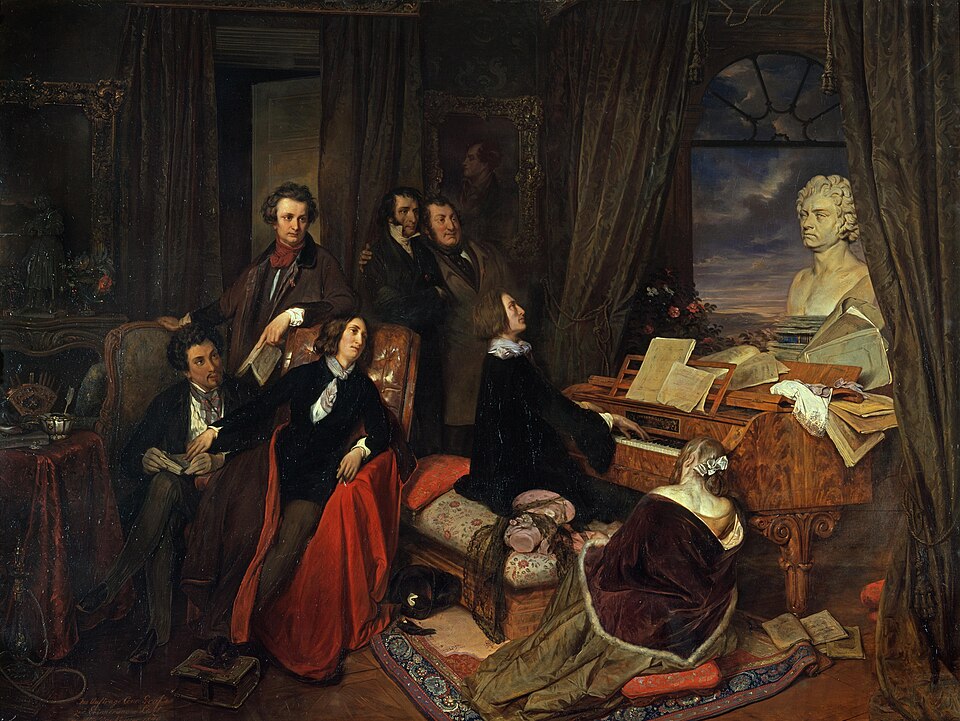
Mozart's break from servitude under Salzburg's archbishop in 1781 and Beethoven's noble-funded independence in 1809 opened a new model: a composer supported by public concerts, sheet-music publishing and private pupils rather than one employer. By the Romantic era, touring virtuosos like Franz Liszt and Niccolò Paganini earned celebrity and fortune purely from ticketed performance, while a growing middle-class concert audience, not just aristocratic patrons, now decided who succeeded.

An early Edison phonograph with its brass horn and wax cylinder
Levin C. Handy (per http://hdl.loc.gov/loc.pnp/cwpbh.04326 ) · Public domain · Wikimedia Commons
c. 1900-present

Recording, broadcast and streaming

The phonograph, radio and film let a single performance reach audiences far larger than any concert hall, building an entirely new recording-royalty economy — and then, in the space of two decades, digital downloading and streaming collapsed most of what that economy paid per copy. Today's musician typically stitches together income from live performance, streaming royalties, sync licensing, teaching and direct fan support rather than depending on any single source.

What this job replaced

Neighbouring trades that no longer exist — absorbed, automated or regulated away.

The court Kapellmeister

c. 1500-1800

A Kapellmeister directed and composed for one aristocratic or church household's musical establishment entirely, much like Bach at Leipzig or Haydn at Esterházy — a stable but fully dependent post that largely disappeared as the French Revolution and the rise of public concerts broke apart Europe's system of court patronage over the following decades.

The cinema pit musician

c. 1895-1929

Silent-film theaters employed organists and small orchestras to improvise or perform scored accompaniment live during every screening, one of the largest sources of steady musical employment in early 20th-century cities. The job vanished almost overnight after The Jazz Singer (1927) proved synchronized recorded sound worked, and theaters switched to sound film within a few years.

The music copyist

c. 1700-1990s

Before notation software, a copyist hand-transcribed a composer's full score into the separate individual parts each orchestral player reads from — skilled, essential and entirely manual work. Programs like Finale (1988) and Sibelius (1993) let composers generate parts directly from a digital score, and the standalone copying trade largely disappeared within a decade.

Trades that vanished →

The thread running through all of it is who pays, and for what: a temple or court once paid for music tied to one occasion or household, a publisher and concert public later paid for a work that could travel, and a streaming platform now pays a fraction of a cent for a single play among billions.

What has stayed constant is the years of training a musician needs before any of those payers will listen at all — whether that training happens inside a conservatory, a guild, a gharana or a garage.

Keep exploring

More in Arts & Creation