🧪Origins & Evolution

Chemist · The scientist who makes and measures matter itself — from Tapputi's Babylonian perfume still to today's robot laboratories, still the one who decides what the spectrum means.

Chemistry is unusual among the sciences in having spent most of its history as two trades at once: a practical craft — metallurgy, dyeing, glassmaking, brewing, embalming — whose recipes worked without anyone knowing why, and a speculative art, alchemy, whose central goals of transmuting metals and brewing immortality were impossible. The craft supplied the techniques; the failed art supplied the apparatus, the obsession with purity, and eventually the people who turned both into a science.

The turning points were less about new substances than new bookkeeping. Once Lavoisier's balance showed that mass is conserved in every reaction, and Dalton's atoms explained why elements combine in fixed ratios, chemistry acquired arithmetic — and from that point the profession doubled in reach every generation, from 63 known elements in 1869 to more than 200 million registered substances today.

Where it began

c. 3000 BCEMesopotamia & Egypt

The first chemists left products, not theories: Mesopotamian glass and bronze, Egyptian pigments, cosmetics and embalming resins, fermented beer on both rivers. The earliest practitioner whose name survives is a woman — Tapputi-Belatekallim, a royal perfume-maker in Babylon around 1200 BCE, recorded on a cuneiform tablet distilling flowers, oil and calamus with water, then filtering and re-distilling the result. Her tablet contains the oldest known description of a still, an apparatus chemists would refine for the next three thousand years.

Timeline

c. 1200 BCETapputi, the first named chemist

A cuneiform tablet from Babylon records the royal perfume-maker Tapputi-Belatekallim preparing scent for the king by distilling flowers, oil and calamus with water, filtering the mixture and distilling it again. It is the earliest known description of a distillation apparatus, and Tapputi is the first person in history recorded doing chemical work under her own name.

c. 800 CEThe Islamic laboratory

The vast Arabic corpus attributed to Jabir ibn Hayyan systematizes distillation, crystallization, sublimation and calcination and insists that claims be tested by experiment. Al-Razi's later Secret of Secrets classifies substances and describes laboratory equipment piece by piece. Translated into Latin from the 12th century under the name "Geber," these works taught Europe its chemistry.

1661Boyle's Sceptical Chymist

Robert Boyle's book attacks both Aristotle's four elements and the alchemists' three principles, arguing that matter consists of moving corpuscles and that an element should mean a substance that analysis cannot break down further. Just as radically, Boyle published his methods openly instead of hiding them in alchemical cipher — the habit that made chemistry cumulative.

1789Lavoisier's Traité élémentaire de chimie

Antoine Lavoisier's textbook lists 33 elements, names oxygen and hydrogen, states that mass is conserved in every reaction, and replaces alchemical jargon with systematic nomenclature — all built on obsessively precise balance measurements funded by his private tax-collecting fortune. Five years later, revolutionary France guillotined him for that fortune.

1808Dalton gives chemistry atoms

John Dalton's A New System of Chemical Philosophy proposes that each element consists of atoms with a characteristic weight, combining in simple whole-number ratios. The idea turned recipes into arithmetic: a chemist could now calculate what a reaction should yield and check the answer on a balance.

1828Wöhler makes urea without a kidney

Trying to prepare ammonium cyanate in Berlin, Friedrich Wöhler instead obtained urea — until then known only from living animals — and wrote delightedly to his mentor Berzelius that he could make urea "without the use of kidneys." The synthesis undermined the idea of a special vital force in living matter and helped open organic chemistry as a field.

1856Perkin's accidental purple

Over Easter vacation, 18-year-old William Henry Perkin tried to synthesize the antimalarial quinine in his home laboratory in London and instead oxidized aniline into an intense purple dye. He patented mauveine, opened a dye works, and — especially after Queen Victoria wore mauve — launched the synthetic-dye industry that became the template for all industrial chemistry.

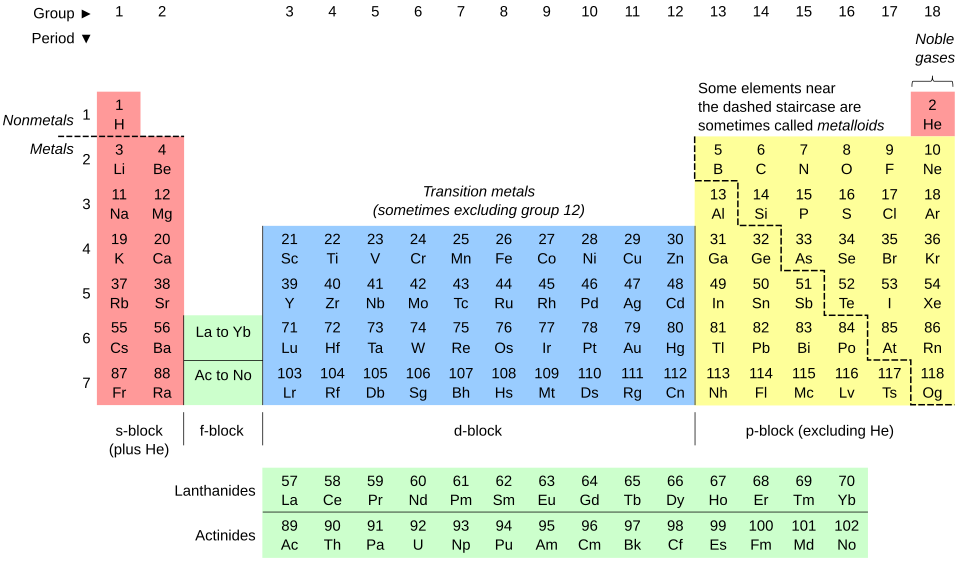
1869Mendeleev's periodic table

Arranging the 63 known elements by atomic weight, Dmitri Mendeleev found repeating patterns strong enough that he left deliberate gaps and predicted the properties of the missing elements. Gallium (1875), scandium (1879) and germanium (1886) matched his predictions closely, converting a filing system into a law of nature.

1913Haber–Bosch feeds the world

Fritz Haber's 1909 bench demonstration of ammonia synthesis from air and hydrogen was scaled up by Carl Bosch at BASF's Oppau plant, which began production in 1913. Synthetic nitrogen fertilizer now supports roughly half of world food production — while Haber's parallel work on chlorine warfare in 1915 made him chemistry's most morally contested figure.

2024AI enters the Nobel citation

The Nobel Prize in Chemistry went to David Baker for computational protein design and to Demis Hassabis and John Jumper for AlphaFold2, which predicts protein structures from sequence alone. It was the first chemistry prize awarded chiefly for work done in software — a marker of how much molecular design has shifted from flask-first to computation-first.

The eras

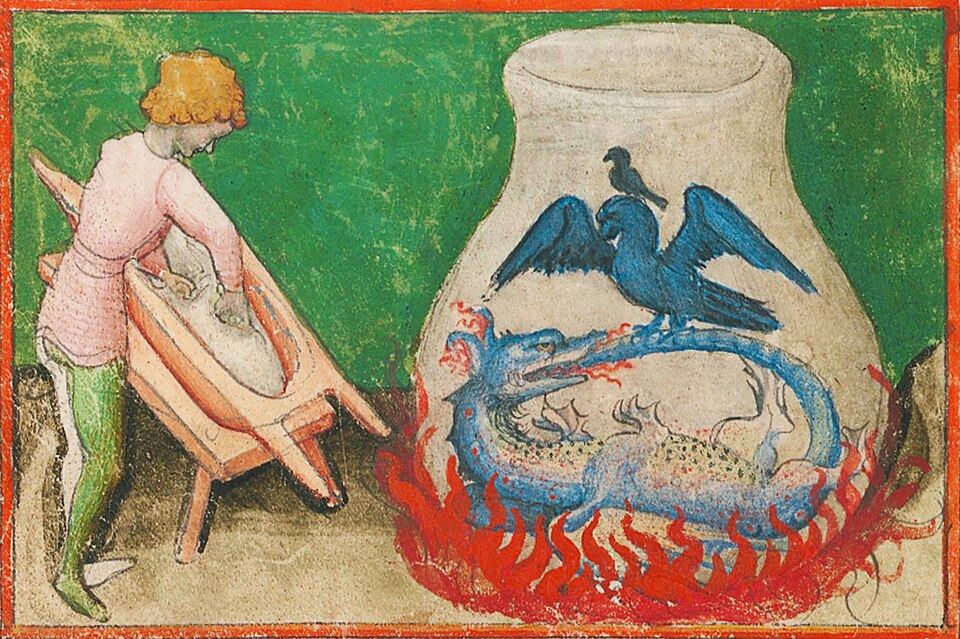
An alchemist's workshop with furnaces, stills and glass vessels in a historical illustration.
Unknown author Unknown author · Public domain · Wikimedia Commons
c. 3000 BCE – 800 CE

Craft chemistry and the first alchemists

For millennia, chemical knowledge lived inside crafts: Mesopotamian glassmakers and bronze-casters, Egyptian embalmers and pigment-grinders, dyers, tanners and brewers on every continent, each guarding recipes that worked for reasons nobody could state. Alongside the crafts grew the speculative tradition — Greco-Egyptian alchemists in Alexandria such as Zosimos of Panopolis writing recipes in deliberate code, and Chinese alchemists whose search for an elixir of immortality produced, among much else, the first gunpowder. Practitioners ranged from honored royal specialists like the Babylonian perfumer Tapputi to anonymous workshop laborers.
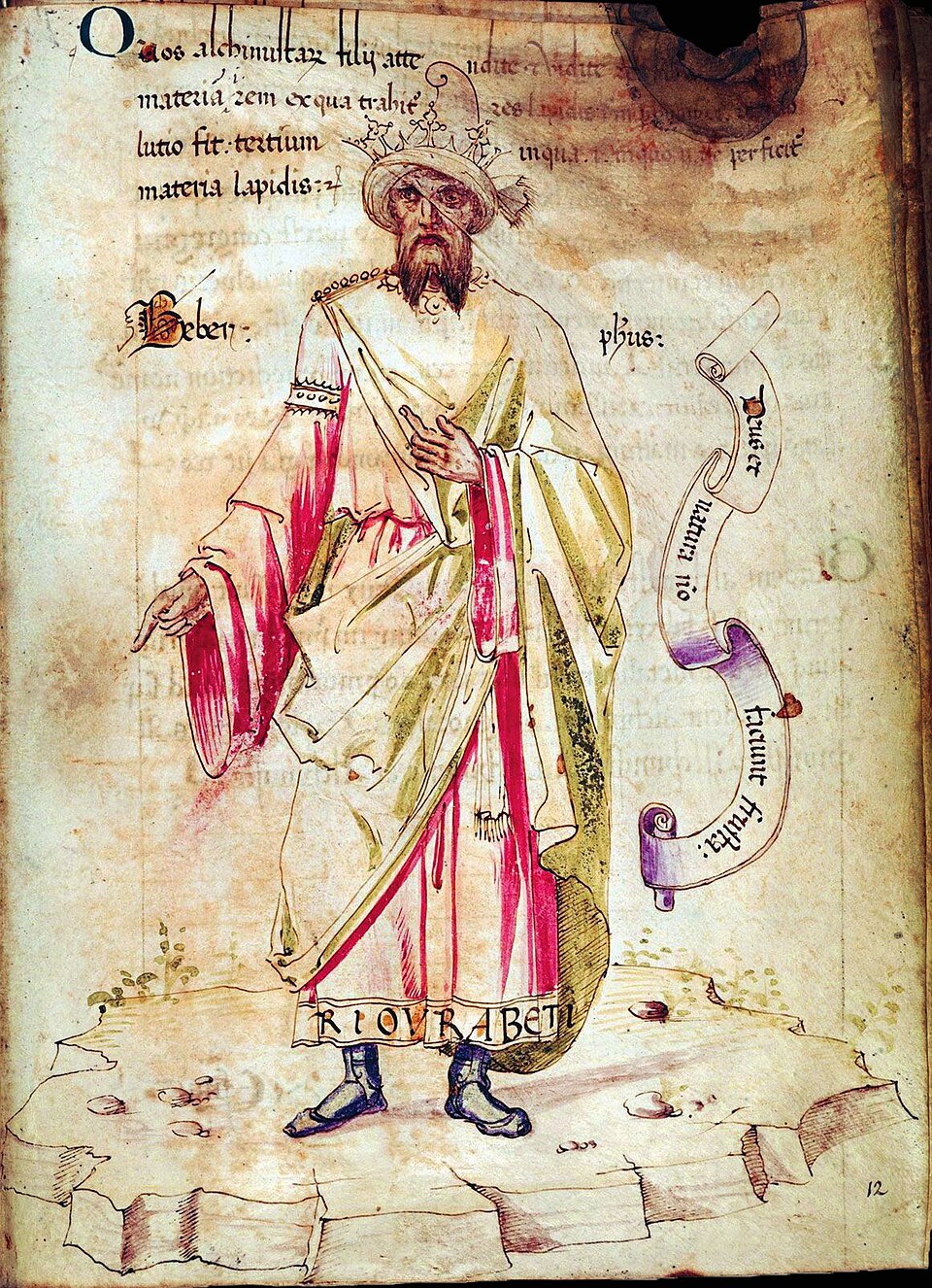
A depiction of the medieval Islamic alchemist Jabir ibn Hayyan, known in Latin Europe as Geber.
Unknown author Unknown author · Public domain · Wikimedia Commons
800 – 1661

Alchemy from Baghdad to Basel

The Islamic world turned alchemy into something recognizably experimental: the Jabirian corpus and al-Razi's manuals describe real apparatus, classify real substances and demand that ideas be tested at the bench. Latin Europe absorbed this literature through 12th-century translation centers such as Toledo, and for four centuries alchemy ran on royal patronage, genuine metallurgical skill and no shortage of fraud. Paracelsus redirected the art toward medicine in the early 1500s, insisting the point of chemistry was to make remedies, not gold — a step toward the laboratory science to come.

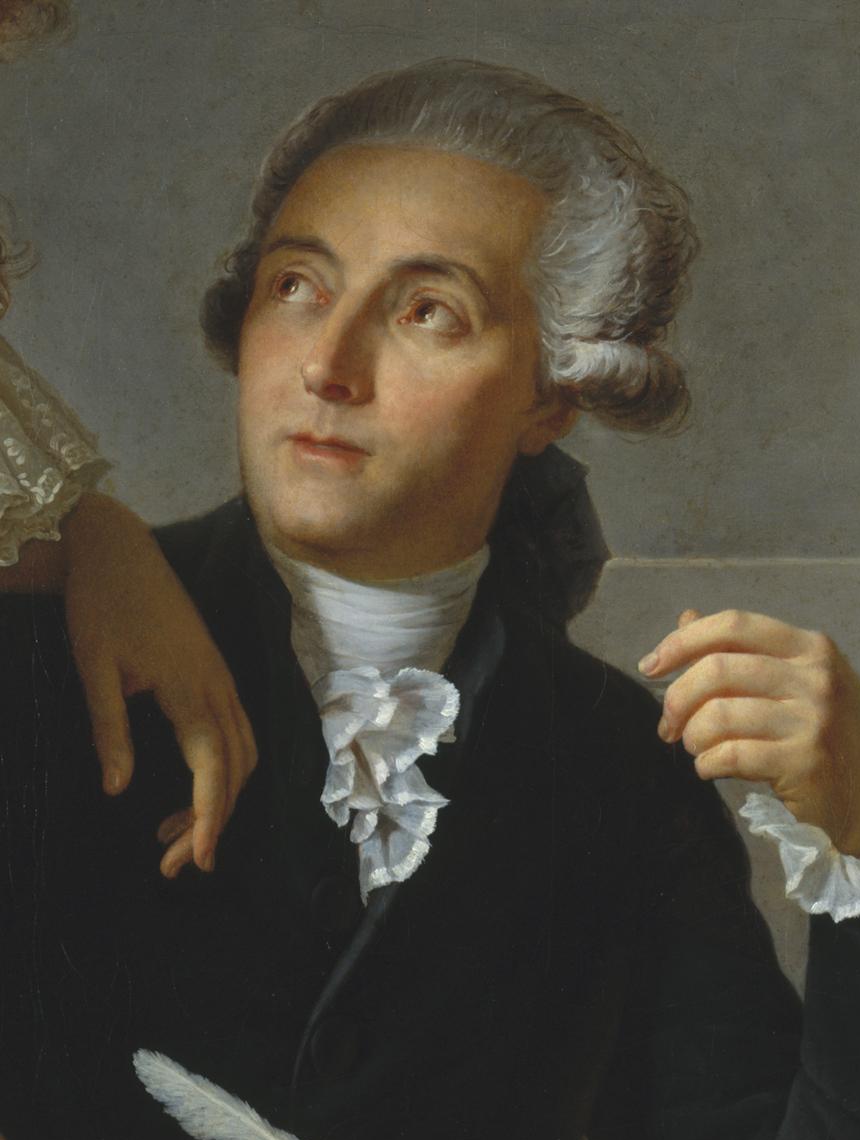
Portrait of Antoine Lavoisier, central figure of the eighteenth-century chemical revolution.
Jacques-Louis David · Public domain · Wikimedia Commons
1661 – 1789

The chemical revolution

Between Boyle's Sceptical Chymist and Lavoisier's Traité, chemistry separated itself from alchemy by changing its habits rather than its glassware: publish openly, weigh everything, define an element by what analysis cannot split. The pneumatic chemists — Black, Cavendish, Priestley, Scheele — isolated gas after gas, and Lavoisier's balance-sheet accounting of combustion overthrew the phlogiston theory that had organized the field for a century. By the era's end chemistry had a nomenclature, a conservation law and a professional identity distinct from both medicine and mysticism.

The periodic table of the elements, first organized in predictive form by Mendeleev in 1869.
Lekritz · CC BY-SA 4.0 · Wikimedia Commons
1789 – 1914

Atoms, elements and the dye works

Dalton's atomic theory gave chemistry arithmetic; electrolysis and spectroscopy delivered new elements almost yearly; Mendeleev's 1869 table organized them and predicted more. Meanwhile Perkin's 1856 mauve accident showed that molecules could be an industry: German firms — BASF, Bayer, Hoechst — built research laboratories staffed by PhD chemists, invented the corporate R&D model, and by 1900 dominated world dye and pharmaceutical production. The era closed with Haber and Bosch fixing nitrogen from air, the single invention that would do most to feed the twentieth century.

1914 – present

The molecular century

Quantum mechanics explained the chemical bond; instrumentation transformed practice — where structure determination once took years of degradation chemistry, NMR spectroscopy and X-ray crystallography now reveal molecules in hours. Chemists built the polymer age from nylon (1935) onward, the antibiotic and pharmaceutical age, and the materials inside every battery and semiconductor. The same century forced a reckoning: chemical weapons, CFCs, DDT and PFAS each made regulation and green chemistry part of the job, and since the 2010s machine learning and robotic labs have begun redesigning the bench itself.

What this job replaced

Neighbouring trades that no longer exist — absorbed, automated or regulated away.

Alchemist

c. 300–1783

For fourteen centuries alchemists pursued transmutation and the elixir of life with royal patrons, coded manuscripts and real laboratory skill — Boyle and Newton both practiced seriously. The trade's respectability died in stages as chemistry professionalized; a late marker came in 1782–83, when English chemist James Price claimed to turn mercury into gold, was challenged by the Royal Society to repeat the feat before witnesses, and drank prussic acid in front of the delegation instead. The apparatus, and the ambition to remake matter, passed to chemistry.

Saltpetre man

c. 1540–1860s

Gunpowder needed potassium nitrate, and before industrial chemistry the only source was nitrate-rich earth from dovecotes, stables and cellar floors. English "petermen" carried royal warrants entitling them to dig up private property — even church floors — and were widely loathed for it. The trade collapsed when imported Chilean and Indian nitrates undercut it in the nineteenth century, and the Haber–Bosch process finally made nitrogen fixation a factory product rather than something scraped from the ground.

Natural indigo planter

c. 1600–1914

Indigo, "blue gold," supported vast plantation economies in India and the Americas. Adolf von Baeyer synthesized the dye molecule in 1880, and after an 18-year, roughly 18-million-goldmark development effort BASF put synthetic indigo on the market in 1897. Indian natural indigo exports collapsed within two decades, and the coercive planting system left behind in Bihar became the target of Gandhi's first Indian civil-disobedience campaign at Champaran in 1917 — a whole agricultural profession erased by one laboratory molecule.

Trades that vanished →

Chemistry's history is a repeated pattern: a craft works for centuries without theory, a theory arrives and explains it, and the explanation then generates industries nobody could have imagined — dyes from coal tar, fertilizer from air, medicines from soybeans, materials from equations.

The pattern has not stopped. Machine-learned models now propose molecules before any flask is involved, exactly as Mendeleev's table once predicted elements before anyone found them. Each time, the tools changed and the center of the job did not: someone still has to make the substance, measure what actually formed, and decide what the result means.

Keep exploring

More in Science & Research