🧪The Greats

Chemist · The scientist who makes and measures matter itself — from Tapputi's Babylonian perfume still to today's robot laboratories, still the one who decides what the spectrum means.

Choosing eight names from a science practiced by every civilization is necessarily unfair — chemistry's history is unusually full of collaborators, technicians and wives whose contributions were absorbed into someone else's fame, and of entire craft traditions that never wrote anything down. The eight below are chosen because their influence is documented, checkable and still visible in how chemistry is done.

They span twelve centuries and seven countries: a corpus from Abbasid Baghdad that may be a whole school wearing one name, a French tax collector who weighed everything, a Polish woman boiling tonnes of ore in a Paris shed, a sharecropper's grandson racing Oxford to an alkaloid, and a Chinese researcher who found a cure in a fourth-century recipe. What they share is that matter obeys different rules — or we understand the rules differently — because each of them worked.

The all-time podium

Dmitri Mendeleev
Dmitri Mendeleev
Russia
2
Antoine Lavoisier
Antoine Lavoisier
France
1
Marie Curie
Marie Curie
Poland / France
3

The eight who reached the top

1
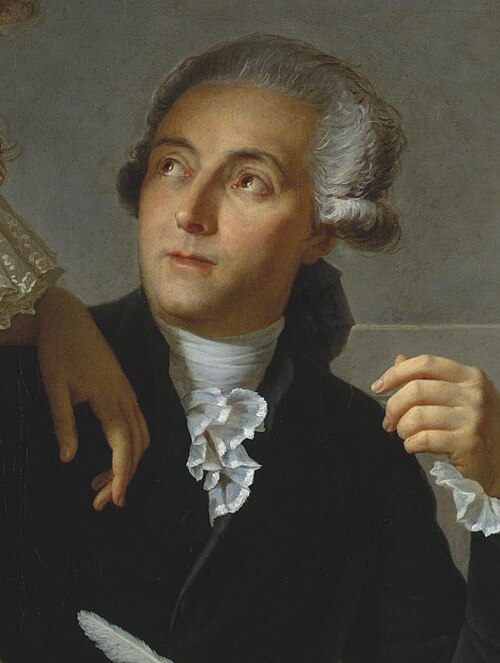
Portrait of Antoine Lavoisier, founder of modern chemistry. Jacques-Louis David · Public domain

Antoine Lavoisier

France · 1743–1794

Lavoisier turned chemistry into a quantitative science: his balance experiments established conservation of mass, his oxygen theory of combustion demolished phlogiston, and his 1789 Traité listed 33 elements and gave the field its modern nomenclature. His wife Marie-Anne Paulze was translator, illustrator and full collaborator in the work.

The story

Lavoisier funded his laboratory as a partner in the Ferme générale, the private consortium that collected France's taxes — and during the Terror that fortune became his death sentence. He was guillotined with 27 other tax farmers on 8 May 1794, at fifty. The mathematician Joseph-Louis Lagrange remarked the next day that it had taken only an instant to cut off that head, though a hundred years might not produce another like it.

“Weigh everything, trust the balance over the theory — and no reputation is protection when politics turns.”
Elements in the 1789 Traité
33 substances
Age at the guillotine
50 years old
Conservation of mass
Still taught daily
2
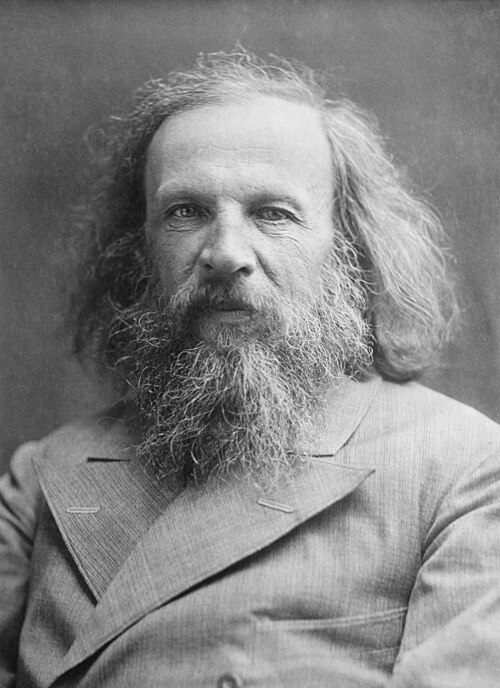
Portrait of Dmitri Mendeleev, creator of the periodic table. Original: Unknown author Unknown author Upload: Germansociety2014 · Public domain

Dmitri Mendeleev

Russia · 1834–1907

The youngest of a large Siberian family whose mother trekked him across Russia to get him educated, Mendeleev arranged the 63 known elements by atomic weight in 1869 and saw a law where others saw coincidence — leaving deliberate gaps and predicting, in detail, the elements that would fill them.

The story

When Paul-Émile Lecoq de Boisbaudran discovered gallium in 1875, he measured its density as 4.7 — but Mendeleev's published prediction for the missing element demanded roughly 5.9, and the Russian wrote to say the Frenchman was measuring an impure sample of Mendeleev's element. Boisbaudran purified his gallium, remeasured, and got 5.9: the theorist had corrected the discoverer about a metal the theorist had never seen.

“A pattern strong enough to predict is stronger than any single measurement that disagrees with it.”

Elements known in 1869
63
Predicted elements confirmed
Ga, Sc, Ge
Element 101 named for him
Mendelevium (1955)
3
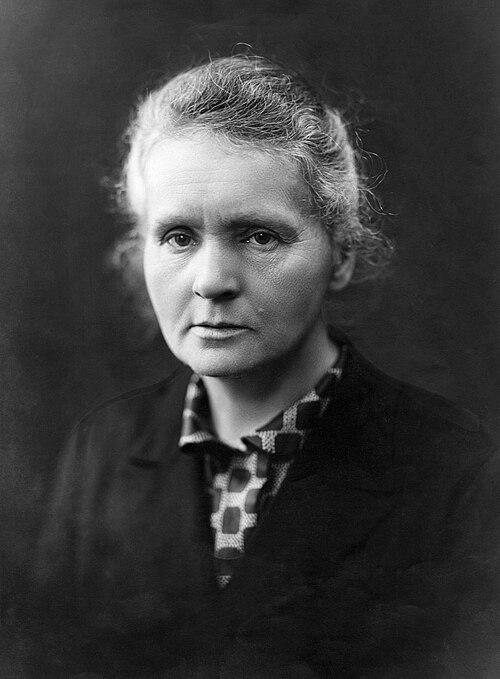
Photograph of Marie Curie, discoverer of polonium and radium. Henri Manuel · Public domain

Marie Curie

Poland / France · 1867–1934

Barred from university in Russian-ruled Poland, Maria Skłodowska studied at a clandestine "Flying University" before reaching the Sorbonne. She coined the word radioactivity, discovered polonium and radium in 1898, and remains the only person to win Nobel Prizes in two sciences — physics in 1903 and chemistry in 1911.

The story

To prove radium existed, Curie spent 1898 to 1902 processing tonnes of pitchblende residue in a leaky shed at a Paris industrial school, stirring boiling ore with an iron rod nearly her own height, to isolate about a decigram of radium chloride. Wilhelm Ostwald, visiting, called the shed a cross between a stable and a potato cellar. Her notebooks from those years are still radioactive; the Bibliothèque nationale stores them in lead and asks readers to sign a waiver.

“If the effect is real, isolating it is worth years of labor no one else is willing to do.”

Nobel Prizes
2 (1903, 1911)
Elements discovered
Po and Ra, 1898
Pitchblende processed by hand
Tonnes, 1898–1902
4
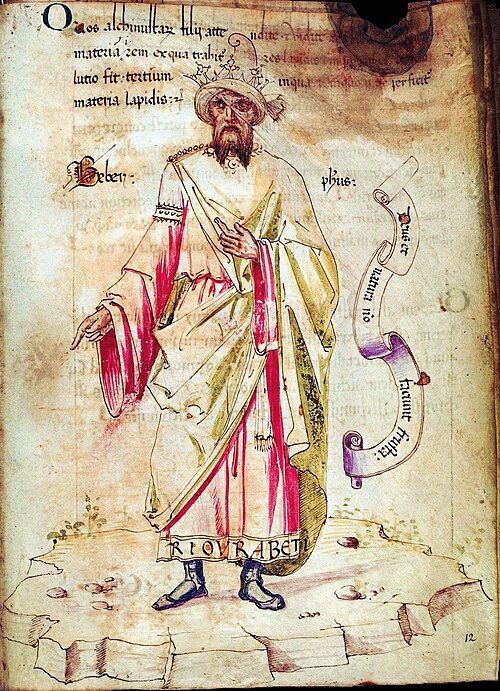
Depiction of Jabir ibn Hayyan, the most influential name in early Islamic chemistry. Unknown author Unknown author · Public domain

Jabir ibn Hayyan

Abbasid Caliphate (Iraq/Persia) · c. 721 – c. 815

The name attached to the most influential body of chemical writing before modern times: hundreds of Arabic treatises systematizing distillation, crystallization and sublimation, classifying substances by properties, and insisting that the worth of a claim is decided at the bench. Latin Europe learned its chemistry from "Geber" for four centuries.

The story

The corpus under Jabir's name grew so vast — some three thousand titles by traditional count — that scholars long doubted one lifetime could hold it. The philologist Paul Kraus showed in 1943 that the writings span generations and were likely produced by a school writing under the master's name, while a later Latin author, "pseudo-Geber," borrowed the brand for Europe's most important medieval chemistry textbook. The most influential chemist of the Middle Ages may be a thousand-year-old collective pen name.

“Method outlives the individual: a tradition that teaches how to test claims matters more than who signs them.”

Treatises attributed
~3,000 titles
Centuries of influence
1,000+ years
Latin translations begin
12th century
5
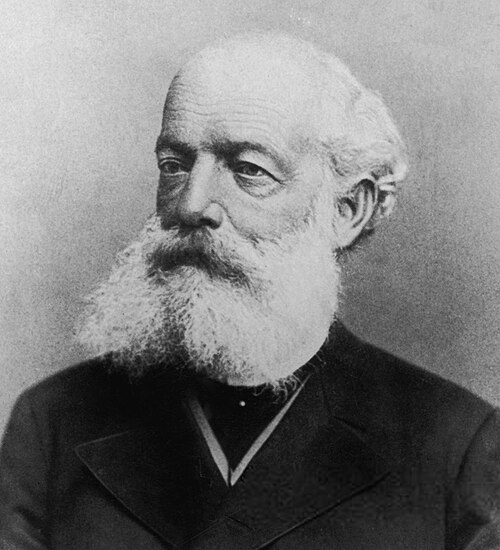
Portrait of August Kekulé, architect of structural organic chemistry. Unknown author Unknown author · Public domain

August Kekulé

Germany · 1829–1896

Kekulé gave organic chemistry its grammar: carbon is tetravalent and links into chains (1858), and benzene's six carbons close into a ring (1865). Structural theory turned molecular formulas into architecture, and his students carried the method across Europe — three of the first five chemistry Nobel laureates trained under him.

The story

At the 1890 "Benzolfest" in Berlin celebrating 25 years of the benzene ring, Kekulé told the story everyone now knows: dozing before a fire, he dreamed of atoms forming snakes, until one seized its own tail — and he awoke to the ring. Historians still argue whether the dream happened in Ghent in 1865 or was invented as after-dinner theater 25 years later; either way, the structure it decorates has never needed revision.

“Insight can arrive from anywhere; what makes it science is the years of testing after you wake up.”

Benzene ring proposed
1865
Students among first 5 Nobels
3 of 5
Valence theory published
1858
6

Dorothy Hodgkin

United Kingdom · 1910–1994

Working at Oxford with hands progressively crippled by rheumatoid arthritis diagnosed at 24, Hodgkin used X-ray crystallography to solve molecules thought too complex for the method: penicillin in 1945, vitamin B12 — 181 atoms — in 1955. She won the 1964 Nobel Prize in Chemistry, unshared, the only British woman yet to win a science Nobel.

The story

In 1934 Robert Robinson handed Hodgkin a few milligrams of crystalline insulin, and she photographed its diffraction pattern within the year — then spent the next three and a half decades building, method by method and computer by computer, the tools the problem demanded. Her group finally solved insulin's structure in 1969, thirty-four years after that first photograph. She then spent years touring the world's labs, sharing the structure with diabetes researchers.

“Pick a problem worth decades, then let the problem tell you which tools have to be invented.”

Years from first photo to insulin
34 (1935–69)
Nobel Prize in Chemistry
1964, unshared
Atoms in vitamin B12
181 solved, 1955
7

Percy Julian

United States · 1899–1975

Grandson of enslaved Alabamians, barred from most American graduate schools by race, Julian earned his PhD in Vienna and became one of the century's great synthetic chemists: first total synthesis of physostigmine in 1935, then industrial-scale steroid chemistry from soybeans that helped make cortisone affordable. He held over 100 patents.

The story

In 1935 Julian, an underfunded instructor at DePauw, was completing physostigmine's synthesis just as Oxford's Robert Robinson — the most powerful organic chemist alive — published his own route. Julian declared in print that Robinson's intermediate was wrong, staking his career on the melting point of the final compounds: his matched the natural alkaloid, Robinson's did not. DePauw still would not give him a faculty post, so he took his chemistry to industry — and later, when his Chicago-area home was firebombed, his neighbors stood guard.

“If your data are right, say so in print — even when the other name is the biggest in the field.”

Physostigmine synthesis
1935, DePauw
Patents held
100+
First Black chemist in the NAS
Elected 1973
8

Tu Youyou

China · b. 1930

A phytochemist with no doctorate, no study abroad and no academician's title — China's press called her the "three noes" scientist — Tu led the Project 523 team that isolated artemisinin from sweet wormwood in 1972. Artemisinin-based therapy became the world's front-line malaria treatment; she received the 2015 Nobel Prize.

The story

After hundreds of herbal extracts failed, Tu re-read the fourth-century physician Ge Hong's Emergency Formulas Kept Up One's Sleeve, which said to soak qinghao in cold water and wring out the juice — no boiling. Suspecting heat destroyed the active compound, she switched to low-temperature ether extraction; on 4 October 1971, extract number 191 inhibited malaria parasites in mice completely. To move quickly to patients, Tu and two colleagues volunteered as the first human subjects in 1972.

“Read the old literature as data, not decoration — and test the detail everyone else skipped.”

The extract that worked
No. 191, 1971
Traditional recipes reviewed
2,000+
Malaria deaths averted
Millions since 2000

Bars are scaled to the leader in this list.

Comparison Lab

Toggle names on and off — every bar rescales to the leader of your selection.

5 / 8

The argument

"Father of chemistry" is a genuinely contested title: partisans of Jabir point to the experimental method a millennium early, Boyle's champions cite the break with alchemy in 1661, and Lavoisier's the quantitative revolution — the honest answer is that a science this old was founded several times on three continents.

Chemistry's credit ledger is notoriously incomplete. Marie-Anne Lavoisier's translations and illustrations were absorbed into her husband's fame; Rosalind Franklin's crystallography was decisive for DNA's structure; Lise Meitner, co-discoverer of nuclear fission and a 48-time Nobel nominee, watched the 1944 chemistry prize go to her collaborator Otto Hahn alone. Any top-eight list inherits those distortions.

A list of named individuals also flatters the wrong picture of the science: most chemical knowledge in history was produced by dyers, metallurgists, brewers, perfumers and industrial teams who published nothing under their own names. Tapputi of Babylon survives by the accident of one tablet — the equally skilled thousands around her do not.

Keep exploring

More in Science & Research