Roughly 6-9 million players across 130+ countries, per World RugbyPlayers
World Rugby, founded 1886 as the International Rugby Football Board; now 132 member unionsGoverning body
Rugby World Cup, held every four years since 1987; France 2023 drew about 2.4 million spectatorsFlagship event
South Africa, with four (1995, 2007, 2019, 2023) — the only team to win fourMost world titles
Rugby School, England, in the 1820s-1840s; the Rugby Football Union codified the laws in 1871Origins
15 a side over two 40-minute halves on a pitch up to 100 m by 70 m, plus in-goal areasFormat
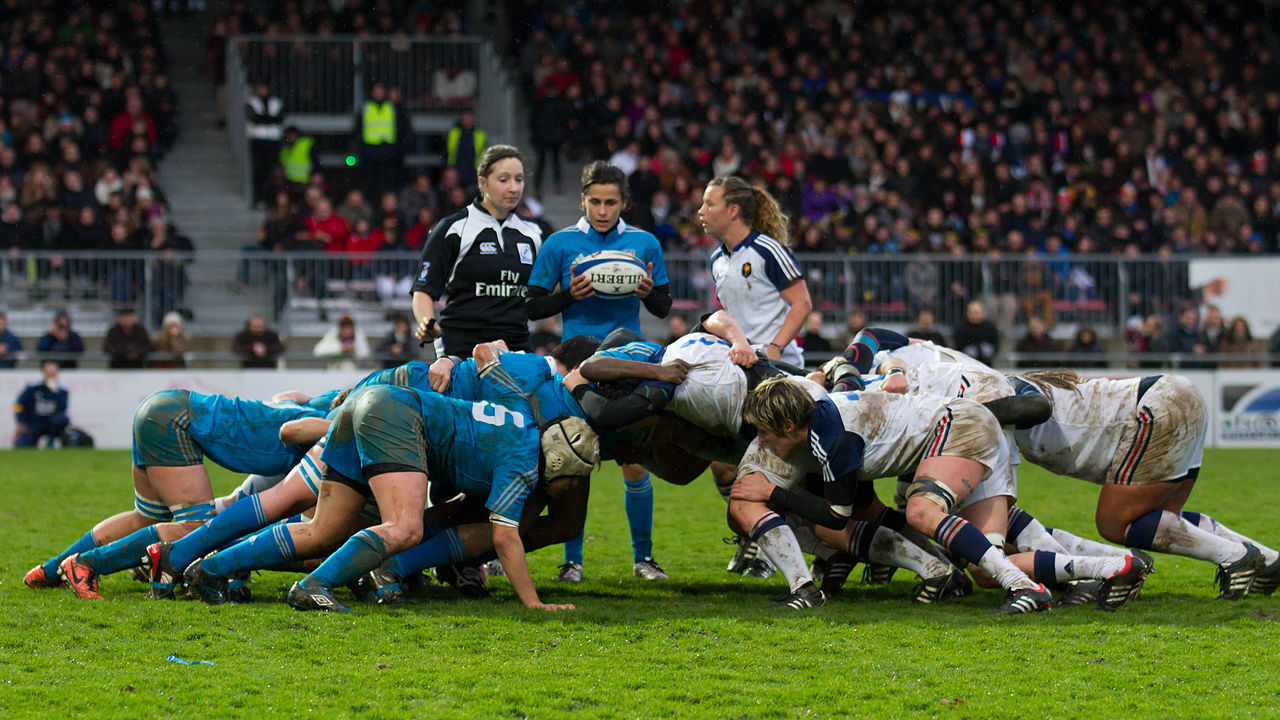
Rugby union is a fifteen-a-side collision sport built on a single tension: the ball may be carried and kicked freely, but it can only be passed backwards, so every metre of ground must be won by running into contact and recycling possession. When the ball-carrier is tackled, a fight called the breakdown erupts over the ball; when it goes out of bounds or an infringement halts play, the game restarts with a scrum or a lineout, the set pieces where matches are often decided. Fifteen specialists — eight heavy forwards and seven quicker backs — occupy numbered roles, and the eighty minutes flow almost continuously, with no timeouts once the whistle has started play.
What grips people is the collision of brute force and fine strategy inside the same phase. A rolling maul grinding towards the line is settled by leverage and lung capacity; a backline strike move a moment later is settled by timing and sleight of hand. Rugby rewards a 130-kilogram prop and a 75-kilogram winger equally, giving almost any body type a position, and its culture prizes deference to the referee — addressed as 'sir' — and the post-match handshake between opponents. Territory is the game's currency: sides kick for position, defend their own 22, and strangle opponents through relentless pressure as often as they score.
What makes rugby singular is the permanent, legal fight for possession. Unlike most invasion games, the defending side can win the ball back at almost every tackle, scrum and lineout, so possession is never safe and momentum swings on a single turnover. The oval ball bounces unpredictably, turning kicks into lotteries; the offside line, running across the pitch at each breakdown, forces attackers to build through phases rather than simply pass forward. The sport stayed rigidly amateur until 1995, when it turned professional almost overnight, and that late transition still shapes its finances, its global map, and its fierce present-day argument over player welfare and head injury.
What is the difference between rugby union and rugby league?
They are two separate codes that split in 1895 over payments to players. Rugby union has 15 players a side; rugby league has 13. The biggest difference is the tackle: in union, both teams contest the ball at every tackle through the ruck, so possession can change hands constantly, whereas in league the tackled team retains the ball but must hand it over after six tackles. Union has scrums with eight contesting forwards and lineouts to restart play; league's scrums are largely uncontested and it has no lineouts. Union is the global game with the World Cup and Six Nations, while league is strongest in northern England, Australia and the Pacific.
How does scoring work in rugby union?
There are four ways to score. A try, worth five points, is scored by grounding the ball over the opponents' goal line and is the primary objective. After a try, the scoring side attempts a conversion — a kick at goal from a spot in line with where the try was scored — worth two points. During open play, a team awarded a penalty may kick at goal for three points, and a player can also attempt a drop goal, kicking the ball through the posts from open play, also worth three points. A penalty try, awarded when a certain try is illegally prevented, is worth seven points with no conversion needed. The team with the most points after 80 minutes wins.
Why can't you pass the ball forward in rugby?
The forward-pass ban is the rule that shapes everything about how rugby is played. A pass must travel level or backwards relative to the player throwing it; a ball thrown or knocked forward results in a scrum to the other side. Because you cannot simply throw the ball ahead to a team-mate, the only legal ways to move it forward are to run with it or to kick it. This forces teams to advance by carrying into contact, offloading and building through phases, and it makes support running — team-mates staying behind the ball-carrier to receive a backward pass — fundamental. The rule is what gives rugby its distinctive flow of forward carries and lateral, looping attacks.
What is a ruck, and how is it different from a maul?
Both are contests that form after contact, but the key difference is whether the ball is on the ground. A ruck forms when a ball-carrier is tackled to ground and players from both sides bind over the ball; once a ruck is formed, players may not use their hands and must drive with their feet to win the ball for the scrum-half. A maul forms when the ball-carrier is held up but stays on their feet and team-mates bind on with the ball still in hand; the group can then drive forward, most dangerously off a lineout near the try line. Simply put: ruck means ball on the ground and no hands, maul means ball off the ground and still in hand.
Which country has won the most Rugby World Cups?
South Africa has won the most, with four titles in 1995, 2007, 2019 and 2023 — becoming the first four-time champions when they beat New Zealand 12-11 in the 2023 final in Paris. New Zealand, the most consistent side in the tournament's history, have three (1987, 2011 and 2015), Australia have two (1991 and 1999), and England have one (2003), the only Northern Hemisphere nation ever to win it. The World Cup has been held every four years since the inaugural 1987 tournament co-hosted by New Zealand and Australia, and only four nations have ever lifted the Webb Ellis Cup, underlining how dominant the southern hemisphere's big three have been.
How long is a rugby union match?
A match lasts 80 minutes, played in two halves of 40 minutes with a half-time break of up to 15 minutes. Unlike football, the referee stops the clock for injuries, substitutions and Television Match Official reviews, so a half often runs beyond 40 minutes of real time. Importantly, a half does not end the instant time expires: play continues until the ball next becomes dead, which is why a team can mount one final attack after the hooter has sounded. In knockout matches that finish level, two 10-minute periods of extra time are played, followed if necessary by sudden death and ultimately a place-kicking competition to decide the winner.
What are the British & Irish Lions?
The Lions are a unique touring team made up of the best players from England, Scotland, Ireland and Wales, who unite behind a single red jersey once every four years to tour one of the southern hemisphere's giants — New Zealand, South Africa or Australia. The tradition dates to 1888, and a Lions tour features a series of midweek matches against provincial sides plus a three-Test series against the host nation. Because the four nations are usually fierce rivals, being selected for the Lions is one of the greatest honours in the sport, and series wins are rare and celebrated — the 1971 win in New Zealand and the 1997 win in South Africa are among the most famous in rugby history.
When did rugby union become professional?
Rugby union was strictly amateur for most of its history and only turned professional in 1995. For a century the sport banned paying players, a stance so central that it caused the 1895 split with the clubs that became rugby league. But by the mid-1990s the amateur ideal had become untenable: players were global stars generating huge revenue while forbidden from earning a living, and covert payments — 'shamateurism' — were widespread. In the wake of the 1995 World Cup, and with media money pouring in, the International Rugby Board declared the game 'open' on 26 August 1995, legalising payment almost overnight. The abrupt change transformed players into full-time athletes and reshaped the size, speed, structures and finances of the modern game.