1949, the FIM Grand Prix World ChampionshipFirst season
1,000cc four-cylinder prototype, 157 kg minimumPremier-class machine
22 rounds, plus a Sprint at every event2026 calendar
Giacomo Agostini, 15 (8 in the premier class)Most world titles
Valentino Rossi, 89Most premier-class wins
368.6 km/h, Jorge Martin, Mugello 2026Outright speed record
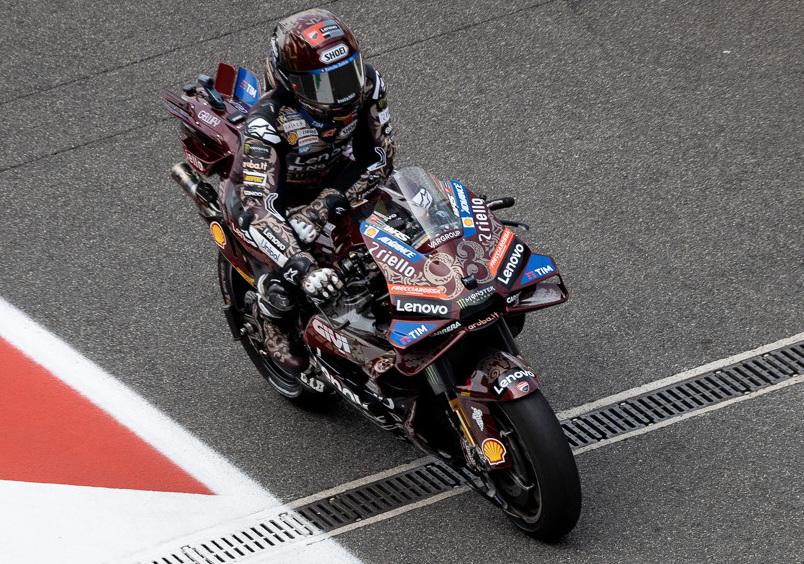
MotoGP is the premier class of the FIM Road Racing World Championship Grand Prix, the series that has crowned a world champion every year since 1949. It is a prototype formula: no bike on the grid can be bought, and none is derived from a road model. Current machines run 1,000cc four-cylinder engines capped at an 81mm bore, weigh a minimum of 157 kilograms, make well over 300 horsepower and exceed 360 km/h. Riders lean past 60 degrees, brake from those speeds on carbon discs that only work above roughly 250 degrees Celsius, and race for around 40 minutes without stopping. Twenty-two rounds make up the 2026 calendar.
A Grand Prix weekend now produces two scoring races. Since 2023 every round has included a Saturday Sprint over roughly half distance, paying 12 points to the winner down to one for ninth, alongside the Sunday Grand Prix that pays 25 down to one for fifteenth. Grid position comes from a two-part qualifying session, with the ten fastest riders from Friday's hour-long Practice going straight through to Q2. There are no scheduled pit stops. Tyres come from a single supplier, Michelin since 2016 and Pirelli from 2027, and the rider who best manages a rear tyre over the closing laps usually decides the race.
The modern championship is defined by Ducati. The Bologna factory won six consecutive constructors' titles from 2020 to 2025 and supplies roughly a third of the grid, while Aprilia, KTM, Honda and Yamaha fight over the rest under a four-tier concessions system built to close the gap. Marc Marquez ended a six-year title drought in 2025, scoring a record 545 points in his first season with the factory Ducati team. Off track, Liberty Media completed its purchase of series promoter Dorna Sports in July 2025, placing MotoGP alongside Formula 1. A sweeping technical reset arrives in 2027: 850cc engines, smaller fairings, no ride-height devices and fully sustainable fuel.
What is the difference between MotoGP and World Superbike?
MotoGP is a prototype championship: every bike is a purpose-built racing machine that cannot be bought and has no road-going equivalent. Current MotoGP machines run 1,000cc four-cylinder engines producing well over 300 horsepower at a minimum weight of 157 kilograms. World Superbike, by contrast, uses heavily modified versions of motorcycles you can buy from a dealer, with regulations that limit how far they can be altered and balancing rules that equalise performance between manufacturers. MotoGP is faster and technically far more advanced, but Superbike racing is often closer because the machinery is more constrained. The two series have distinct rider markets, and moving between them is common in both directions.
How does the MotoGP Sprint race work?
Since 2023, every Grand Prix weekend has included a Sprint on Saturday afternoon, run over roughly half the Sunday race distance, typically 10 to 14 laps and around 20 minutes. It uses the same grid set by Saturday morning qualifying, and there is no separate session for it. Points go to the top nine finishers only: 12 for the win, then 9, 7, 6, 5, 4, 3, 2 and 1. The Sprint result does not change Sunday's grid, and riders are free to choose different tyres for each race, though the shorter distance pushes almost everyone onto softer compounds. A perfect weekend is worth 37 points.
Who has won the most MotoGP world championships?
Giacomo Agostini holds the record with 15 world championships, eight of them in the premier 500cc class and seven in the 350cc class, won between 1966 and 1975. In the premier class specifically, Agostini's eight titles lead Valentino Rossi and Marc Marquez, who have seven each. Mike Hailwood also won nine world championships across the 250cc, 350cc and 500cc classes. For race wins, Agostini leads all classes with 122, while Rossi holds the premier-class record with 89 victories from 2000 to 2017. Marquez passed Agostini's premier-class total of 68 during the 2025 season and now sits second behind Rossi.
How fast do MotoGP bikes go?
The outright record is 368.6 km/h, set by Jorge Martin on an Aprilia RS-GP during practice at Mugello in May 2026, beating the 366.1 km/h Brad Binder recorded at the same circuit in 2023. Mugello's kilometre-long main straight makes it the usual venue for speed records, though Sepang, Phillip Island and Losail also produce numbers above 350 km/h. More impressive than the top speed is the deceleration: a MotoGP bike sheds more than 250 km/h in around four seconds and roughly 250 metres, generating over 1.5g through carbon brake discs that only work properly above about 250 degrees Celsius.
What changes in MotoGP in 2027?
Four major things happen at once. Engine capacity drops from 1,000cc to 850cc with maximum bore reduced from 81mm to 75mm, and the engine allocation falls from seven to six per rider per season. Fuel capacity falls from 22 litres to 20 for a Grand Prix, and all fuel must be 100 percent non-fossil in origin, up from the 40 percent minimum in force since 2024. Aerodynamics are cut back, with narrower fairings and restricted rear devices, and ride-height and holeshot systems are banned outright. Finally, Pirelli replaces Michelin as sole tyre supplier after eleven seasons. The combined intent is slower, cheaper bikes that are easier to follow and overtake.
Why do MotoGP riders drag their knees and elbows?
Hanging off the inside of the bike moves the combined centre of mass of rider and machine inwards, which means the motorcycle itself can stay more upright for a given cornering speed and keep a larger, safer contact patch on the tyre. Knee sliders came first, in the 1970s, as riders such as Kenny Roberts began moving their bodies off the seat. As tyres and chassis improved, lean angles increased past 60 degrees and the elbow started reaching the tarmac too, a style Marc Marquez normalised in the 2010s. The contact also provides feedback: a rider can feel exactly how far the bike is leaned and, in a front-end slide, sometimes use knee and elbow to prop the machine back up.
Do MotoGP riders make pit stops?
Not in normal conditions. A MotoGP race is run start to finish on one set of tyres and one tank of fuel, with no refuelling and no scheduled stops, which is why tyre management over the closing laps decides so many races. The exception is the flag-to-flag rule for changing weather. If a race declared dry is hit by rain, the white flag is shown and riders may pit to swap onto a second, identical bike already fitted with wet tyres, a change that typically costs 25 to 30 seconds. The same applies in reverse when a wet race dries out. If conditions become genuinely dangerous, race direction red-flags the race instead.
What are Moto2 and Moto3?
They are the two support classes that run at every Grand Prix and form the official ladder into MotoGP. Moto3, which replaced the 125cc class in 2012, uses 250cc single-cylinder four-strokes with cost caps and a rev limit; low power means slipstreaming dominates and races are decided in huge packs. Moto2, which replaced the 250cc class in 2010, uses a spec 765cc three-cylinder Triumph engine with chassis from independent constructors such as Kalex, making it a test of rider and chassis rather than engine budget. The minimum age in all three classes is 18, raised for the 2023 season after a series of fatal accidents in junior racing.