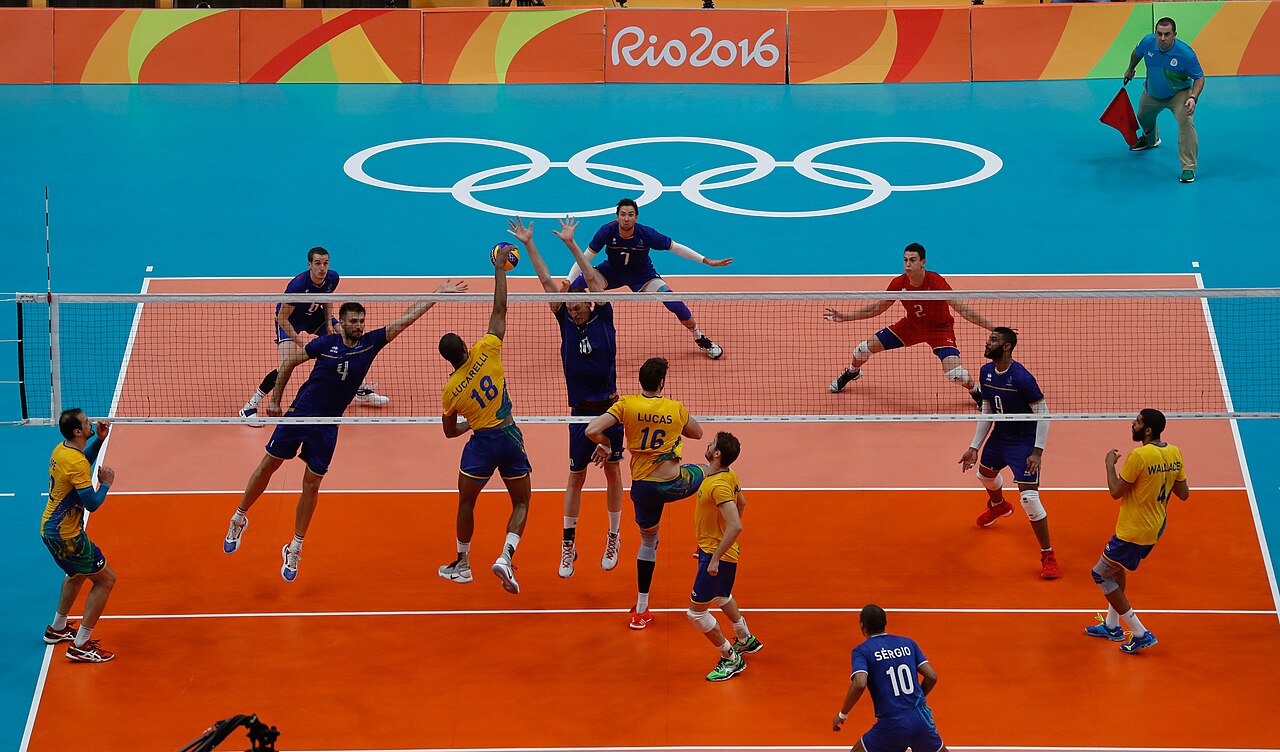
Volleyball is a rally sport of controlled violence: six players a side, a net dividing an 18-by-9-metre court, and a ball that may touch the floor only once before the point is lost. Each team gets three contacts to dig, set and attack, and no player may strike the ball twice in succession. That three-touch rhythm - pass, set, spike - is the game's DNA, repeated thousands of times a match at speeds that push a hard-driven ball past 100 kilometres per hour. Unlike most invasion games, opponents never share the same side of the net; the contest is a duel of serve, reception and counterattack conducted entirely across a two-and-a-half-metre barrier.
What hooks spectators is the swing between order and chaos. A perfectly run offence looks choreographed - the setter releasing a quick to the middle a fraction before the blockers can commit - yet a single shanked pass turns the rally into scramble defence, players sprawling and pancaking to keep the ball alive. Momentum is brutally visible: rally-point scoring means every exchange changes the number on the board, and a five-point run can flip a set in ninety seconds. Because rotation forces every athlete through all six zones, there is nowhere to hide; the 2.10-metre middle must also pass, and the libero anchors the back court without ever scoring.
Volleyball is unusual in how completely it is built around specialisation inside strict positional rules. The rotation and overlap laws dictate where six players must stand at the instant of serve, yet each is a specialist who sprints to a base the moment the ball is contacted. The libero, in a contrasting jersey, cannot serve, block or attack a ball above net height - a defensive role written into the rulebook in 1998. Add the split between the men's 2.43-metre net and the women's 2.24, the beach game's two-player sand variant, and a scoring system that rewards nerve on serve, and you have a sport that is at once physical, tactical and intensely psychological.
There are five specialist roles distributed across six on-court players. The setter (S) runs the offence, delivering the second ball to attackers. Outside hitters (OH), also called left-side hitters, attack from the left and lead serve-receive. The middle blocker (MB) hits quick sets and anchors the block at the net. The opposite (OPP), or right-side hitter, attacks from the right and blocks the opponent's outsides. The libero (L) is a back-row defensive specialist in a contrasting jersey who cannot serve, block or attack above net height. Teams may also use a defensive specialist (DS) who substitutes for weaker back-row passers. A standard 5-1 lineup fields one setter, two outsides, two middles, one opposite, and a libero rotating through the back row.
How does volleyball scoring work?
Modern volleyball uses rally-point scoring: a point is awarded on every rally regardless of which team served. Matches are best-of-five sets. The first four sets are played to 25 points and the deciding fifth set to 15, but a team must always win by a two-point margin, so sets can extend beyond the target - 26-24, 30-28 - until someone leads by two. The first team to win three sets takes the match; there are no draws and no clock. Rally scoring, adopted by FIVB around 1999, replaced the older side-out system in which only the serving team could score, making matches faster and easier to schedule for television.
What is the difference between the 5-1 and 6-2 systems?
Both describe how a team organises its setters. In a 5-1, a single setter runs the offence through all six rotations, giving consistency and one dedicated right-side attacker, the opposite. The drawback is that in three rotations the setter is in the front row, leaving only two front-row hitters. In a 6-2, two setters play opposite each other in the rotation, so whichever is in the back row sets while the front-row setter becomes an attacker - meaning the team always has three front-row hitters and a bigger attack. The cost is losing the rhythm of a single playmaker, and each setter must also attack and serve well. Most elite teams favour the 5-1.
Why can't the libero attack or serve?
The libero is a specialised back-row defender, introduced in 1998 to raise the standard of reception and floor defence, and the rules deliberately confine the role to defence. A libero cannot complete an attack on a ball that is entirely above the height of the net, cannot block or attempt to block, and generally cannot serve, though some competitions permit it in one rotation. If the libero uses an overhand finger-set to feed a hitter while standing on or in front of the attack line, that hitter may not attack the ball above net height. In exchange for these limits, the libero enjoys unlimited substitutions for back-row players and wears a contrasting jersey so officials can track the role easily.
How high is a volleyball net?
For indoor competition the net is set at 2.43 metres for men and 2.24 metres for women, measured at the centre of the court; the two ends may sit fractionally higher but within a small tolerance. The men's height dates to the sport's early standardisation and has remained fixed for generations. Youth, seated and some recreational categories use lower nets. In beach volleyball the same 2.43-metre men's and 2.24-metre women's heights apply. The court itself measures 18 by 9 metres, split into two nine-metre squares by the net, with an attack line three metres from the centre dividing each half into front and back zones.
Who is the greatest volleyball player of all time?
Most experts name Karch Kiraly of the United States, the only player to win Olympic gold both indoors, in 1984 and 1988, and on the sand, in 1996, and the figure FIVB honoured as the best male player of the 20th century. In the women's game the equivalent is Cuba's Regla Torres, a three-time Olympic champion whom FIVB named the best female player of the century. Beyond those two the debate is open, with the likes of Giba, Lorenzo Bernardi, Sergey Tetyukhin, Zhu Ting and Paola Egonu all in the conversation. Because volleyball is a team sport without a single career statistic, any ranking blends titles, longevity and individual dominance.
What is the difference between indoor and beach volleyball?
Indoor volleyball is played six against six on an 18-by-9-metre hard court, with specialised positions, rotations, substitutions and a libero, in a best-of-five match to 25 points a set. Beach volleyball pits two against two on a smaller 16-by-8-metre sand court, with no positional specialisation, no substitutions and players covering the whole court themselves. Beach matches are best-of-three sets to 21 points, with a deciding third set to 15. The sand slows movement and rewards all-round skill, since each player must serve, pass, set and attack. Both have been Olympic sports - indoor since 1964, beach since 1996 - and while some athletes, most famously Karch Kiraly, have excelled at both, the two games now have largely separate professional pathways.
How many players are on a volleyball team?
Six players from each team are on the court at any time, arranged in the three-front, three-back rotational order. A full match-day roster typically carries 12 to 14 players, including one or two liberos and specialists who substitute in. Teams rotate one position clockwise each time they win back the serve, so every player must play front and back court. Standard rules allow six substitutions per set for the six court positions, handled separately from the libero, who may replace any back-row player an unlimited number of times without counting against that total. Coaches use substitutions to bring on serving specialists, defensive specialists or fresh attackers at key moments.