Quick facts
Contested in nearly 200 countries; one of the original modern Olympic sports since the 1904 St. Louis Games, with women's boxing added at London 2012Global reach
Four major professional sanctioning bodies: the WBA (1921, as the NBA), WBC (1963), IBF (1983) and WBO (1988); the amateur code is now run by World Boxing, formed in 2023Governing bodies
Mayweather vs Pacquiao, May 2, 2015, generated roughly 4.6 million US pay-per-view buys and over $410 million in PPV revenue, the highest-grossing fight everRichest event
Tyson vs Jake Paul, streamed live on Netflix on November 15, 2024, reached about 108 million viewers with a reported 65 million concurrent streamsBiggest audience
17 professional divisions, from minimumweight (105 lb / 47.6 kg) up to heavyweight (over 200 lb / 90.7 kg)Weight classes
World title bouts are 12 rounds of three minutes, scored by three ringside judges on the 10-point must systemChampionship format
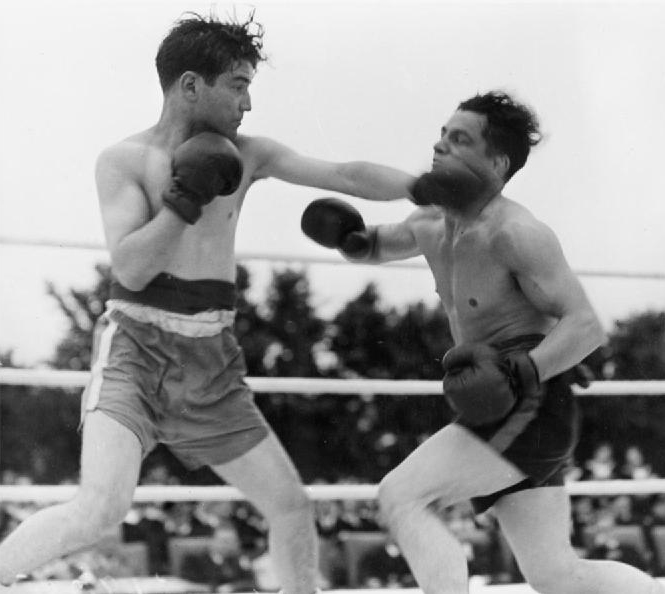
Boxing is the oldest form of organized combat in sport, and the most exposed. Two fighters of matched weight step between the ropes with nothing but gloved fists, a mouthpiece and their own nerve; there is no ball to hide behind, no teammate to cover a mistake, and no clock to run out for a losing side. A punch missed or a chin caught cold is answered in real time and in full view. From the ancient pygmachia added to the Olympic Games in 688 BC to a Netflix stream watched by 108 million people, the essential contract has never changed: hit and do not get hit.
What grips people is the compression of risk into ninety-second bursts. A twelve-round title fight is a negotiation conducted at the edge of consequence, where a fighter behind on all three cards is one left hook from erasing the whole night. The sport braids courage with intelligence, which is why the old trade name, the sweet science, has outlived a century of critics. Muhammad Ali against George Foreman in Kinshasa, Marvin Hagler and Thomas Hearns trading for eight electric minutes, Manny Pacquiao's whirlwind against Miguel Cotto: the appeal is watching disciplined skill hold up, or break, under the most honest pressure any sport applies.
Boxing is also uniquely global and uniquely fragmented. It crowns champions in seventeen weight divisions through four rival sanctioning bodies, so the map of greatness runs from Mexican body-punchers to Filipino southpaws, Ukrainian technicians, Cuban amateurs and British sellout arenas. That fragmentation frustrates casual fans but feeds a deeper truth: at 105 pounds and at 250, the fundamentals are identical, and a pound-for-pound argument can seriously place a flyweight above a heavyweight. No other sport lets a 5-foot-4 champion be ranked, straight-faced, as better than a man who outweighs him by a hundred pounds.
Frequently asked questions
How many rounds is a professional boxing match?
Professional bouts range from four to twelve rounds of three minutes each, separated by one-minute rests. World championship fights are twelve rounds. Non-title fights are shorter, typically four to ten rounds depending on the fighters' experience. Title bouts were traditionally fifteen rounds, but the sport reduced them to twelve after the South Korean fighter Kim Duk-koo died from injuries suffered in a fifteen-round lightweight title fight against Ray Mancini in 1982. The WBC led the change that year, and the other sanctioning bodies followed, with the last fifteen-round title fight held in 1988. Amateur and Olympic men's bouts are three rounds; women's professional championship fights are usually ten two-minute rounds, though there is a push to allow three-minute rounds.
What does undisputed champion mean in boxing?
An undisputed champion holds all four major world titles in a division simultaneously: the WBA, WBC, IBF and WBO belts. Because boxing is governed by these four rival sanctioning bodies rather than one league, each division can have four different 'world champions' at once, and unifying all of them is the sport's ultimate achievement. Fragmentation made it nearly impossible for decades, but a deliberate revival has produced modern undisputed champions such as Canelo Alvarez at super middleweight in 2021 and Oleksandr Usyk, who in 2024 became the first four-belt undisputed heavyweight champion and the first undisputed heavyweight since Lennox Lewis in 1999. Undisputed titles are prized but fragile, since the bodies' conflicting mandatory-defense rules often force a champion to vacate one belt soon after unifying.
Who is the greatest boxer of all time?
The most common answer is Sugar Ray Robinson, whom The Ring magazine and most historians rank as the greatest pound-for-pound fighter ever. Across a 25-year career he went roughly 173-19-6 with 108 knockouts, held the welterweight title and won the middleweight crown five times, and was unbeaten for 91 consecutive fights between 1943 and 1951. The phrase pound-for-pound, meaning greatness independent of weight, was coined to describe him. The debate's other leading names are Muhammad Ali, the most culturally significant boxer and a three-time heavyweight champion; Henry Armstrong, who held three world titles at once; and Joe Louis, whose heavyweight reign lasted nearly twelve years. Because fighters compete in different divisions and eras with no shared scoreboard, the ranking is a matter of informed judgment rather than settled fact.
What are the weight classes in boxing?
Professional boxing has seventeen weight divisions, matching fighters by size for safety and fairness. From lightest to heaviest they are: minimumweight (105 lb), light flyweight (108), flyweight (112), super flyweight (115), bantamweight (118), super bantamweight (122), featherweight (126), super featherweight (130), lightweight (135), super lightweight (140), welterweight (147), super welterweight (154), middleweight (160), super middleweight (168), light heavyweight (175), cruiserweight (200) and heavyweight (over 200 lb, with no upper limit). The 'super' and 'junior' prefixes denote in-between classes added over the decades. Fighters must make their division's weight limit at an official weigh-in, usually the day before the bout, and often rehydrate substantially before fighting. The proliferation of divisions is one reason boxing has so many world champions.
How is a boxing match scored?
Fights that go the distance are decided by three ringside judges using the 10-point must system. In each round, the judge awards 10 points to the fighter he believes won it and 9 or fewer to the other; a close round is 10-9, a round with a knockdown is usually 10-8, and a dominant round can be 10-8 or lower. Judges score clean, effective punching, ring generalship, defense and aggression, and they cannot see one another's cards during the fight, which is why split decisions happen. At the end, the scorecards are tallied: a fighter needs a majority of the three judges to win. Outcomes include unanimous decision (all three judges agree), split decision (two to one), majority decision (two judges plus one even card) and various draws. A knockout or stoppage ends the fight before the cards matter.
What is the difference between a KO and a TKO?
A knockout (KO) occurs when a fighter is knocked down and cannot rise before the referee counts to ten, ending the fight. A technical knockout (TKO) ends the fight while a fighter is still technically able to stand, when the referee decides he can no longer intelligently defend himself, when the ringside doctor halts the bout for injury, when a fighter's corner throws in the towel to protect him, or when a jurisdiction's three-knockdown rule triggers. Both count as stoppage wins and are recorded together in a fighter's knockout total. The distinction is essentially about how the stoppage happens: a full count for a KO, a judgment call by the referee, doctor or corner for a TKO. A related result is a retirement (RTD), when a fighter quits on his stool between rounds.
Why are there four different world champions in each weight class?
Because boxing has no single governing body. Four rival organizations, the WBA (1921), WBC (1963), IBF (1983) and WBO (1988), each sanction their own world championships, rankings and title fights, and each charges fees for the privilege. A fighter can hold one, two, three or all four belts in a division. The bodies emerged over the 20th century through splits and rivalries, and while fans and purists criticize the confusion, the system persists because it is lucrative for the organizations and gives promoters more titles to sell. Holding all four at once makes a fighter undisputed champion, the closest boxing comes to a single, clear world champion. Many purists instead follow the lineal championship, the man who beat the man, which ignores the sanctioning bodies entirely and traces the title through actual head-to-head succession.
What does pound-for-pound mean in boxing?
Pound-for-pound is a way of ranking fighters independent of their actual weight, imagining them as equals in size to judge pure skill and accomplishment. Because a heavyweight will always beat a flyweight physically, the concept asks a hypothetical: if all fighters were the same size, who would be best? It lets a small fighter like Sugar Ray Robinson, Roberto Duran or Manny Pacquiao be ranked above much larger champions. The phrase was coined for Robinson, universally regarded as the pound-for-pound standard. Publications like The Ring maintain active pound-for-pound rankings of the sport's best current fighters across all divisions, and the label 'pound-for-pound king' is one of boxing's highest informal honors, held in recent eras by fighters such as Floyd Mayweather, Pacquiao, Canelo Alvarez, Terence Crawford and Naoya Inoue.