Fédération Internationale de Gymnastique (FIG), founded in Liège in 1881 — the oldest international sports federationGoverning body
On the program at every modern Olympics since Athens 1896; women's events added in 1928Olympic status
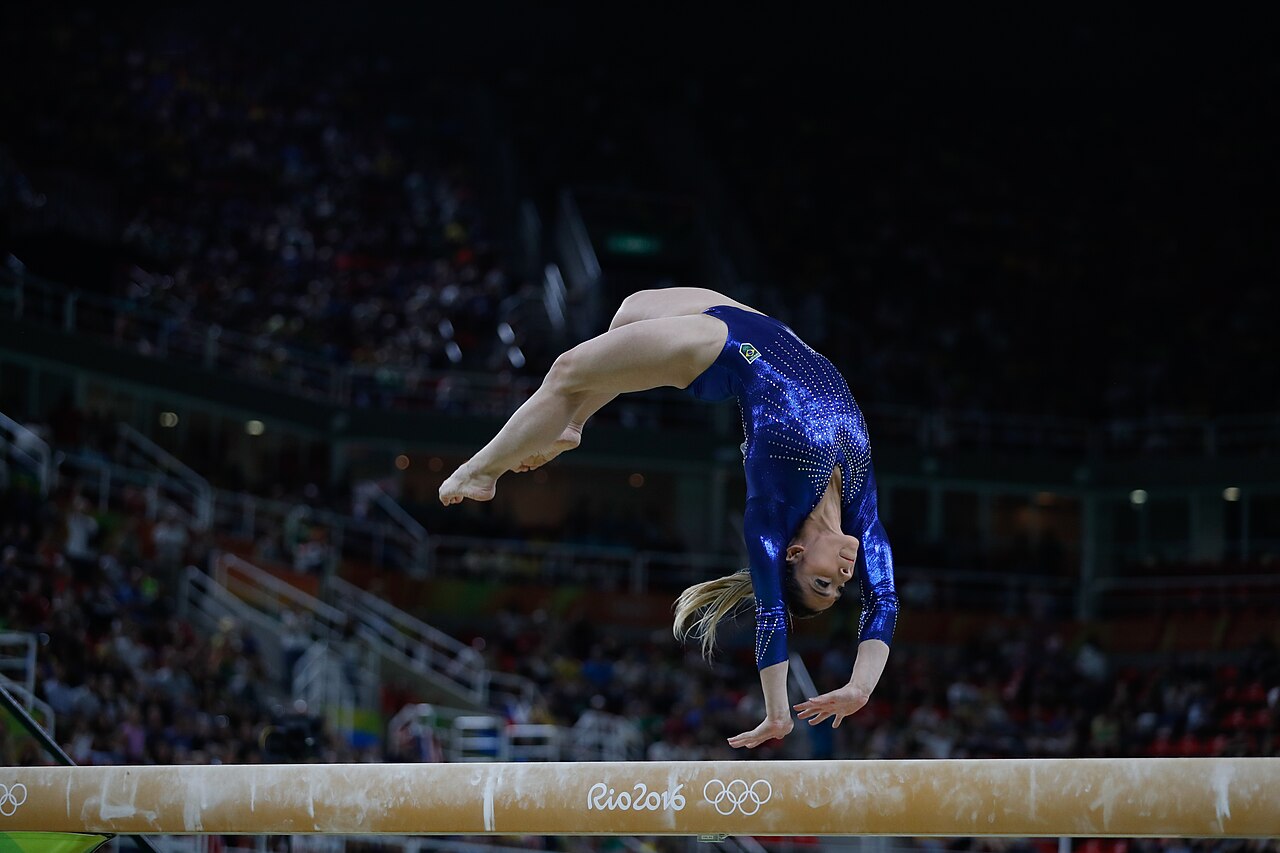
Six for men (floor, pommel horse, rings, vault, parallel bars, high bar); four for women (vault, uneven bars, beam, floor)Apparatus
14 in total — eight for men, six for womenOlympic medal events
Open-ended Code of Points since 2006: a difficulty score plus an execution score that starts at 10.00Scoring
Simone Biles — 41 Olympic and World Championship medals, 30 of them gold (through Paris 2024)Most decorated gymnast
Artistic gymnastics asks a human being to leave the ground, rotate about two axes at once, and arrive standing still. Everything else — the apparatus, the chalk, the Code of Points — exists to measure how well that is done. Men contest six apparatus, women four, and each routine lasts between five seconds and ninety. Within those windows a gymnast must satisfy composition requirements, accumulate difficulty, and hide every trace of effort, because the execution panel deducts for bent knees, flexed feet, a hop on landing and a shoulder angle a few degrees off vertical. No sport compresses so much preparation into so little visible time.
The sport's modern identity was set in 2006, when the FIG abolished the perfect 10 and replaced it with an open-ended system: a difficulty score with no ceiling, added to an execution score that still begins at 10.00 and only falls. That single change turned gymnastics into an arms race between what is possible and what is clean. A triple-twisting double somersault is worth more than a double-twisting one, but only if it lands; a fall costs a full point and, in the three-up three-count Olympic team final, usually costs a medal too.
Geographically the sport has always been a contest between systems rather than individuals. The Soviet Union won ten consecutive women's Olympic team titles from 1952 to 1992; Japan's men won five in a row from 1960 to 1976 and won again in Paris in 2024; Romania built a school around Nadia Comăneci; China swept both team golds in Beijing in 2008; the United States produced the most dominant gymnast in history in Simone Biles. Paris 2024 then scattered gold to Algeria, the Philippines, Ireland, Armenia and Brazil — evidence that the pipeline is finally global.
How is artistic gymnastics scored, and what happened to the perfect 10?
Since 2006 every routine receives two scores that are added together. The difficulty score, or D-score, has no upper limit and is calculated from the values of the counting elements plus credit for required element groups and for connections performed without a pause. The execution score, or E-score, starts at 10.00 and only falls, with judges deducting 0.1 for a small fault, 0.3 for a medium one, 0.5 for a large one and 1.00 for a fall. The perfect 10 was abolished after the 2004 Athens Games, where a start-value error decided the men's all-around and a crowd protest over Alexei Nemov's high bar score halted competition. The old system could no longer separate gymnasts whose difficulty had outgrown its ceiling.
Why do men and women compete on different apparatus?
The two programs developed separately and were standardised at different times. The men's six apparatus — floor, pommel horse, rings, vault, parallel bars and high bar — descend directly from the nineteenth-century German Turnen movement and were essentially fixed by the 1930s, with a strong emphasis on upper-body strength. The women's program entered the Olympics in 1928 and was built around vault, uneven bars, balance beam and floor, emphasising acrobatic tumbling, flexibility and, on beam and floor, an explicit artistry component judged within the execution score. The result is that men contest eight Olympic medal events and women six, an imbalance FIG has been repeatedly asked to address. The apparatus themselves have not changed in principle for roughly a century.
Who is the greatest gymnast of all time?
Simone Biles has the strongest case by almost every measure. Through Paris 2024 she holds 41 Olympic and World Championship medals with 30 golds, including a record 23 world titles and six world all-around crowns, plus Olympic all-around golds in 2016 and 2024. Five elements in the Code of Points carry her name, and FIG has deliberately valued her hardest skills below what she argued they were worth in order to discourage imitation. The historical alternatives are serious: Larisa Latynina's 18 Olympic medals remain the gymnastics record, Kohei Uchimura went unbeaten in all-around competition from 2009 to 2016 on six apparatus, and Vitaly Scherbo won six golds at a single Games. The answer usually depends on whether you value accumulation, dominance or difficulty of the task.
How old do you have to be to compete at the Olympics?
Women must turn 16 during the calendar year of the competition and men must turn 18. The women's minimum was raised from 15 to 16 in 1997, after decades in which teenagers as young as 14 won Olympic titles — Nadia Comaneci was 14 when she won the 1976 all-around, a record now permanently unbreakable. The rule was introduced partly on health grounds, since very young gymnasts training elite volumes face growth-plate injuries and disordered eating risks, and partly because minors cannot meaningfully advocate for themselves inside coaching systems. Age falsification has been alleged repeatedly, most publicly against members of the Chinese team at Beijing 2008, and FIG now requires documentary verification through national federations.
What does it mean when a skill is named after a gymnast?
The Code of Points catalogues every recognised element, and a gymnast who invents a genuinely new one can have it entered under their own name permanently. The requirements are strict: the element must be submitted to the FIG technical committee in advance, and it must be performed successfully in qualification at a World Championships or Olympic Games, without a fall or a major error. Natalia Yurchenko's round-off vault entry, Yelena Produnova's front handspring double front, Aliya Mustafina's bar transition and Epke Zonderland's release combinations all carry their inventors' names. Simone Biles has five named elements across vault, beam and floor, the most of any woman, including the Yurchenko double pike named Biles II in 2023.
What are the twisties?
The twisties are a sudden loss of air awareness in which a gymnast cannot sense where their body is during rotation. Twisting skills are performed almost entirely on proprioceptive memory built through thousands of repetitions, and when that mapping breaks down the athlete may over-rotate, under-rotate or freeze mid-air. This is not stage fright: landing a double somersault without knowing which way is down is a realistic route to a spinal or head injury, which is why gymnasts stop competing rather than push through. Simone Biles withdrew from the Tokyo Olympic team final in July 2021 for exactly this reason. The episode changed how the sport treats the condition, which is now managed as an injury requiring graded rehabilitation rather than as a lapse of nerve.
How does the Olympic team competition work?
Teams of five gymnasts compete in qualification, where four perform on each apparatus and the best three scores count. The eight highest-ranked teams advance to the final, which is contested three-up, three-count: only three gymnasts perform on each apparatus and every single score is added, with no drop score to absorb a mistake. That format, introduced at Sydney in 2000, makes the team final the most nerve-shredding event in the sport, because one fall costs a full point that cannot be discarded. Coaches manage it through lineup order, usually leading off with their steadiest performer and anchoring with the highest scorer. Qualification results do not carry over: every team starts the final from zero.
What is the difference between artistic, rhythmic and trampoline gymnastics?
They are separate FIG disciplines with their own rulebooks and Olympic events. Artistic gymnastics is the apparatus-based sport described here, contested by men on six apparatus and women on four. Rhythmic gymnastics is a women's discipline combining dance and flexibility with hand apparatus — hoop, ball, clubs and ribbon — performed on a floor area to music, with individual and group events. Trampoline gymnastics awards medals for a ten-skill routine judged on execution, difficulty and time of flight, measured electronically. FIG also governs acrobatic gymnastics, aerobic gymnastics, parkour and gymnastics for all, though only artistic, rhythmic and trampoline currently appear on the Olympic program.