IMMAF, founded 2012 (130+ nations)International federation
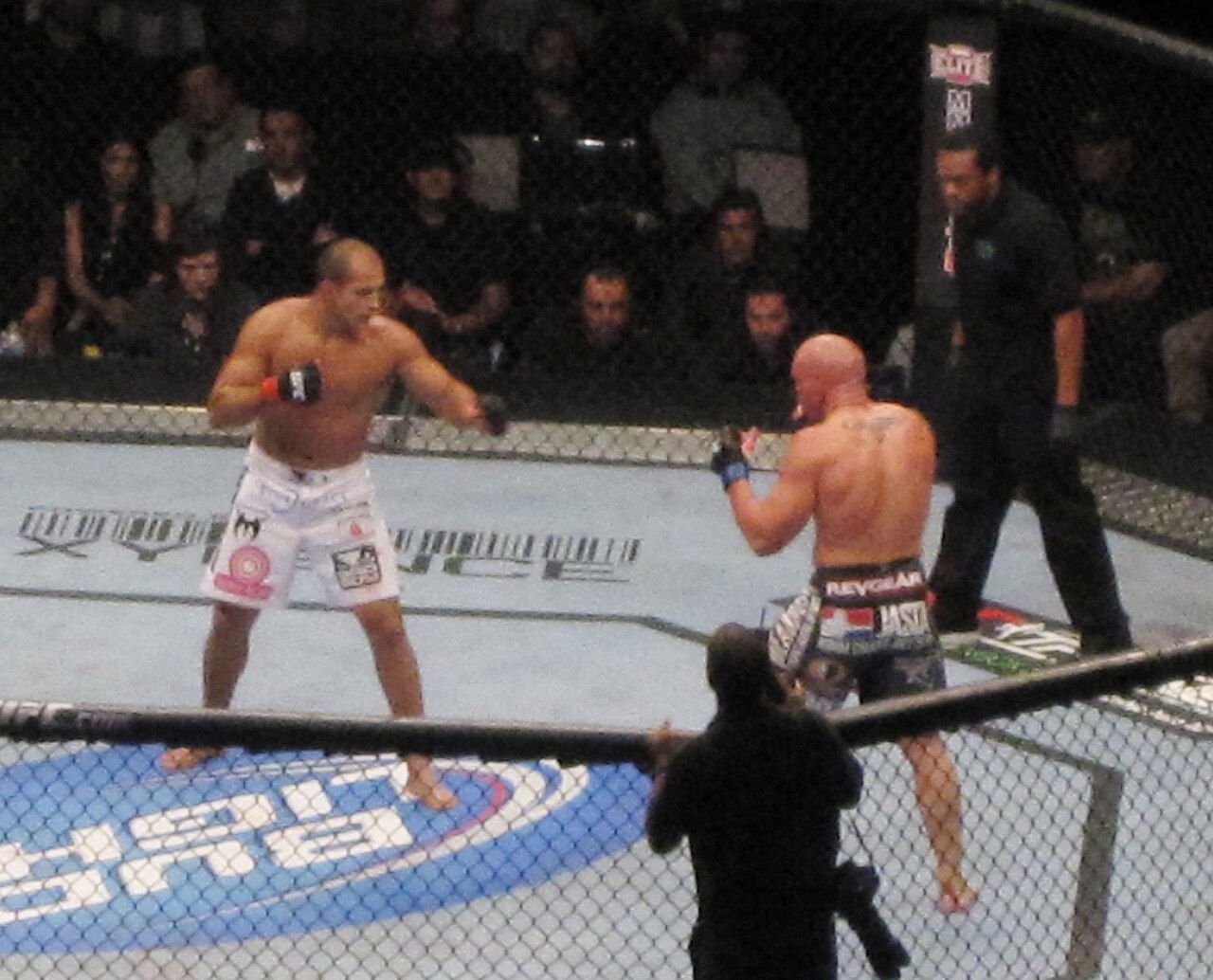
Mixed martial arts is combat's most complete test: a full-contact sport that fuses striking, wrestling and submission grappling inside a single contest. A fighter must punch and kick like a boxer or Muay Thai stylist, defend and complete takedowns like a wrestler, and threaten or survive chokes and joint locks like a Brazilian jiu-jitsu black belt. Bouts unfold in a fenced enclosure — the Octagon in the UFC — over three or five five-minute rounds. Victory can arrive in a single second by knockout or take twenty-five minutes and hinge on a judge's scorecard. No other mainstream sport asks an athlete to master so many disciplines at once.
The sport grips people because every exchange carries genuine stakes and no lead is ever safe. A fighter dominating four rounds can be knocked cold in the fifth; a grappler mounted and losing can lock a fight-ending armbar from the bottom. That constant threat of a finish makes MMA uniquely tense to watch. It is also deeply personal — one athlete against another, no ball, no teammates and nowhere to hide, styles and personalities colliding in real time. Rivalries like Khabib versus McGregor or the Jones-Cormier feud drew millions of pay-per-view buyers precisely because the drama is unscripted and the consequences are immediate and physical.
What makes MMA unique is its refusal to privilege any one martial art. The early UFC events of the 1990s were laboratories that pitted karate against sumo and boxing against jiu-jitsu to answer a simple question: which style truly works? The answer turned out to be all of them and none of them — the sport rewarded athletes who blended everything. Modern fighters are not karateka or wrestlers but hybrids, fluent across ranges from distance kicking to cage clinch to the ground. That evolutionary pressure, plus a global talent pipeline running from Dagestan to Brazil to Nigeria, keeps the sport's technical ceiling rising every single year.
MMA stands for mixed martial arts, a full-contact combat sport that combines techniques from multiple disciplines — boxing, Muay Thai, kickboxing, wrestling, Brazilian jiu-jitsu, judo and more — into a single ruleset. Rather than restricting fighters to one style, MMA lets them strike standing, clinch, take the fight to the ground and use submissions, all within one contest. The sport grew out of style-versus-style challenge matches designed to test which martial art was most effective in a real fight. The modern answer is that no single art dominates; the best competitors blend striking, wrestling and grappling into a seamless, complete skill set.
Is MMA the same as the UFC?
No. MMA is the sport; the UFC (Ultimate Fighting Championship) is a promotion — a private company that organizes events and crowns its own champions within that sport. The relationship is like the one between basketball and the NBA. Because the UFC is by far the largest and most prestigious promotion, signing most of the world's best fighters, the two terms are often used interchangeably in casual conversation, but they are not the same. Other MMA promotions include ONE Championship in Asia, the PFL, Bellator and Japan's RIZIN, and historically PRIDE and Strikeforce. A fighter can compete in MMA without ever fighting in the UFC.
What martial arts are used in MMA?
MMA draws on a wide range of disciplines, generally grouped by range. For striking, fighters use boxing (punches and head movement), Muay Thai (kicks, knees, elbows and clinch work), kickboxing and karate (kicking and footwork). For taking the fight to the ground, freestyle and Greco-Roman wrestling supply takedowns and takedown defense, and judo adds throws. On the ground, Brazilian jiu-jitsu governs positional control and submissions like chokes and joint locks. Elite fighters do not practice these as separate arts but blend them into one continuous system, transitioning fluidly from a punch to a takedown to a submission depending on where the fight goes.
How do you win an MMA fight?
There are four main ways to win. A knockout (KO) ends the fight when a legal strike renders an opponent unconscious. A technical knockout (TKO) comes when the referee, a doctor or the opponent's corner stops the bout because a fighter can no longer intelligently defend himself. A submission ends things when a fighter taps out to a choke or joint lock, verbally quits, or is choked unconscious. If no finish occurs, the fight goes to the judges' scorecards and is decided by decision — unanimous, split or majority — under the 10-Point Must System. Fights can also end in a draw, a disqualification for fouls, or a no-contest.
Is MMA more dangerous than boxing?
Research suggests MMA produces more visible injuries — cuts, bruises and minor damage — but potentially fewer catastrophic brain injuries than boxing. The key reason is the finish: MMA fighters can win by submission or ground-and-pound, and referees tend to stop fights quickly, so a competitor takes fewer repeated head blows than a boxer who is knocked down, given a standing eight-count and allowed to continue over 12 rounds. MMA's lighter gloves cause more surface cuts but transfer less repeated concussive force than boxing's heavily padded gloves, which let fighters absorb more head trauma over time. Both are inherently risky combat sports, and long-term brain-health concerns apply to each; no combat sport is truly safe.
What are the weight classes in MMA?
The UFC uses eight men's divisions: flyweight (125 lb), bantamweight (135 lb), featherweight (145 lb), lightweight (155 lb), welterweight (170 lb), middleweight (185 lb), light heavyweight (205 lb) and heavyweight (up to 265 lb). There are four women's divisions: strawweight (115 lb), flyweight (125 lb), bantamweight (135 lb) and featherweight (145 lb). Fighters must make their division's limit at an official weigh-in, usually the day before the fight, and title bouts allow no extra weight while non-title fights permit a one-pound allowance. Bouts contested at a weight between divisions, or where a fighter misses weight, are called catchweight fights.
Who is the greatest MMA fighter of all time?
There is no consensus, but the debate centers on a handful of names. Jon Jones has the deepest résumé and dominated two divisions, though controversies cloud his legacy. Khabib Nurmagomedov retired a perfect 29-0, never seriously challenged. Georges St-Pierre offered the most sustained, professional welterweight dominance and won a second title in a second division. Anderson Silva held the longest UFC title reign in history, and Demetrious Johnson is often called the most technically complete fighter ever. Among women, Amanda Nunes settled the argument by cleaning out two divisions. Which one is the true GOAT depends on whether you prize an unbeaten record, depth of competition or longevity.
What is Brazilian jiu-jitsu and why does it matter in MMA?
Brazilian jiu-jitsu (BJJ) is a grappling art focused on controlling an opponent on the ground and forcing a submission with chokes or joint locks. It matters enormously because the very first UFC events proved its effectiveness: Royce Gracie, a slender BJJ practitioner, submitted much larger strikers, showing that a skilled grappler could neutralize a stand-up fighter by taking the fight to the mat. BJJ organizes ground fighting as a hierarchy of position — guard, side control, mount, back control — with the principle 'position before submission.' Every serious MMA fighter now trains it, both to attack submissions and, just as importantly, to defend takedowns and escape dangerous positions when the fight hits the ground.