Milestones in order. This is history, not a weekly activity grid.
- The Webb Ellis legend
- First written laws
- The Rugby Football Union is founded
- The first Home Nations Championship
- The International Rugby Football Board
- The first British touring side
- The Great Schism
- The Original All Blacks
- The United States win Olympic gold
- France expelled, Bledisloe born
- The Lions conquer New Zealand
- 'That try' at the Arms Park
- The first Rugby World Cup
- Mandela, the Springboks and the open game
Last reviewed Sources & creditsMedia creditsMethodology
Quick answers
What is the difference between rugby union and rugby league?
They are two separate codes that split in 1895 over payments to players. Rugby union has 15 players a side; rugby league has 13. The biggest difference is the tackle: in union, both teams contest the ball at every tackle through the ruck, so possession can change hands constantly, whereas in league the tackled team retains the ball but must hand it over after six tackles. Union has scrums with eight contesting forwards and lineouts to restart play; league's scrums are largely uncontested and it has no lineouts. Union is the global game with the World Cup and Six Nations, while league is strongest in northern England, Australia and the Pacific.
How does scoring work in rugby union?
There are four ways to score. A try, worth five points, is scored by grounding the ball over the opponents' goal line and is the primary objective. After a try, the scoring side attempts a conversion — a kick at goal from a spot in line with where the try was scored — worth two points. During open play, a team awarded a penalty may kick at goal for three points, and a player can also attempt a drop goal, kicking the ball through the posts from open play, also worth three points. A penalty try, awarded when a certain try is illegally prevented, is worth seven points with no conversion needed. The team with the most points after 80 minutes wins.
Why can't you pass the ball forward in rugby?
The forward-pass ban is the rule that shapes everything about how rugby is played. A pass must travel level or backwards relative to the player throwing it; a ball thrown or knocked forward results in a scrum to the other side. Because you cannot simply throw the ball ahead to a team-mate, the only legal ways to move it forward are to run with it or to kick it. This forces teams to advance by carrying into contact, offloading and building through phases, and it makes support running — team-mates staying behind the ball-carrier to receive a backward pass — fundamental. The rule is what gives rugby its distinctive flow of forward carries and lateral, looping attacks.
What is a ruck, and how is it different from a maul?
Both are contests that form after contact, but the key difference is whether the ball is on the ground. A ruck forms when a ball-carrier is tackled to ground and players from both sides bind over the ball; once a ruck is formed, players may not use their hands and must drive with their feet to win the ball for the scrum-half. A maul forms when the ball-carrier is held up but stays on their feet and team-mates bind on with the ball still in hand; the group can then drive forward, most dangerously off a lineout near the try line. Simply put: ruck means ball on the ground and no hands, maul means ball off the ground and still in hand.
Which country has won the most Rugby World Cups?
South Africa has won the most, with four titles in 1995, 2007, 2019 and 2023 — becoming the first four-time champions when they beat New Zealand 12-11 in the 2023 final in Paris. New Zealand, the most consistent side in the tournament's history, have three (1987, 2011 and 2015), Australia have two (1991 and 1999), and England have one (2003), the only Northern Hemisphere nation ever to win it. The World Cup has been held every four years since the inaugural 1987 tournament co-hosted by New Zealand and Australia, and only four nations have ever lifted the Webb Ellis Cup, underlining how dominant the southern hemisphere's big three have been.
How long is a rugby union match?
A match lasts 80 minutes, played in two halves of 40 minutes with a half-time break of up to 15 minutes. Unlike football, the referee stops the clock for injuries, substitutions and Television Match Official reviews, so a half often runs beyond 40 minutes of real time. Importantly, a half does not end the instant time expires: play continues until the ball next becomes dead, which is why a team can mount one final attack after the hooter has sounded. In knockout matches that finish level, two 10-minute periods of extra time are played, followed if necessary by sudden death and ultimately a place-kicking competition to decide the winner.
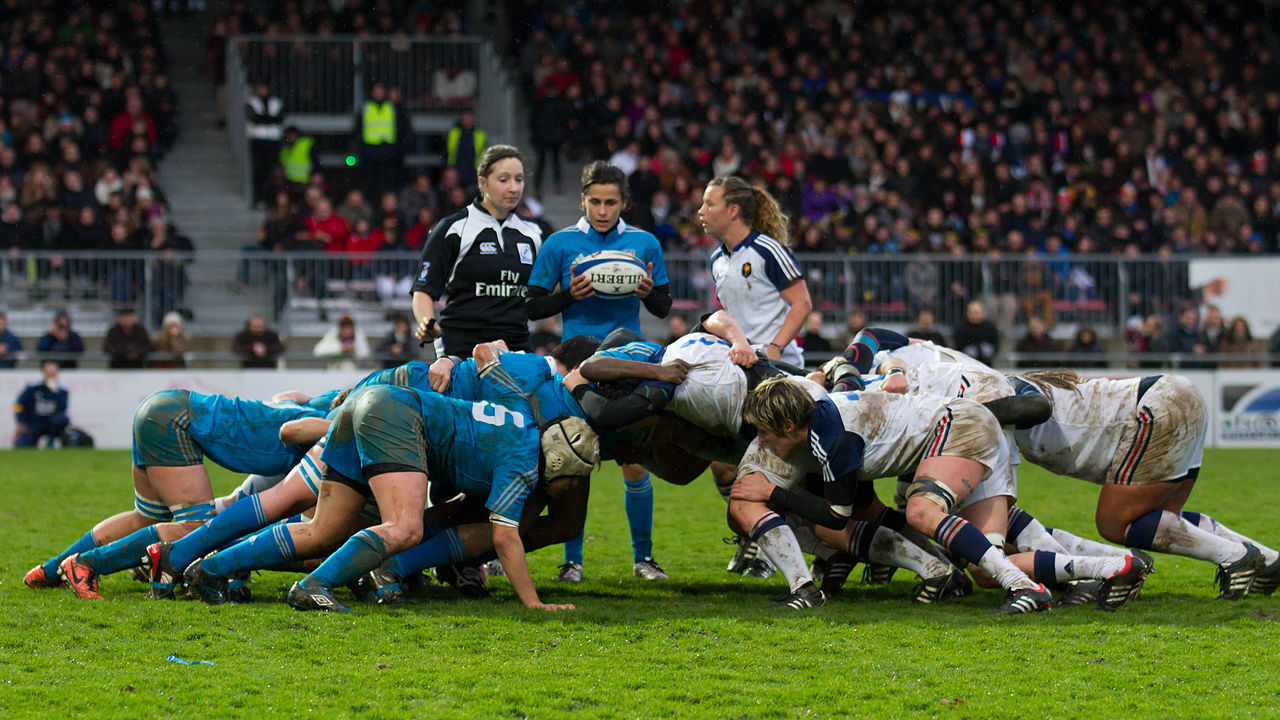
Rugby union grew out of the football played at Rugby School in Warwickshire in the early nineteenth century, where handling and carrying the ball were permitted. The legend that a pupil named William Webb Ellis first picked up the ball and ran with it in 1823 is almost certainly a myth, but it gave the sport its founding story and the name of its greatest trophy. The pupils wrote the first formal laws in 1845, and as old boys carried the game to universities and clubs, the need for a common code produced, in 1871, the Rugby Football Union and the sport's first international.
The century and a half since divides into clear eras: Victorian codification and the traumatic 1895 split that created rugby league; a long amateur age of touring sides and Five Nations rivalries; the arrival of the World Cup in 1987; the sudden turn to professionalism in 1995; and a modern, globalised, data-driven game wrestling with player welfare. Each era pivots on specific matches and rulings — the Originals' 1905 tour, the 2003 drop goal in Sydney, South Africa's one-point run in 2023 — that reshaped how the game was played, paid for and watched.
Timeline
A plaque at Rugby School credits pupil William Webb Ellis with first catching the ball and running with it 'with fine disregard for the rules'. Historians doubt the tale, but the World Cup trophy bears his name.
Three Rugby School pupils draft the first formal Laws of Football Played at Rugby School, codifying handling and carrying and giving the running game its earliest rulebook.
Twenty-one clubs meet at the Pall Mall Restaurant in London on 26 January to form the RFU. On 27 March, Scotland beat England at Raeburn Place, Edinburgh, in the sport's first international.
England, Scotland, Ireland and Wales contest the inaugural international championship, the direct ancestor of the Six Nations and the oldest surviving rugby tournament.
Scotland, Wales and Ireland form the IRFB to govern the laws; England joins in 1890. The body eventually becomes the IRB and, in 2014, World Rugby.
A British team tours New Zealand and Australia, the origin of what becomes the British and Irish Lions, rugby's unique four-yearly composite touring team.
Twenty-two northern English clubs break away at the George Hotel in Huddersfield over 'broken time' pay for working-class players, founding the Northern Union — later rugby league — and splitting the sport in two.
New Zealand's first full tour of Britain wins 34 of 35 matches, losing only 3-0 to Wales in a match still disputed over the unawarded 'Deans try'. The All Blacks' aura is born.
The USA beat France in the final to retain the Olympic title they won in 1920. It is the last time rugby union features at the Games until the sevens format returns in 2016.
France is expelled from the Five Nations amid accusations of professionalism, not readmitted until 1947. The same year, Australia and New Zealand begin contesting the Bledisloe Cup.
The British and Irish Lions win their only Test series in New Zealand, led by Barry John and Gareth Edwards — still the benchmark against which every Lions tour is measured.
The Barbarians beat New Zealand in Cardiff with a length-of-the-field team try finished by Gareth Edwards, commentated by Cliff Morgan and replayed ever since as rugby's most famous score.
Co-hosted by New Zealand and Australia, the inaugural tournament ends with the All Blacks beating France 29-9 in Auckland, giving the sport its global showpiece at last.
South Africa win a home World Cup, Nelson Mandela handing the trophy to Francois Pienaar in a Springbok jersey. Weeks later, on 26 August, the IRB declares rugby 'open' and professionalism arrives.
Italy joins the Five Nations to create the Six Nations Championship, expanding Europe's flagship tournament and giving the Azzurri a permanent seat at the top table.
England beat Australia 20-17 in Sydney with Jonny Wilkinson's extra-time drop goal, the only Northern Hemisphere side ever to be crowned world champions.
Rugby sevens debuts at the Rio Games after a 92-year absence for the code; Fiji win the men's gold, the nation's first Olympic medal of any colour, and Australia take the women's title.
The first World Cup in Asia sees the host Brave Blossoms reach the quarter-finals; South Africa, captained by Siya Kolisi, beat England 32-12 in Yokohama for a third title.
The Springboks win three consecutive knockout matches by a single point, edging New Zealand 12-11 in the Paris final to become the first four-time world champions.
England host the Women's Rugby World Cup and lift it at a packed Twickenham, where a crowd of around 82,000 sets a world record for a women's rugby match.
The eras
Codification and the Great Schism
Rugby's first seventy years turned a chaotic public-school pastime into a codified sport and then tore it apart. The handling game at Rugby School, its first laws written in 1845, spread through universities and old-boy clubs until the need for common rules produced the Rugby Football Union in 1871; that same spring, Scotland and England contested the first international at Raeburn Place. The Home Nations Championship followed in 1883, and the International Rugby Football Board formed in 1886 to arbitrate the laws. But the game's amateur ideal collided with its social base. In the industrial north of England, clubs wanted to compensate working men for wages lost playing on Saturdays — 'broken time' — while the southern establishment insisted on pure amateurism. In August 1895, twenty-two clubs met at the George Hotel in Huddersfield and broke away to form the Northern Union, which evolved into rugby league with its own thirteen-a-side code. The schism was permanent and bitter, splitting players, regions and classes for a century, and it defined rugby union as the self-consciously amateur code — a stance that would shape, and eventually strangle, its development until 1995.
The touring age and the amateur ideal
With the codes divided, union built its identity around international tours and fierce amateur pride. New Zealand's 1905 Originals swept Britain, winning 34 of 35 matches and losing only to Wales, and established the All Blacks' mystique and the haka as a global calling card. South Africa's Springboks and the Wallabies followed as touring powers, and the long sea voyages made a Test series against a hemisphere rival the pinnacle of the sport. Rugby union even flourished briefly at the Olympics, the United States taking gold in 1920 and 1924 before the format lapsed. Yet the amateur ethos policed itself ruthlessly: France was expelled from the Five Nations in 1931 over suspicions of veiled professionalism, readmitted only in 1947. The game's map settled into the pattern that still endures — the four Home Nations plus France in the north, New Zealand, South Africa and Australia in the south — with the Bledisloe Cup, first contested in 1931, framing the trans-Tasman rivalry. Two World Wars interrupted fixtures and cost a generation of players, but the club and international infrastructure survived, carrying the amateur game into its post-war heyday.
The golden amateur era
The decades after the Second World War are remembered as amateur rugby's romantic peak, defined by touring theatre and Five Nations rivalry rather than trophies. Wales produced two golden generations, the 1950s side and then the 1970s team of Gareth Edwards, Barry John, JPR Williams and Phil Bennett, winning Grand Slams and supplying the spine of the greatest Lions tours. The 1971 Lions remain the only British and Irish side to win a Test series in New Zealand, and the 1974 'Invincibles' went unbeaten through apartheid-era South Africa. The Barbarians' 1973 win over the All Blacks, crowned by Edwards' length-of-the-field try in Cardiff, distilled the era's ideal of adventurous running rugby. New Zealand and South Africa traded blows as the dominant powers, though the Springboks' isolation over apartheid increasingly severed them from world competition. Beneath the glamour, tension grew: players were global stars generating gate revenue while forbidden from earning a living from the game, and 'shamateurism' — boot money and inflated expenses — became an open secret. By the mid-1980s the sport's leaders concluded it needed a global championship, setting the stage for the tournament that would change everything.
The World Cup and the open game
The first Rugby World Cup, co-hosted by New Zealand and Australia in 1987, gave the sport a unifying showpiece and an engine of commercial growth; David Kirk's All Blacks beat France in the inaugural final. Australia won a tense 1991 tournament in Britain, but it was 1995 that changed the game forever. South Africa, readmitted after apartheid, hosted and won a World Cup that became a nation-building epic, Nelson Mandela presenting the trophy to Francois Pienaar, while a young Jonah Lomu — four tries against England in the semi-final — announced rugby's first global superstar and its box-office potential. Within weeks the money the amateur ideal had pretended not to see broke through: on 26 August 1995 the IRB declared rugby 'open', legalising payment overnight. The professional era arrived in a scramble, as media magnates funded new competitions, southern hemisphere unions launched Super 12 and the Tri Nations, and Europe created club cups. Players became full-time athletes almost immediately, transforming the size, speed and preparation of the game, even as administrators improvised the structures — contracts, salary caps, club-versus-country tension — that professional rugby still argues about today.
Professional rugby matures
The first professional decade brought new competitions, bigger bodies and a shift in the balance of power. Italy joined to create the Six Nations in 2000, and Europe's Heineken Cup and the southern Super Rugby franchises grew into the club game's proving grounds. Northern Hemisphere rugby reached its zenith in 2003, when Clive Woodward's England — built on a monstrous pack, Jonny Wilkinson's boot and relentless professionalism — beat Australia in Sydney with a last-minute drop goal to become the only northern side ever to win the World Cup. The southern giants answered: England's aura faded, and 2007 saw South Africa win in Paris while an under-strength France stunned New Zealand in the quarter-finals, deepening the All Blacks' two-decade World Cup drought and its attendant national anxiety. Defences hardened as professional conditioning made players faster and heavier, and the game grew more structured, kick-heavy and territorial, prompting periodic law tweaks to keep the ball alive. The era closed with New Zealand finally ending their long wait, winning a nervy home tournament in 2011 with an 8-7 final over France — the release of the sport's most burdened favourite.
The global, contested modern game
Modern rugby is faster, more analytical and more anxious about its own physicality than ever. New Zealand set a professional benchmark by retaining the World Cup in 2015 behind Dan Carter and Richie McCaw, but the decade's story belongs to South Africa, who won in 2019 under Siya Kolisi — the first black Springbok captain to lift the Cup — and again in 2023, edging France, England and New Zealand each by a single point to become the first four-time champions and pioneering the 'Bomb Squad' forward-heavy bench. Japan's 2019 tournament pushed the game into Asia and produced the host Brave Blossoms' run to the quarter-finals. Off the field, the era is dominated by player welfare: mounting evidence linking repeated head impacts to long-term brain injury has driven a lawsuit by former professionals, lowered legal tackle heights, and reforms such as the 20-minute red card and the head-contact process. Meanwhile the club game strains financially — English clubs including Wasps and Worcester collapsed in 2022-23 — private equity has bought into the Six Nations and leagues, and the women's game has exploded, its 2025 World Cup drawing record crowds and signalling rugby's most promising growth market.
Rugby union's history reads as a long negotiation between violence and beauty, and between amateur idealism and commercial reality. The 1895 schism, the century-long amateur stand, and the overnight professionalism of 1995 each forced the sport to decide what it wanted to be, and the modern game — global, richer, and reckoning with the physical cost of its collisions — is making that decision again. Yet the essentials would be legible to a spectator from 1905: the contest for the ball at every tackle, the roar as a rolling maul crosses the line, and the eternal wager that the side which wins the collisions will win the match.
Keep exploring
More in this category
Soccer
The simplest game on Earth, played by hundreds of millions and argued over by half the planet.
🏀Basketball
Five players, 24 seconds, and geometry at full sprint — the city game that conquered the world.
⚾Baseball
The clockless chess match where a round bat meets a round ball and the best hitters on earth still fail seven times out of ten.
🏈Football
Four downs, ten yards, one end zone: the ultimate game of territory, collision, and coaching.
🏏Cricket
The bat-and-ball contest where a single match can last five days and still turn on one ball.
🏒Hockey
The fastest team sport on Earth: six skaters, one frozen puck, and no time to breathe.
🏐Volleyball
Three touches, no second chances: the fast, vertical duel fought across a net no one may cross.
🤾Handball
The fastest scoring team sport on the planet: seven a side, thirty minutes a half, and a goal roughly every ninety seconds.