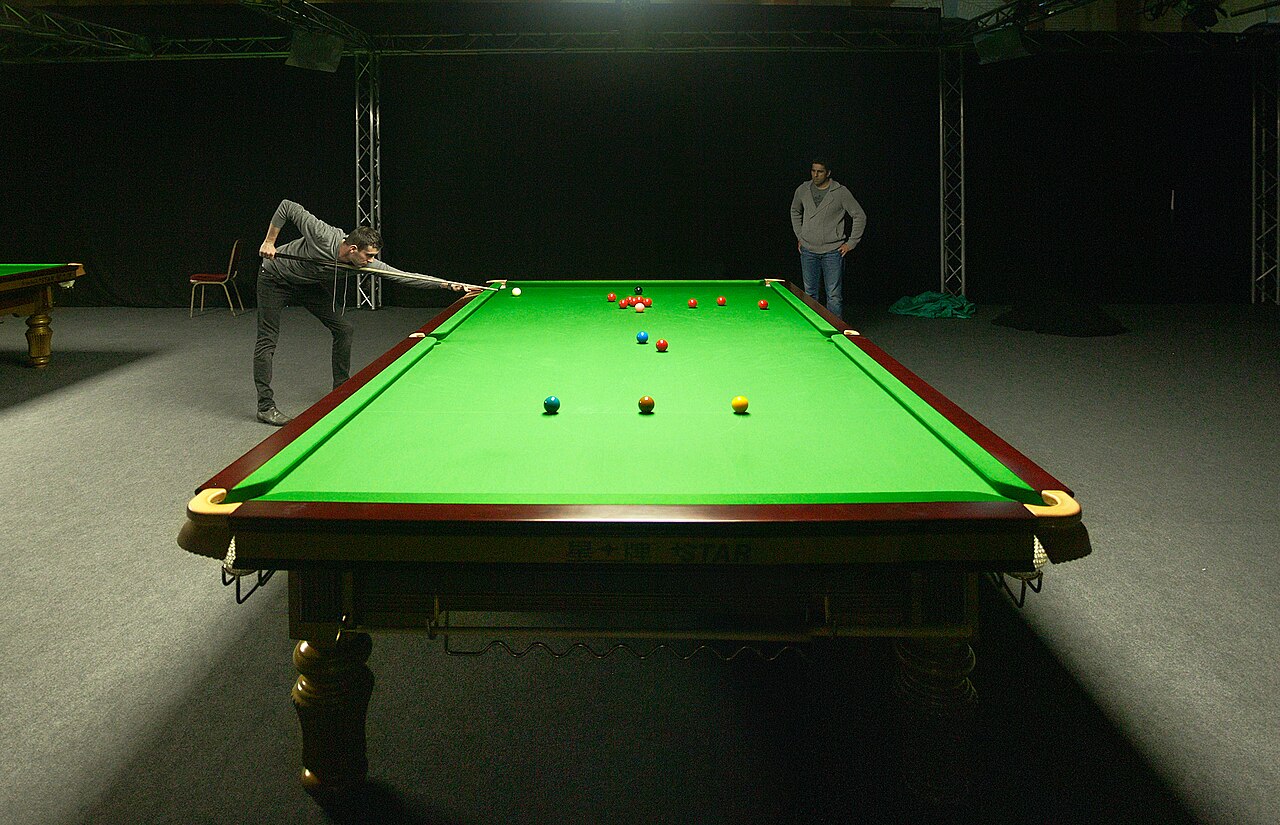
12 ft by 6 ft — a playing surface of 3,569 mm by 1,778 mm, the largest in mainstream cue sportsTable size
22: one white cue ball, 15 reds worth 1 point each, and six colours worth 2 to 7Balls in play
147 — fifteen reds each followed by the black, then the six colours in sequenceMaximum break
Devised by British Army officers in Jabalpur, India, in 1875; brought to Britain in the 1880sOrigins
World Championship, staged at Sheffield's Crucible Theatre since 1977; 500,000 pounds to the winnerBiggest event
Joe Davis with 15 (1927-1946); Ronnie O'Sullivan and Stephen Hendry share the modern record of 7Most world titles
Snooker is the slowest-burning of the great cue sports and the most punishing. Twenty-two balls sit on a table twelve feet by six, with templated pockets only a few millimetres wider than the balls themselves, and the striker must alternate red and colour, red and colour, assembling a score the opponent can only sit and watch. A perfect visit — fifteen reds, fifteen blacks and the six colours in order — is worth exactly 147, and every one made in professional competition is logged as an event in its own right. The game was invented by bored British Army officers in India in 1875 and codified in Britain a generation later.
What makes it distinctive is that failure is public and total. There is no clock, no teammate and no hiding place: a missed pot hands the table to a player capable of clearing it, so a single loose shot can cost a frame outright. That asymmetry produces snooker's second language, safety play, in which two professionals can trade twenty defensive shots without either attempting a pot, each trying to leave the other with nothing. The tension of that exchange, played in near silence in a 980-seat theatre, is why the sport translated so unexpectedly well to television.
Its geography is changing fast. Britain and Ireland supplied almost every champion for a century, and Sheffield still hosts the world final over four sessions and two days. But China now sends more players to the professional tour than any country except England, Zhao Xintong became the first Asian world champion in 2025, Belgium's Luca Brecel had broken the British monopoly two years earlier, and Saudi Arabia has bought its way onto the calendar with the richest event outside the World Championship. A 128-player tour that was once a British television curiosity is now a genuinely global circuit.
A maximum is the highest break available in normal play. There are fifteen reds on the table, each worth one point, and after every red the striker may nominate a colour. Taking the black, worth seven, after all fifteen reds gives 15 times 8, or 120 points. When the reds are gone, the six colours must be potted in order for another 27 points: yellow 2, green 3, brown 4, blue 5, pink 6, black 7. That totals 147. Breaks above 147 are possible only when a free ball is awarded after a foul while reds remain, which is how Jamie Burnett made a 148 in 2004.
Why is the World Championship played at the Crucible?
The tournament moved to the Crucible Theatre in Sheffield in 1977, at the suggestion of promoter Mike Watterson, whose wife had seen a play there. It was a practical choice for a sport with a small audience, but the venue turned out to suit television perfectly. It seats fewer than a thousand people, places the front row within a few feet of the table, and for the first week splits the arena so two matches run side by side. That intimacy makes it intensely uncomfortable to play in and compelling to watch, and it has become inseparable from the event's identity despite regular speculation about a move to a bigger or better-paying venue.
What does it actually mean to be snookered?
You are snookered when another ball blocks your path, so that no part of any ball you are allowed to hit can be struck in a direct straight line from the cue ball. Because jump shots are illegal in snooker, the only escape is to bounce the cue ball off one or more cushions and still make first contact with a legal ball. Fail, and you concede at least four points, and the opponent can hand the same shot straight back. Laying snookers is how players recover large deficits: each failed escape adds points and usually another chance to lay the snooker again.
How long does a professional snooker match last?
It depends entirely on the round. Early rounds of ranking events are often best of seven and can finish in under ninety minutes. The World Championship starts at best of nineteen and escalates to a best-of-35 final played over four sessions across two days, typically finishing late on a Monday night. A single frame usually takes fifteen to twenty-five minutes, but there is no shot clock in standard competition, and tactical exchanges can extend one enormously. The record is a frame between Fergal O'Brien and David Gilbert in 2017 that lasted 123 minutes 41 seconds on its own.
Who is the greatest snooker player of all time?
The two candidates are Ronnie O'Sullivan and Stephen Hendry, who share the modern record of seven world titles. O'Sullivan leads on every other measure: more than 40 ranking titles to Hendry's 36, 23 Triple Crown titles to 18, more than 1,200 career centuries to 775, and 15 maximum breaks to 11, achieved across a career spanning four decades. Joe Davis's fifteen world titles between 1927 and 1946 are numerically unmatched, but he invented the championship and faced a professional field of a few dozen. Most modern assessments place O'Sullivan first, Hendry second and Davis in a category of his own.
What is the difference between snooker, pool and billiards?
They are three separate games played on different tables. Snooker uses a twelve-foot table, twenty-two balls and rounded pocket openings barely wider than a ball, and requires alternating reds and colours in a fixed sequence. Pool, in its American forms, uses a smaller table, larger balls, wider cut pockets and fewer balls, and rewards shot-making over long sequences. English billiards is played with just three balls on a snooker table and scores through cannons, pots and in-offs, and it was the dominant professional cue sport in Britain until snooker overtook it in the 1930s. Snooker demands the finest cue ball control of the three because of the table size and the pocket templates.
Why do players concede frames instead of playing to the end?
Because snooker has an unambiguous arithmetic of hopelessness. When the points remaining on the table are fewer than the deficit, a player needs snookers, which means relying on the opponent to make repeated mistakes. Continuing beyond that point wastes time in matches that may already run past midnight, and the convention across the professional game is to shake hands once the frame is realistically gone. Refusing to concede is regarded as gamesmanship rather than determination, and players who do it are noticed. That said, the etiquette is not a rule: with a favourable layout a player who needs one snooker will often play on.
Is snooker actually growing outside the United Kingdom?
Yes, and the evidence is no longer anecdotal. China supplies more professionals to the 128-player tour than any country except England, hosts several tournaments, and produced the 2025 world champion in Zhao Xintong, the first from Asia. Belgium's Luca Brecel won the title in 2023, the first from mainland Europe. Saudi Arabia launched the richest event outside the World Championship in 2024. Thailand, Hong Kong, Iran and Australia all have players on tour, and the women's championship has become genuinely international. The British audience still funds a large share of the sport, but the playing population and the money are both diversifying quickly.