Badminton World Federation (founded 1934 as the IBF)Governing body
Medal sport since 1992; five eventsOlympic status
Estimated 220 million+Players worldwide
200+ national federationsMember associations
493 km/h (Tan Boon Heong, 2013)Fastest recorded smash
All England Open (since 1899)Oldest championship
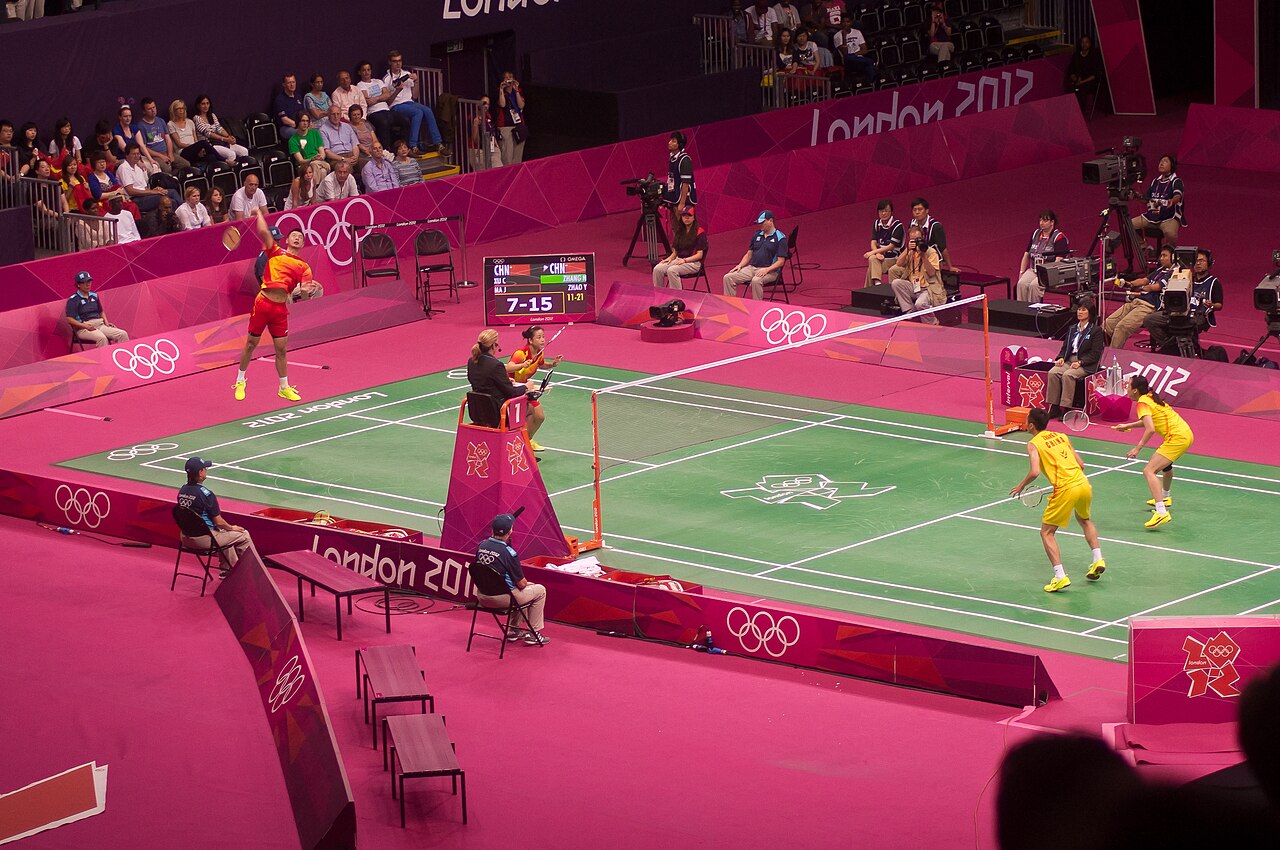
Badminton is the fastest racquet sport in the world, a game of explosive acceleration and impossible touch played over a 1.55-metre net with a feathered shuttlecock that can leave the racket above 400 km/h yet die at the tape a heartbeat later. Contested as singles or doubles on a 13.4-metre court, it rewards a rare blend of raw power, feather-light deception and relentless footwork. Because the shuttle decelerates so violently, no other sport swings so wildly between brute smashing and delicate net play within one exchange. A point can be won by a 300 km/h missile or a shuttle that tumbles over the net by a single centimetre.
What grips people is the tempo and the disguise. Top rallies routinely run 20, 30, even 40 shots, each one an ambush: a player winds up as if to smash, then trickles a net drop; feints a clear, then flicks it cross-court. The best defenders retrieve shots from positions that look hopeless and turn them into counter-attacks in a fraction of a second. Physiologically it is brutal — elite matches demand hundreds of split-steps, lunges and jumps, changing direction six ways from a single central base. Yet the surface story is beauty: the wristy angles, the hold-and-release deception, the geometry of two or four players carving up a tiny court.
Badminton is also one of the world's most-played and most-lopsided sports. An estimated 220 million people play it, from Jakarta side streets to Chinese sports academies, yet elite success concentrates fiercely in Asia — China, Indonesia, Malaysia, Japan and Korea — with Denmark the lone European outpost and India and Thailand rising. It is national obsession in Indonesia and a state project in China. The modern professional era, built on the BWF World Tour and 21-point rally scoring, has sharpened the game into a spectacle of speed and stamina, while the Olympics, since 1992, remain the sport's ultimate prize and the stage on which its legends are crowned.
Why did badminton change to 21-point rally scoring?
Until 2006, badminton used a service-only system in which points could be scored only by the serving side — men played games to 15, women to 11 — which made matches unpredictable in length and hard to schedule for television. The BWF adopted rally-point scoring to 21 in 2006, awarding a point on every rally regardless of who served. The change made matches faster and more consistent in duration, rewarded relentless shot-to-shot consistency, and suited broadcasters. A game is now won by the first to 21 with a two-point margin, capped at 30, and a match is the best of three games. The reform is widely credited with modernising the sport's rhythm.
How fast does a badminton shuttle actually travel?
The shuttlecock is the fastest object in racquet sport off the racket. In a controlled Yonex test in 2013, Malaysia's Tan Boon Heong recorded a smash of 493 km/h (306 mph), and in-competition hits have been measured above 400 km/h. However, the shuttle decelerates more violently than any comparable projectile because its feathered skirt creates enormous drag. That is why a smash struck at 400 km/h can still be returned — by the time it crosses the net and reaches the defender it has shed most of its speed. This unique combination of blistering launch speed and rapid deceleration is exactly what makes badminton both explosive and, for defenders, improbably retrievable.
Who is the greatest badminton player of all time?
The most common answer is China's Lin Dan, and it is close to consensus. Nicknamed Super Dan, he won consecutive Olympic golds in 2008 and 2012 — the first man to defend the singles title — took five World Championships and six All England titles, and is the only player to have held all nine of the sport's major titles, the Super Grand Slam. His fiercest rival, Malaysia's Lee Chong Wei, spent a record 349 weeks as world No. 1 but never won Olympic or world gold, losing several finals to Lin. Across eras, figures such as Rudy Hartono, Susi Susanti and Carolina Marin also enter the debate, but Lin Dan survives every version of the argument.
Why is Asia so dominant in badminton?
Elite badminton is overwhelmingly concentrated in Asia — China, Indonesia, Malaysia, Japan and Korea — for reasons of culture and structure. In Indonesia the sport is a national passion with a deep grassroots club system, while China operates a centralised state academy that identifies and develops talent from childhood, producing extraordinary depth across all five disciplines. The intensity of domestic competition in these countries means players face world-class opponents constantly. Denmark is the lone traditional European power, and India, Thailand and Chinese Taipei have risen strongly in recent years. But the combination of mass participation, institutional investment and fierce internal competition keeps East and Southeast Asia as the sport's unshakeable heartland, producing the majority of Olympic and world champions.
What is the difference between the singles and doubles court?
The court is the same length, 13.4 metres, for both, but the width and service boxes differ. Singles uses the inner side lines, making the court 5.18 metres wide, and the full-length back boundary, creating a long, narrow court that rewards deep clears and corner-to-corner movement. Doubles uses the full outer side lines, 6.1 metres wide, but a shorter service court — the serve must land inside the doubles long service line, roughly 0.76 metres short of the back line — to prevent an overwhelming serving advantage in the faster doubles game. In practice this means the side tramlines are in for doubles but out for singles, and the deep service area is out for the doubles serve.
Why did Lee Chong Wei never win Olympic or world gold?
Lee Chong Wei was one of the greatest players in history and spent a record 349 weeks as world No. 1, yet the biggest titles eluded him largely because of Lin Dan. He reached three Olympic finals (2008, 2012, 2016) and four World Championship finals, losing all of them, three of those decisive defeats coming against Lin. The 2011 and 2013 world finals and the 2012 Olympic final, in particular, were agonisingly close contests decided by the finest of margins. He also overcame a 2015 doping ban and a 2018 nasal cancer diagnosis late in his career. His story is the sport's great near-miss: sustained dominance and 69 titles, but never the single gold his career deserved.
Is badminton really the fastest racquet sport?
Yes, in terms of the speed the projectile reaches off the racket. Recorded smash speeds have exceeded 490 km/h in testing and 400 km/h in competition, faster than a tennis serve, a squash ball or a golf drive at launch. The caveat is that the shuttlecock decelerates far more rapidly than any of those, so it does not remain fast for long. Badminton is also among the most physically demanding sports at the elite level, with rallies of 30 to 40 shots and hundreds of explosive movements per match. So while the shuttle is the fastest object at the moment of impact, the sport's speed is really about the reaction time, footwork and shot-making it demands.
What are the Thomas, Uber and Sudirman Cups?
They are badminton's major national team championships, distinct from the individual tournaments. The Thomas Cup, first held in 1948-49, is the men's world team championship, contested through ties made up of singles and doubles rubbers; Indonesia leads with a record 14 titles. The Uber Cup, launched in 1956-57, is the women's equivalent, dominated by China with a record 15 titles. The Sudirman Cup, first held in 1989, is the mixed team championship, testing a nation's strength across all five disciplines in a single tie, and China has won it 13 times. These team events, held biennially, stir a national fervour — especially in Asia — that individual tournaments rarely match, and are among the sport's most prestigious collective prizes.