Around 27 million registered players in more than 200 national federations affiliated to the IHFGlobal following
International Handball Federation (IHF), founded in Copenhagen in 1946; its amateur predecessor dates to 1928Governing body
Indoor court 40 by 20 metres, goals 3 by 2 metres, and a 6-metre goal area no field player may stand inPlaying surface
Two halves of 30 minutes, with elite teams now scoring around 30 goals eachMatch length
Outdoor 11-a-side handball debuted in 1936; the indoor game has been Olympic since Munich 1972 for men and Montreal 1976 for womenOlympic status
France, with 6 (1995, 2001, 2009, 2011, 2015, 2017)Most men's world titles
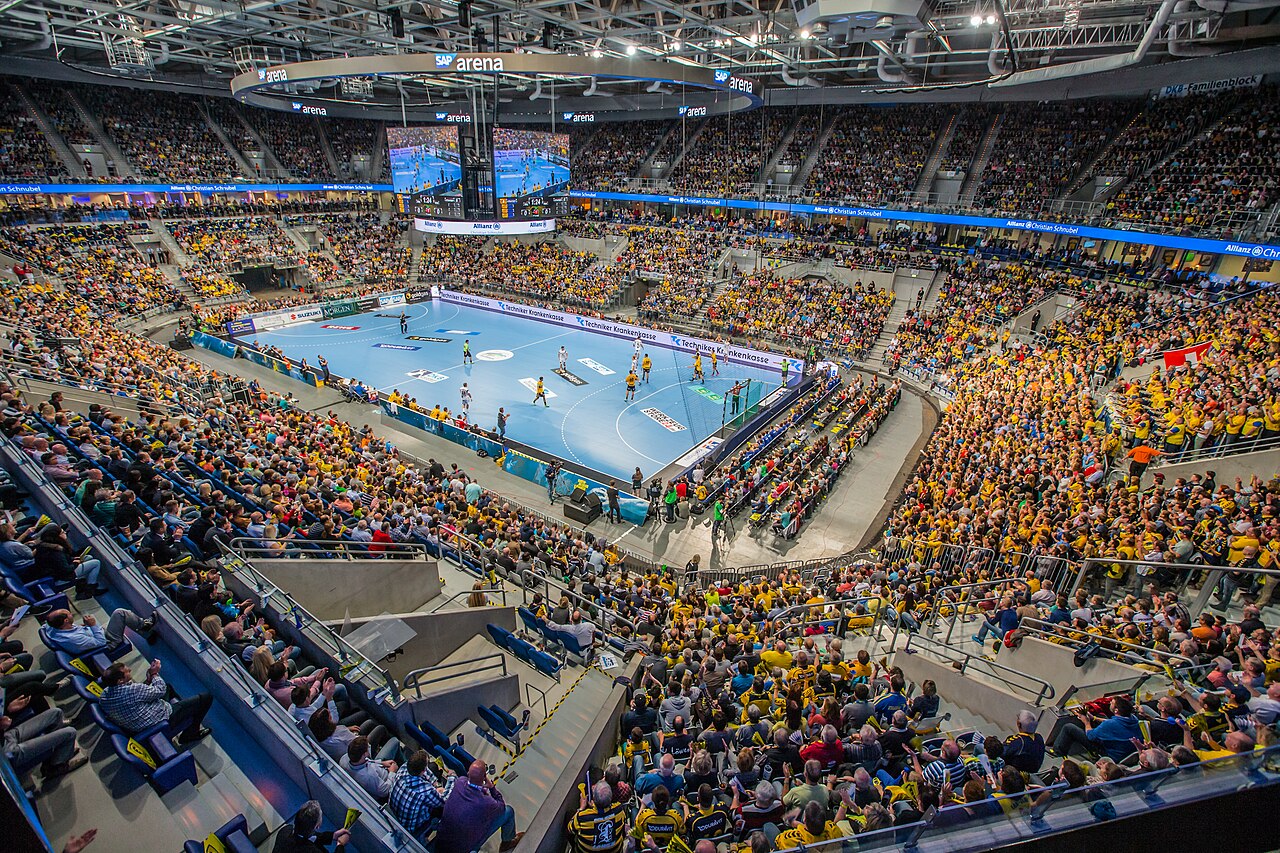
Handball is the highest-scoring team sport played indoors. Seven against seven on a court 40 metres long and 20 wide, two halves of thirty minutes, and a final score that routinely passes sixty goals between the two sides. The premise is simple: carry, bounce or pass a ball small enough to palm in one hand, take no more than three steps between dribbles, and throw it past a goalkeeper defending a frame three metres wide and two high. The complication is the six-metre arc in front of that goal, which no field player may stand in. Every shot is therefore taken from distance or launched from the air above the line, which gives the sport its signature image: a player suspended mid-flight over the crease.
Its heartland is continental Europe. Denmark, France, Norway, Sweden, Germany, Spain, Croatia and Hungary treat handball as a first-tier national sport, and the German Handball-Bundesliga fills arenas week after week. When Germany played Switzerland in Duesseldorf at the 2024 European Championship, 53,586 people came, a world record for the sport. The International Handball Federation counts roughly 27 million players across more than 200 member federations, and the map is widening: Egypt reached the Olympic semifinals in Tokyo, Qatar reached a World Championship final in 2015, and Brazil's women won the world title outright in 2013. Handball is Europe's biggest indoor sport and, quietly, one of the most played games on Earth.
Athletically it sits somewhere between basketball and rugby. Backcourt players jump into contact to shoot from nine metres, pivots wrestle for position with their backs to goal, and wings finish from angles so tight that the geometry, not the goalkeeper, is the real opponent. Defending is a contact discipline with legal limits: a defender may use a bent arm and the torso to block an attacker's path, so the game is played at collision speed with almost no stoppages. Substitutions flow on and off the court without the referee's permission, possessions last seconds, and momentum swings in bursts of three and four unanswered goals that coaches burn timeouts to stop.
Team handball is an indoor sport played seven against seven on a court 40 metres long and 20 metres wide, in two halves of thirty minutes. Players throw, catch and bounce a ball small enough to hold in one hand, aiming to throw it into a goal 3 metres wide and 2 metres high defended by a goalkeeper. The defining rule is the goal area: a six-metre arc in front of each goal that only the goalkeeper may stand in, so every shot is taken from outside it or from the air above it. A player may take three steps and hold the ball for three seconds before passing, dribbling or shooting. Scores are high, typically around thirty goals per team.
How many players are on a handball team?
Seven players from each team are on court at any moment: six outfield players and a goalkeeper. The outfield positions are left wing, left back, centre back, right back, right wing and pivot, also called the line player. Teams may name up to sixteen players on the match sheet, and substitutions are unlimited and need no permission from the referees, provided players enter and leave through their own substitution zone near the halfway line. Because of that freedom, most elite teams swap several players between attack and defence on every change of possession, so almost the entire squad gets meaningful court time in a single match and defensive and attacking specialists can coexist.
How long is a handball match?
A match is two halves of thirty minutes with a ten-minute interval, so sixty minutes of playing time. The clock stops for timeouts, injuries and disciplinary sanctions, which means a typical elite match takes seventy to eighty minutes in real time. Each team has three one-minute timeouts per match, with no more than two in a single half. If a knockout match is level at full time, two periods of five minutes are played; if it is still level, a second five-plus-five period follows, and if the scores remain tied the match is decided by 7-metre throws, five per side and then sudden death. In league play a draw simply stands.
What are the basic rules about steps and dribbling?
A player holding the ball may take a maximum of three steps before passing, shooting or starting to dribble, and may hold the ball stationary for a maximum of three seconds. Dribbling with one hand is unlimited, but once the ball is gathered in both hands the count restarts and dribbling again is a double-dribble violation, which concedes a free throw. In practice players move in a rhythm of three steps, one bounce, three more steps, then release. The ball may be played with any part of the body above the knee; touching it with the foot or lower leg is a violation for everyone except the goalkeeper, who may use any part of the body inside the goal area.
Which country is the best at handball?
In the men's game the two strongest nations of the modern era are France and Denmark. France hold the record with six World Championships and three Olympic golds, won mainly between 2008 and 2020, and added the 2024 European title. Denmark have been dominant since 2019, winning four consecutive World Championships in 2019, 2021, 2023 and 2025 plus Olympic gold in 2016 and 2024. Sweden, Germany, Spain, Croatia and Norway are the other consistent contenders. In the women's game Norway are the benchmark, with ten European Championships, four world titles and Olympic golds in 2008, 2012 and 2024, closely followed by Denmark, France and Hungary.
Why do handball teams take their goalkeeper off?
Since a 2016 rule change, a team may substitute its goalkeeper for an extra field player without any special jersey requirement, which lets it attack seven against six with its own goal empty. The extra attacker guarantees that one player is unmarked somewhere along the six-metre line, forcing the defence out of its normal sliding coverage and raising the chance of scoring. The risk is total: any turnover gives the opposition an uncontested throw at an open net from up to forty metres away. Coaches therefore use it selectively - when trailing late, when a teammate is serving a two-minute suspension, or against a defence that has been shutting down conventional attacks.
Is team handball the same as American handball?
No, they are unrelated sports that share a name. Team handball, the subject of this page, is the Olympic sport played seven a side on a 40 by 20 metre indoor court with goals and goalkeepers, governed by the International Handball Federation. American handball, and its cousins Gaelic handball, Basque pelota mano and Chinese handball, are racquetless wall games in which one or two players strike a small ball against a wall with the hand, closer in structure to squash than to anything Olympic. In most of continental Europe the word handball means only the team sport; in Ireland and parts of the United States it usually means the wall game.
Who is the greatest handball player of all time?
The most common answer is Nikola Karabatic of France, who won three Olympic golds, four World Championships and three European Championships, took the Champions League with three different clubs and was named IHF World Player of the Year three times. The serious alternatives are Mikkel Hansen, who matched Karabatic's three individual awards and drove Denmark's four-title era; Magnus Wislander, voted Player of the Century by the IHF in 2000; Thierry Omeyer, widely regarded as the best goalkeeper the sport has produced; and Cristina Neagu, the only player of either sex with four world player awards. Which name you choose usually depends on whether you weight trophies, peak level or position.