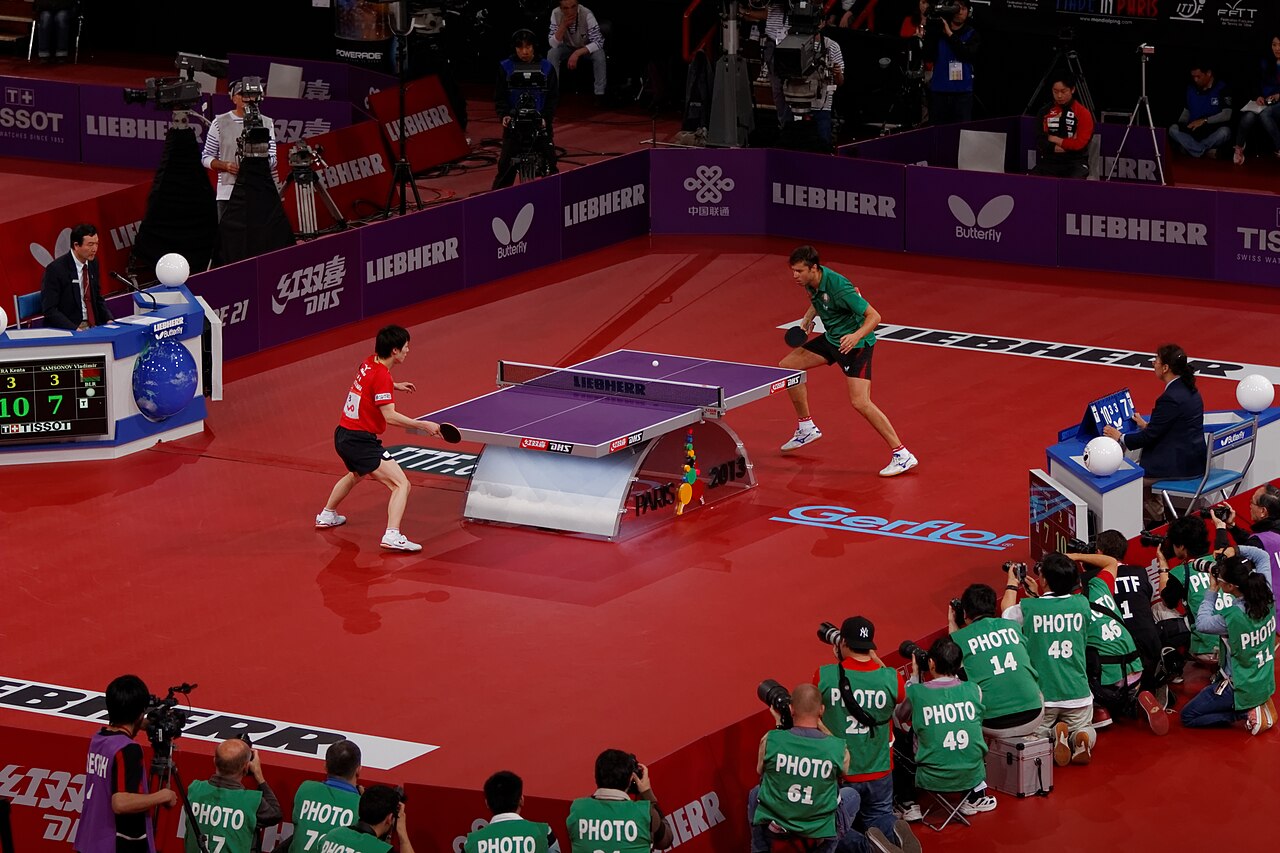
Table tennis compresses the geometry of tennis onto a 2.74-metre table and speeds it up until the ball crosses the net in a fraction of a second. What defines the sport is spin: a good player imparts thousands of revolutions per minute, so the ball curves in flight and kicks unpredictably off the bounce. Points are won not by hitting harder than the opponent but by reading the rotation, neutralising it, and redirecting it. A rally can last one stroke or fifty, but the decisive information, whether the incoming ball is topspin, backspin or sidespin, must be processed in roughly a quarter of a second.
The sport grips people because it rewards a rare blend of reflex, touch and deception at very close quarters. Standing a metre or two from an opponent, players disguise serves, flick winners off the bounce and counter-loop at blistering speed while the crowd sits close enough to hear the contact. Unlike many racket sports, the margins are microscopic: the ball is 40mm across and the edge of the table is live, so a match can turn on a net-cord or a ball that clips the far corner. It is simultaneously a garage pastime and one of the most demanding professional sports in the world.
What makes table tennis unique is how equipment and technique co-evolve. The introduction of sponge rubber in the 1950s, speed glue in the 1980s, the 40mm ball in 2000 and the seamless plastic ball in 2014 each rewrote the tactical playbook overnight. Grips split into shakehand and penhold traditions; rubbers range from grippy inverted sheets to disruptive long pips. Above all sits China's academy system, which has turned the sport into a national discipline and produced a dynasty so deep that its domestic trials are often harder to win than the Olympics themselves.
China's dominance stems from a systematic, state-backed development pyramid that identifies and trains talent from a very young age across thousands of schools and provincial academies, feeding a fiercely competitive national team. The sport carries deep cultural and historical significance since Rong Guotuan won China's first world title in 1959, and success is heavily resourced. The talent pool is so deep that the domestic selection trials are often harder to win than the Olympics themselves, and elite training partners simulate every world rival. The result is that China has won 37 of the 42 Olympic golds contested since 1988, an unmatched level of sustained supremacy in any global sport.
What is a career Grand Slam in table tennis?
The career Grand Slam is the sport's ultimate individual honour: winning the singles titles at all three of the game's major competitions, the World Championships, the World Cup and the Olympic Games, over the course of a career. It is exceptionally rare. Liu Guoliang became the first man to achieve it, completing the set in 1999. Zhang Jike holds the record for the fastest, sweeping all three in just 445 days. Ma Long is the only player to complete a double career Grand Slam, winning each of the three titles at least twice. Among women, Deng Yaping, Wang Nan, Zhang Yining and others have also achieved it.
Why was the ball changed from 38mm to 40mm and then to plastic?
The ball was enlarged from 38mm to 40mm after the 2000 Sydney Olympics to slow rallies slightly and make the ball more visible for television, since the previous game had become extremely fast in the speed-glue era. In 2014 the material changed from flammable celluloid to a seamless 40+ plastic (poly) ball, driven by manufacturing and safety concerns as celluloid production declined. The plastic ball is marginally larger and harder, generating slightly less spin and speed. Together these changes reduced extreme spin and pace, rewarding placement and early timing over pure spin, and are a major reason the modern game is played so close to the table.
What is the difference between shakehand and penhold grips?
The two grips define how a player holds the racket. The shakehand grip resembles a handshake, wrapping the hand around the handle, and offers balanced power on both forehand and backhand; it dominates the modern game. The penhold grip pinches the handle between thumb and forefinger like holding a pen, historically favouring a devastating forehand and quick wrist but a weaker backhand. The development of the reverse-penhold backhand gave penholders a genuine two-wing attack, and champions like Ma Lin and Ryu Seung-min won Olympic gold with it. However, shakehand's easier backhand has made it the default choice for most players worldwide today.
How does scoring work in modern table tennis?
Since 2001, games are played to 11 points rather than the old 21, and a player must win by at least two points, so a tight game can extend into deuce past 11. Service alternates every two points, switching to every point once the score reaches 10-10. A match is the best of an odd number of games, most commonly best of five (first to three games) or best of seven (first to four) at major events. Players change ends after each game, and in a deciding game they swap again when one side reaches five points. There is no time limit under normal play.
What is the banana flick and why did it change the game?
The banana flick, also called the chiquita, is an aggressive backhand receiving stroke in which the player reaches over the table and brushes the ball with a curling motion, imparting sidespin and topspin to attack even short, low serves. Before it became widespread in the 2010s, receivers typically pushed short serves back passively, letting the server dictate the point. The flick transferred the initiative to the receiver, forcing servers to keep serves shorter and lower and shifting the whole game toward fast, backhand-led exchanges at the table. It is one of the main reasons modern points are so often decided within the first three or four balls.
How fast does a table tennis ball actually travel?
Despite the small ball and short table, elite smashes are extremely fast. Because the table is only 2.74m long, the ball crosses to the opponent in a fraction of a second, giving players roughly a quarter of a second to react. Recorded exhibition smashes have exceeded 100 km/h, with some unofficial measurements higher, though the practical challenge is spin, not just speed. A heavily spun ball can rotate thousands of times per minute, curving in flight and kicking unpredictably off the bounce. It is this combination of pace and spin at very close range that makes table tennis one of the most reaction-intensive sports in the world.
Who is considered the greatest table tennis player of all time?
Ma Long of China is the consensus greatest of all time. He is the only man to complete a double career Grand Slam, winning each of the World Championship, World Cup and Olympic singles titles at least twice, and his six Olympic gold medals make him the most decorated Olympic table tennis player. Beyond the trophies, his complete two-wing technique, footwork and longevity across multiple equipment eras set him apart. The strongest counter-argument favours Sweden's Jan-Ove Waldner, the Mozart of table tennis, who achieved a career Grand Slam while challenging China from outside its system and remains revered even in China. Deng Yaping is often named the greatest woman.