Michael Phelps: 28 Olympic medals, 23 goldMost decorated
Swimming is the purest test in sport of a human moving through water, a contest decided by hundredths of a second between an athlete, the clock, and the resistance of a medium roughly 800 times denser than air. Races are contested over four strokes (freestyle, backstroke, breaststroke and butterfly) and distances from an explosive 50-metre dash to the 1,500-metre 'mile', in pools 50 metres long (long course) or 25 metres (short course). Unlike most sports, there is no ball, no opponent to tackle, no referee's judgment on the outcome: an electronic touchpad records the truth to the thousandth of a second, and the wall never lies.
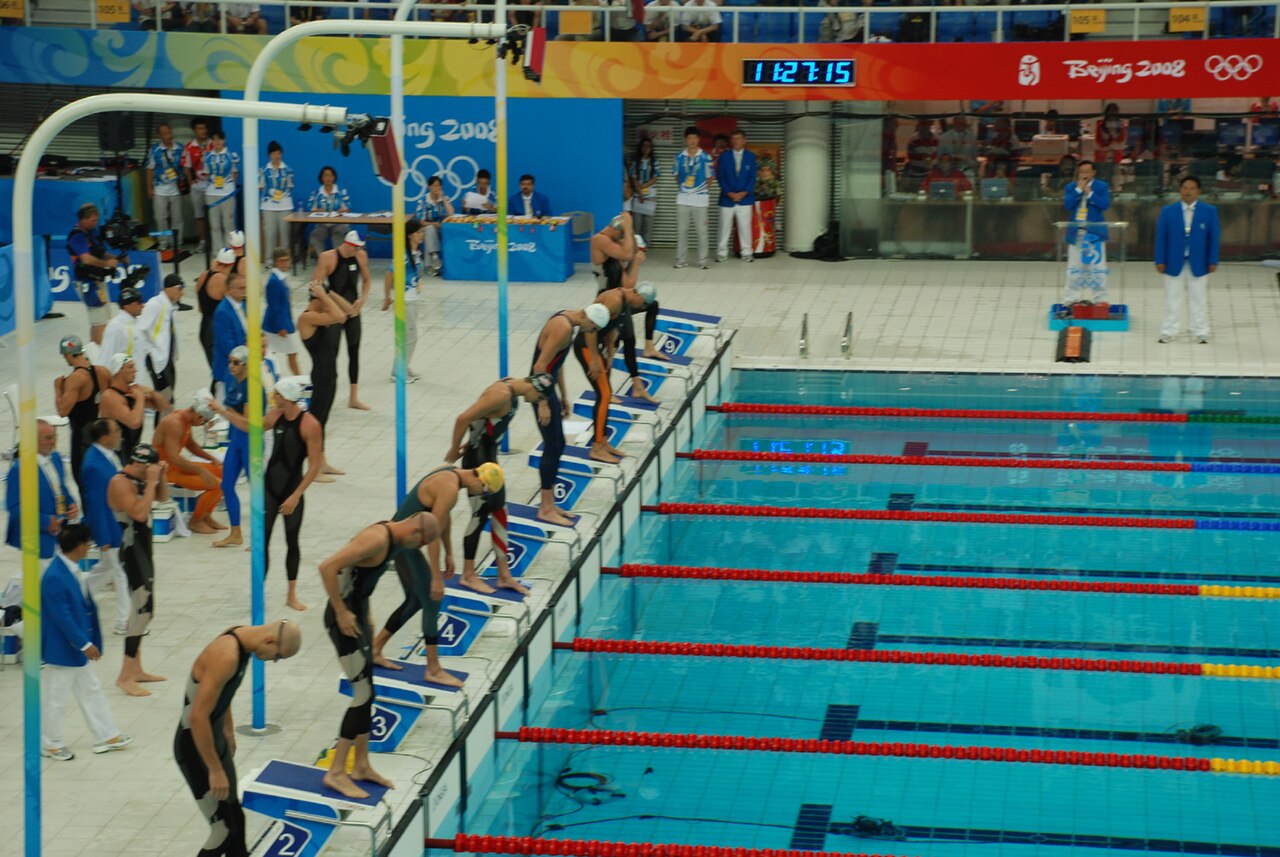
What grips audiences is the brutal clarity. Every Olympic final is a settled argument, eight bodies, one clock, no ambiguity. The drama compresses into 21 seconds for a 50m sprint or unfolds across 15 lung-searing minutes in the 1,500m. Swimming also produces the Olympics' defining serial champions: Michael Phelps, Mark Spitz, Katie Ledecky. Because the sport peaks every four years on the largest stage on earth, careers are measured in Olympic cycles, and a single touch-out, Phelps beating Milorad Cavic by one hundredth in Beijing, can define a legacy. Few sports pair such physiological extremity with such simple, unforgiving scoring.
Swimming is unique in how much of the race happens where fans cannot see. The fastest swimmers win underwater, in the streamlined dolphin-kick phase off each wall, exploiting the 15-metre limit that turned the breakout into a discipline of its own. Technique, the 'catch', distance-per-stroke, streamline, turns, matters as much as raw power, and marginal hydrodynamic gains reshape the sport, as the banned 2009 polyurethane super-suits proved when 43 world records fell in a single week. It is also among the most globally practised human activities, a survival skill before it is a sport, governed by World Aquatics across 209 national federations and contested at every modern Olympics since 1896.
Competitive swimming is contested in four strokes, each with its own rules. Freestyle (front crawl) is the fastest and allows any technique, so swimmers universally use the crawl. Backstroke is swum on the back with an alternating arm pull and is the only stroke started in the water. Breaststroke uses a simultaneous, symmetrical frog-kick and arm pull and is the slowest and most technical. Butterfly features a simultaneous over-water double-arm recovery above a dolphin kick and is the second-fastest but most exhausting. The individual medley combines all four in the order butterfly, backstroke, breaststroke, freestyle. Ranked by 100m world-record pace, the strokes go freestyle, butterfly, backstroke, breaststroke.
Who is the greatest swimmer of all time?
By any objective measure it is Michael Phelps. The American won 28 Olympic medals, 23 of them gold, across five Games from 2000 to 2016, including a record eight golds at Beijing 2008, and set 39 world records and 26 world-championship titles. No other swimmer is close on career hardware, and his versatility across butterfly, freestyle and individual medley is unmatched. The debate for second place is livelier: Katie Ledecky has a case as the most dominant swimmer ever in a single discipline, distance freestyle, and Mark Spitz's seven world-record golds at Munich 1972 remain historic. But first place is settled beyond serious dispute.
Why is freestyle the fastest stroke?
Freestyle (front crawl) is fastest because it minimises drag and keeps at least one arm generating propulsion almost continuously. The alternating over-water arm recovery lets the swimmer maintain near-constant forward force while the body rotates along its long axis, staying flat and streamlined. The flutter kick is compact and produces little braking. By contrast, breaststroke and butterfly have propulsion-free glide and recovery phases and greater vertical movement that create drag, and backstroke, while efficient, sacrifices the ideal head and body position. Technically, freestyle events allow any stroke, but everyone swims the crawl because it is measurably the quickest way through the water. The men's 50m freestyle world record is 20.91 seconds.
What is the 15-metre underwater rule?
After the start and every turn, a swimmer may travel underwater, usually in a streamlined dolphin kick, but the head must break the surface no later than the 15-metre mark in freestyle, backstroke and butterfly. Staying under past 15 metres is an immediate disqualification. The rule exists because the underwater dolphin kick can be faster than surface swimming; in 1988 some backstrokers raced almost an entire length submerged, prompting the sport to cap the phase. Today the underwater breakout is one of the most important skills in swimming, and the athletes who kick fastest to 15 metres and surface most efficiently frequently win. Breaststroke is governed by its own single-pull-down rule instead.
Why were the 2009 super-suits banned?
In 2008 and 2009 manufacturers introduced full-body suits made of polyurethane and other non-textile materials that trapped air, added buoyancy and slashed drag, effectively making swimmers faster without any change in fitness. The effect was so extreme that 43 world records fell at the 2009 World Championships in Rome alone, and races became partly a technology contest. FINA banned non-textile and full-body suits from 2010, restricting swimmers to textile suits covering limited areas. Many 2009 records survived for a decade because human swimmers could not match the artificial advantage, leaving those marks as a statistical scar on the record book that modern athletes are only now erasing.
What is the difference between long course and short course?
Long course refers to a 50-metre pool, short course to a 25-metre pool. The Olympics and the main World Championships are long course, considered the sport's premier standard; separate Short Course World Championships and many World Cup meets use 25m pools. Short-course times are generally faster because the doubled number of turns lets swimmers spend more of the race in the fast underwater dolphin-kick phase and gain speed off each wall. World records are tracked separately for the two pool lengths. American college swimming adds a third format, 25 yards, used only domestically, which is why US collegiate times are not directly comparable to international marks.
How is an Olympic swimming programme structured?
At the Olympics and World Championships, individual events from 50m to 200m are run over three rounds: morning heats, evening semi-finals, and a final for the fastest eight. Events of 400m and longer usually go straight from heats to a timed final, with medals decided by comparing times across heats. The fastest qualifiers earn the central lanes (4 and 5), where the water is calmest. The full Olympic pool programme spans about eight days and 35 events, plus the 10km open-water marathon. The winner of each race is simply the swimmer whose touch registers first on the electronic pad, timed to a hundredth of a second.
How do relay takeovers and false starts work?
Since 1998, a single false start means instant disqualification: any swimmer who moves before the tone is out, with no warning. In relays the same strictness applies to exchanges: the outgoing swimmer may begin a wind-up on the block but their feet must not leave until the incoming teammate touches the wall. Timing pads verify this to 0.03 seconds, and an early departure disqualifies the entire team, as has happened in Olympic finals. Because a legal flying start off the block is much faster than a standing dive, relay teams drill exchange timing relentlessly; a relay is often won by the quality of its takeovers rather than raw swimming speed.