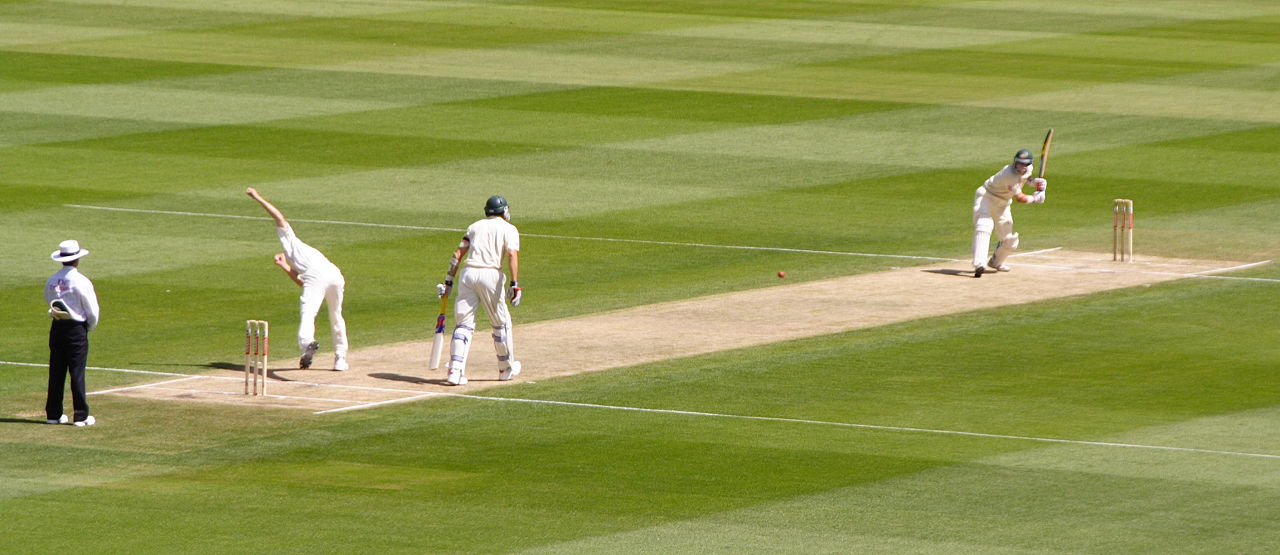
Cricket is a bat-and-ball contest between two teams of eleven, played on an oval field with a rectangular clay pitch, twenty-two yards long, at its centre. One side bats while the other bowls and fields; the batting team scores runs by striking the ball and running between two sets of stumps, or by finding the boundary rope for four or six. The fielding side tries to dismiss batters and restrict runs. What separates cricket from every other major sport is that it is played in three sanctioned formats at once, five-day Test matches, fifty-over One Day Internationals, and twenty-over T20, each demanding a different balance of patience and aggression.
The game's grip comes from its unusual sense of time. A Test match can unfold over five days and still end in a draw, rewarding endurance, nerve, and shifts of momentum that a single afternoon cannot contain; a T20 can turn on a single over. Individual duels sit inside the team contest, a fast bowler against an opener at dawn, a spinner probing on a crumbling final-day pitch, giving cricket the one-on-one drama of a duel wrapped in a collective narrative. In South Asia especially, where more than a billion people follow the game, results carry national weight, and rivalries such as India versus Pakistan draw some of the largest television audiences in world sport.
Few sports are so shaped by their conditions. The state of the pitch, the age and shine of the ball, cloud cover that helps it swing, and the wear that helps it spin all change hour by hour, so captains must read the environment as closely as the opposition. Cricket is also a sport of deep statistical literacy: batting averages, strike rates, and bowling economy are part of its common language, and its records stretch back nearly 150 years in an unbroken line. The result is a game that rewards specialists and all-rounders alike, blends the meditative with the explosive, and can be argued over for a lifetime without settling who was truly the greatest.
A Test gives each side two full innings and asks them to bowl the other out twice, which simply takes time; a minimum of 90 overs is bowled each day across five days, roughly 450 overs in all. The format is designed as an examination of skill, stamina, and temperament rather than a quick result, so batters can occupy the crease for hours and bowlers must find sustained ways to take twenty wickets. If neither side completes the task in time, the match is drawn. This endurance is the point: Test cricket rewards patience and shifting momentum that shorter formats, decided in a single innings, cannot offer.
What is the difference between Test, ODI, and T20 cricket?
The three formats differ in length and intent. Test cricket is played over five days with two innings each and no limit on overs; it is the traditional, most demanding form, ending in a win, loss, or draw. A One Day International gives each side a single innings of 50 overs and always produces a result, favouring a balance of caution and aggression. A Twenty20 gives each side just 20 overs and lasts about three hours, rewarding constant attacking play and big hitting. In short, Test cricket prizes patience and technique, ODIs blend the two, and T20 is built for entertainment and rapid scoring.
What does LBW mean in cricket?
LBW stands for leg before wicket, one of the main ways a batter is dismissed. If the ball strikes the batter's pad or body, rather than the bat, and the umpire judges that it would have gone on to hit the stumps, the batter can be given out. Several conditions apply: the ball must not pitch outside the line of leg stump, and if it strikes the pad outside the line of off stump the batter is safe provided he was attempting a shot. Ball-tracking technology now assists the decision through the review system, projecting the ball's path to show whether it would have hit the wicket.
Who is the greatest cricketer of all time?
There is near-consensus that Sir Donald Bradman is the greatest batsman, and often the greatest cricketer, purely on the strength of his Test average of 99.94, a figure no one else has approached, roughly double that of other all-time greats. Beyond Bradman the debate is genuinely open. Sachin Tendulkar holds the records for most international runs and centuries; Garfield Sobers and Jacques Kallis are the leading all-rounders; Muttiah Muralitharan and Shane Warne dominate bowling; and Brian Lara, Viv Richards, and Virat Kohli have their strong advocates. Because the game has changed so much across eras, most fans accept Bradman at the top and argue endlessly about the order below him.
Why is cricket so popular in India?
Cricket took root in India under British rule and grew into a national passion after independence, but the turning point was the 1983 World Cup, when Kapil Dev's underdog side beat the mighty West Indies at Lord's and inspired a generation. Television then carried the game into hundreds of millions of homes, and stars such as Sachin Tendulkar became national icons. India's vast population and the commercial power of its market made it the financial centre of world cricket, a status cemented by the Indian Premier League from 2008. Today cricket in India is closer to a shared cultural language than a mere sport, cutting across region, language, and class.
What is the Duckworth-Lewis-Stern method?
The Duckworth-Lewis-Stern, or DLS, method is the mathematical formula used to reset targets in limited-overs matches shortened by rain or other interruptions. It recognizes that a team's scoring potential depends on two resources, the overs remaining and the wickets in hand, and calculates a fair revised target based on how much of those resources each side had available. Developed by statisticians Frank Duckworth and Tony Lewis and later refined by Steven Stern, it replaced cruder systems that could produce absurd targets. While its calculations can look opaque to spectators, DLS is widely accepted as the fairest available way to decide interrupted white-ball matches and is used at all levels including World Cups.
What is a googly and a doosra?
Both are deceptive spin deliveries that turn the opposite way to a bowler's stock ball. A googly is bowled by a leg-spinner, who normally turns the ball away from a right-hander; the googly, released from the back of the hand, spins the other way, back into the batter, and is designed to deceive someone expecting the leg-break. A doosra is its off-spin equivalent: an off-spinner usually turns the ball into a right-hander, but the doosra, meaning the other one in Hindi and Urdu, spins away toward the slips. Both rely on disguise, looking identical to the standard delivery out of the hand, and both have produced many bowled and lbw dismissals.
Is cricket in the Olympics?
Cricket will return to the Olympic Games at Los Angeles 2028, in the Twenty20 format, marking its first appearance since the 1900 Paris Games, where only a single match between Great Britain and France was played. The decision, confirmed in 2023, is seen as a major opportunity to grow the sport in new markets, particularly the United States, and to unlock government funding for cricket in dozens of smaller nations where Olympic sports receive state support. The T20 format was chosen because it is short, television-friendly, and easiest to explain to new audiences. Both men's and women's competitions are expected to feature, though the exact number of teams and qualification pathways are still being finalized.